

Spain's first official estimate for the 2026/27 campaign, known as the aforo, will arrive in early October. The eventual harvest is still too uncertain to forecast with confidence, but stocks, demand and imports already provide a useful guide to the likely price range.
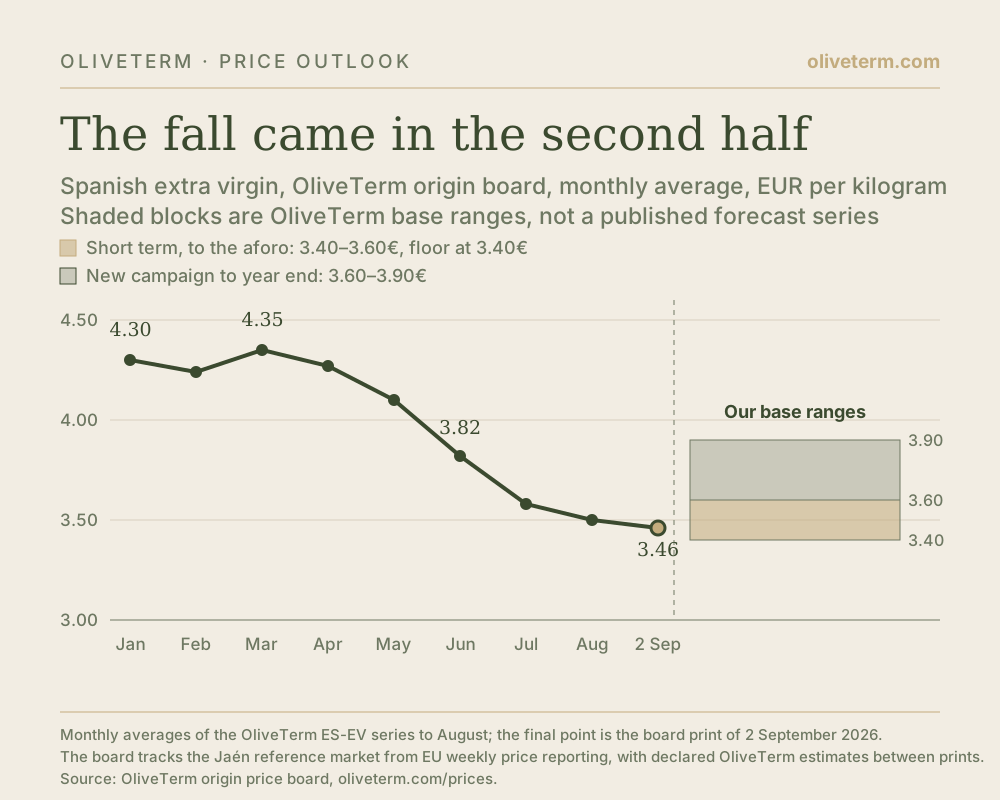
Spanish olive oil prices have been falling since the spring. Conventional extra virgin olive oil, which averaged 4.30€/kg on the OliveTerm origin board in January and 4.27€/kg in April, was changing hands at much lower levels by the beginning of September. Our board printed 3.46€/kg on 2 September, around 20% below its March average. The fall has also lost pace: measured on monthly averages, the board gave up 0.28€ in June and 0.24€ in July, then 0.08€ in August. Lampante was at 3.02€/kg, having traded between 2.91€ and 3.14€ since the end of June.
The October estimate will inevitably shape the market, although there is still no reliable basis for saying how much olive oil Spain will produce. Reports of good flowering, favourable fruit set and heavier tree loads tell the market something about the condition of the crop. They cannot provide a dependable national tonnage before the fruit has completed its development and the first mills begin to establish actual oil yields.
For that reason, OliveTerm is not publishing a production forecast. The more useful exercise at this stage is to ask what different supply outcomes would mean for prices. The starting point is already known: Spain enters the new campaign with more normal availability, demand has recovered from the drought years, and origin prices are once again approaching levels at which production costs begin to matter.
The balance behind the price
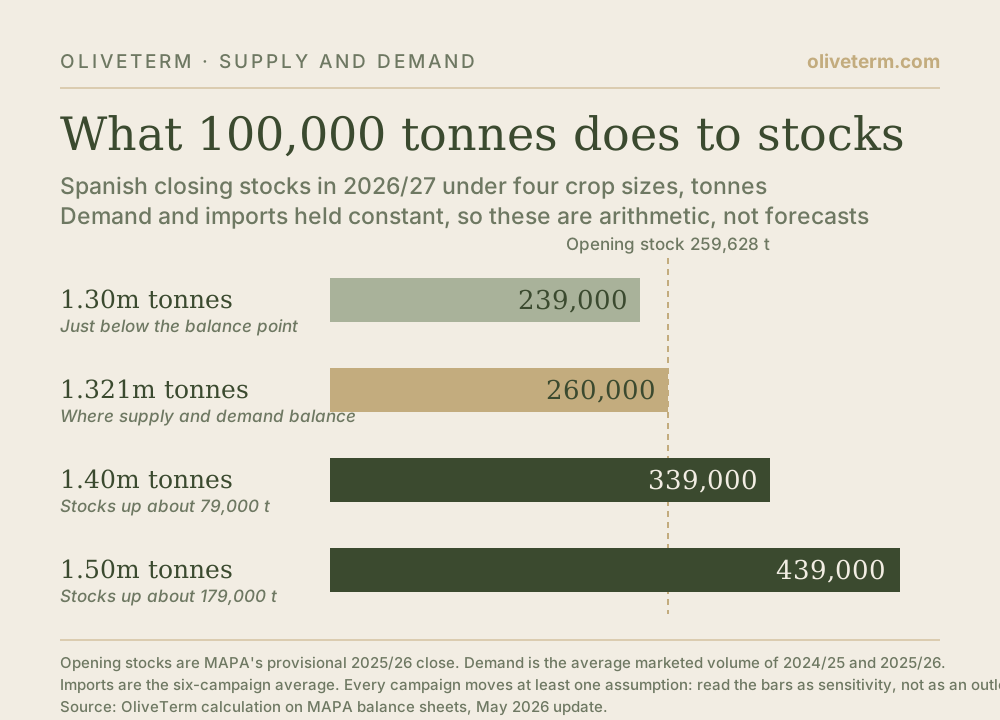
MAPA's provisional balance, last updated in May, puts Spanish production in 2025/26 at 1.295 million tonnes and closing stocks at 259,628 tonnes. Those stocks become the opening inventory for 2026/27, subject to the usual revision at the end of September.
The demand side has changed considerably over the past two campaigns. Spain marketed 1.524 million tonnes in 2024/25 and an estimated 1.545 million tonnes in 2025/26, including domestic sales and exports. In 2022/23, when record prices reduced consumption and constrained trade, marketed volume had fallen to 1.088 million tonnes. Lower prices have since brought buyers back, and the Spanish industry is again moving more than 1.5 million tonnes a year.
Using the average marketed volume of the past two campaigns and average imports over the past six, Spanish production of roughly 1.321 million tonnes would leave closing stocks broadly unchanged. The figure simply marks the level at which supply and demand would balance under those assumptions. It says nothing about the amount Spain will actually produce. Its value lies in showing how sensitive the market has become to the official estimate and, later, to the actual flow of oil from the mills.
If final production were close to 1.3 million tonnes, the system would remain relatively balanced under those demand assumptions. At 1.4 million tonnes, stocks would rise by about 79,000 tonnes. At 1.5 million, the increase would be close to 179,000 tonnes. These are mechanical scenarios which hold demand and imports constant. Neither assumption will survive the campaign unchanged, but the calculation explains why traders are paying so much attention to a difference of only 100,000 or 200,000 tonnes.
Stocks affect prices through timing as much as volume. A comfortable inventory gives buyers more freedom to delay purchases during the main milling months. Mills and producers then face greater pressure to release oil to cover operating costs and payments for olives. When stocks are tight, the opposite occurs: buyers compete for prompt supply and sellers can wait. This shift in bargaining power is usually felt first in lampante and lower-priced virgin oil, before reaching the better qualities.
Our price view for 2026/27
Our base case has two distinct phases. In the short term, conventional extra virgin olive oil at Spanish origin is expected to remain within a range of 3.40–3.60€/kg. Trading may continue to be cautious ahead of the aforo, with buyers reluctant to commit to more oil while the market waits for clearer information. Even so, we do not expect the reference price to break below 3.40€/kg.
From the beginning of the new campaign until the end of the year, our base range rises to 3.60–3.90€/kg. Much of the expectation of greater availability has already been absorbed by the decline seen during 2026. Once harvesting begins, attention will move from the amount of fruit visible on the trees to extraction yields, actual mill output and the pace at which fresh oil is offered. Buyers who have postponed purchases while waiting for the new campaign will also have to return to the market.
The case for a 3.40€/kg floor, which we first set out in July, rests mainly on demand and selling behaviour. Spanish consumption and exports have recovered, while costs across the supply chain are higher than they were five years ago. Farmers and mills are also likely to slow sales if bids fall below levels they regard as economically viable. For prices to move through 3.40€/kg, the market would probably need several unfavourable developments to coincide: a high official estimate, strong extraction yields, weak exports and sustained pressure from competing origins. We do not see that combination as the likely outcome.
A move above 3.90€/kg remains possible if the aforo is more restrained than the market expects, early oil yields disappoint or demand from Italy strengthens. Those developments would leave less oil available and could take prices beyond our base range. At present, however, the most reasonable expectation for the opening months of the campaign remains 3.60–3.90€/kg.
The expected movement is therefore one of stability in the immediate term, followed by moderate firmness as the new campaign gets under way. It is unlikely to follow a straight line. October may still bring a sharp reaction to the official headline, followed by a correction when actual milling data begins to replace the estimate. Our view is that any weakness around the aforo will remain contained above 3.40€/kg and that prices will move into the 3.60–3.90€/kg range as the market approaches the end of the year.
Why we stop at the New Year
Our ranges end with the calendar year deliberately. What happens to prices through 2027 depends on what this campaign actually delivers: the tonnage the mills report once milling is well advanced, the extraction yields behind it, the pace of exports and the stock position Spain builds along the way. None of that is known in September, and any one of them can move the market by more than the width of the ranges above.
We will therefore only put numbers on 2027 once the campaign has produced results to work from. Mill output, export volumes and stock counts from the end of December onwards will give that view a firm basis. Setting a figure before then would be an exercise in confidence rather than analysis.
Why the first aforo can mislead the market
The October estimate deserves attention, but recent campaigns show why it should not be treated as a final production number. In 2023/24, final output was roughly 4.6% above the first forecast. In 2024/25, it exceeded the initial estimate by between 9.6% and 12%, depending on the figure used as the starting point. In 2025/26, the direction reversed: the first aforo was 1,371,938 tonnes and provisional final production was 1.295 million tonnes, a shortfall of 5.6%.
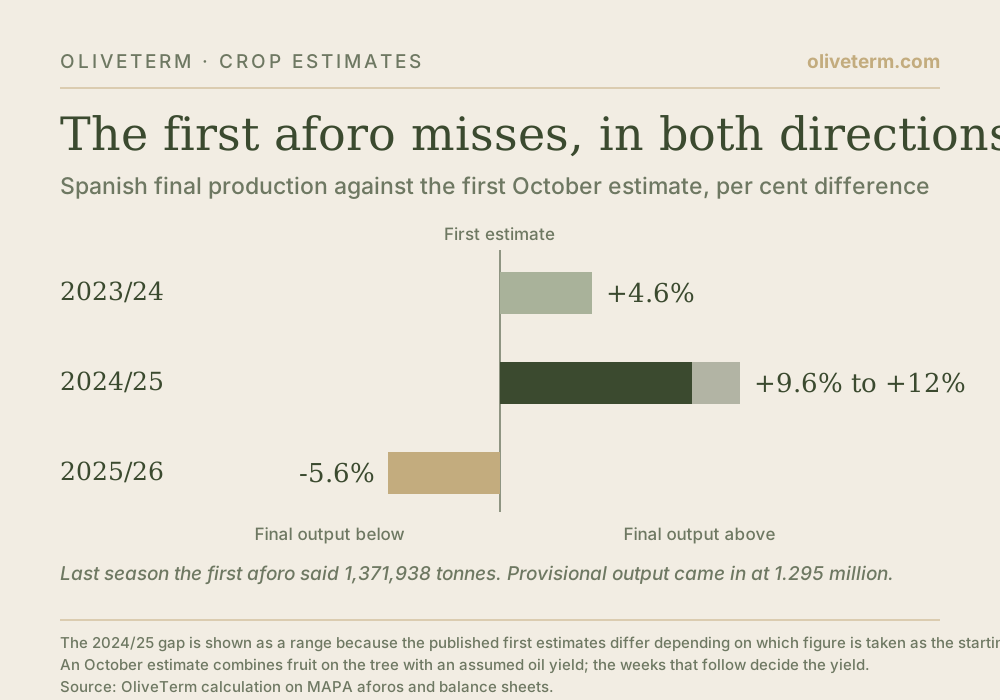
An estimate made in October combines the amount of fruit on the trees with an assumed oil yield. Weather during the following weeks can alter that yield considerably. The number of olives is visible; the amount of oil they will eventually produce is much less certain.
This creates a familiar risk. A large aforo can encourage sellers to accept lower bids immediately, particularly when buyers step back in anticipation of cheaper oil. If the estimate later proves generous, the market can recover quickly. A low estimate can produce the reverse effect. Prices rise first, while subsequent production data determines whether the move lasts.
For sellers with storage and no immediate cash requirement, this argues for caution around the first few days after the October announcement. Withholding the entire crop in expectation of a broad price recovery would carry a different and much larger risk. For buyers, the same uncertainty favours spreading purchases across several dates and avoiding reliance on a single official estimate.
The marketing standard is not the floor
Spain's proposed marketing standard for 2026/27 has been presented in parts of the sector as protection against another collapse in prices. The draft would allow the Ministry to require mills to withdraw oil temporarily and store it until the following campaign. Its practical effect is likely to be more limited than the political discussion suggests.
Under the draft formula, opening stocks plus estimated production must reach 120% of the average of the same measure over the previous six campaigns. Using MAPA's published balances and provisional opening stocks of 259,628 tonnes, the mechanism would require an official production estimate of about 1.583 million tonnes before it could be activated.
Even at that threshold, the volume removed from the market would be about 67,100 tonnes, or approximately 4.2% of production. The maximum withdrawal of 20% would only be reached at a much higher level. The costs of storing the oil would also fall on the mills, either in their own facilities or in rented capacity.
The standard may help at the margin in an exceptionally well-supplied campaign, but it is not the basis of our 3.40€/kg floor. That view rests on the recovery in demand, higher costs, the reluctance of producers to sell aggressively at lower levels and the amount of anticipated supply that has already been reflected in prices. The pace of sales, the availability of competing origins and the willingness of exporters and bottlers to rebuild stocks will remain far more important than the regulation itself.
Imports and foreign crops can change the range
Spain sets the reference price for the international olive oil market, but its balance is not closed. Imports add to available supply, while production elsewhere affects the demand faced by Spanish sellers.
Tunisia is especially relevant on the supply side. It has recently offered oil at competitive prices and COAG Jaén has said that as much as 100,000 tonnes of Tunisian olive oil may have entered Spain during the current campaign. The figure should be treated as an industry claim, although it illustrates the commercial pressure created by lower-priced imports. If Tunisian supply remains abundant, it could keep Spanish prices near the lower end of our ranges and make a move above 3.90€/kg more difficult.
Italy matters in the opposite direction. Its domestic production is structurally below the combined needs of local consumption and a large export industry. Italian packers therefore remain major buyers of Spanish oil. A weak Italian crop increases that requirement, while a better one gives buyers more room to wait. Greece can influence the market in a similar way, particularly in the early months of the campaign.
Exports are the largest source of uncertainty in the Spanish balance. Marketed volume has recovered faster than many expected as prices fell. If total domestic and export demand rises above 1.6 million tonnes, Spain could absorb a larger crop without accumulating the level of stocks implied by a static calculation. If demand stalls as buyers wait for further declines, prices could remain close to 3.40–3.60€/kg for longer before firming.
What to watch from October
The first figure to move the market will be MAPA's national aforo, expected in early October, alongside the forecast from the Junta de Andalucía.
The more reliable evidence will arrive later. Production data from mills in November and December will show whether the initial yield assumptions were realistic. Export volumes will indicate how much oil is leaving the Spanish balance, while the price gaps between origins will reveal whether demand is shifting towards Tunisia, Greece or other suppliers. By 15 November, the Government must also publish any decision to activate the marketing standard. Estimates may be revised from the end of December.
Until those figures arrive, our price outlook remains conditional but clearly defined. We expect conventional Spanish extra virgin olive oil to trade at 3.40–3.60€/kg in the short term, without falling below 3.40€/kg. From the beginning of the new campaign until the end of the year, our base range is 3.60–3.90€/kg. A move above that range would require lower oil yields or stronger foreign demand than the market currently assumes. We are not extending a numerical forecast beyond the New Year, when actual production, exports and stocks will provide a much firmer basis for assessing the rest of the campaign. October will provide the first official estimate; the mills will provide the answer.
Methodology: Balance figures are from MAPA, definitive for 2020/21 to 2024/25 and provisional for 2025/26 in the May 2026 update. Marketed volume is domestic market plus exports. The balance point uses average marketed volume in 2024/25 and 2025/26 and average imports over the previous six campaigns. Prices are OliveTerm origin board values, quoted as monthly averages for 2026 together with the print of 2 September 2026. The price ranges are OliveTerm scenarios based on the current balance and observable market risks. No formal econometric model has been used.