

Between now and the new harvest, very little can change the amount of old-crop olive oil physically available in Spain. Weather will continue to move expectations for the next crop, but the oil that can be bought before the campaign turns has already been produced. What matters now is how much of 2025/26 remains in storage, the stock the Spanish trade calls the enlace. As the campaign enters its final weeks, that figure becomes increasingly important because it determines how much oil Spain carries into the next harvest.
The difficulty is that there is no single number. AICA tells us how much oil exists today. The European Commission publishes an estimate for how much will remain at the end of September. Traders and producers tend to focus on something in between: the amount they believe will actually be left when new-crop oil starts entering the market.
How much oil is there today?
At the end of July, Spain held 568,692 tonnes of olive oil, according to AICA. Around 329,941 tonnes were still at mills, 234,708 tonnes were held by packers, refiners and other operators, and just over 4,000 tonnes sat with the Patrimonio Comunal Olivarero.
That is the latest hard count. But it is not the carryover.
The European Commission's current balance sheet puts Spanish ending stocks for 2025/26 at around 259,600 tonnes. Spanish sector estimates have generally been higher, with expectations of an enlace above 300,000 tonnes.
The difference mainly comes down to timing and definition. AICA's 568,692 tonnes are the physical stocks present at the end of July. They include oil that will continue moving through the system during August and September, as well as working inventory that packers and refiners need to keep operations running. The ending stock is what remains when the campaign officially closes on 30 September.
Estimating the carryover
The simplest starting point is the July stock figure and the rate at which total Spanish inventories are being drawn down.
Between the end of June and the end of July, total stocks fell by roughly 113,600 tonnes. If Spain repeated that net draw in both August and September, the campaign would end with around 340,000 tonnes. A slightly slower pace would leave stocks closer to 370,000 or 380,000 tonnes.
For this analysis, we use 350,000 tonnes as a reasonable midpoint.
This is not an official forecast. It is an OliveTerm estimate based on the latest AICA inventory data and the pace at which physical stocks have been falling as the campaign approaches its end. The final figure may be somewhat higher or lower, but 350,000 tonnes provides a useful working assumption for analysing the supply position going into 2026/27.
At a normalised annual Spanish offtake of 1.5 million tonnes, that carryover alone represents around 2.8 months of supply before a single kilogram of the new crop is added.
Is 350,000 tonnes a lot?
Historically, not really.
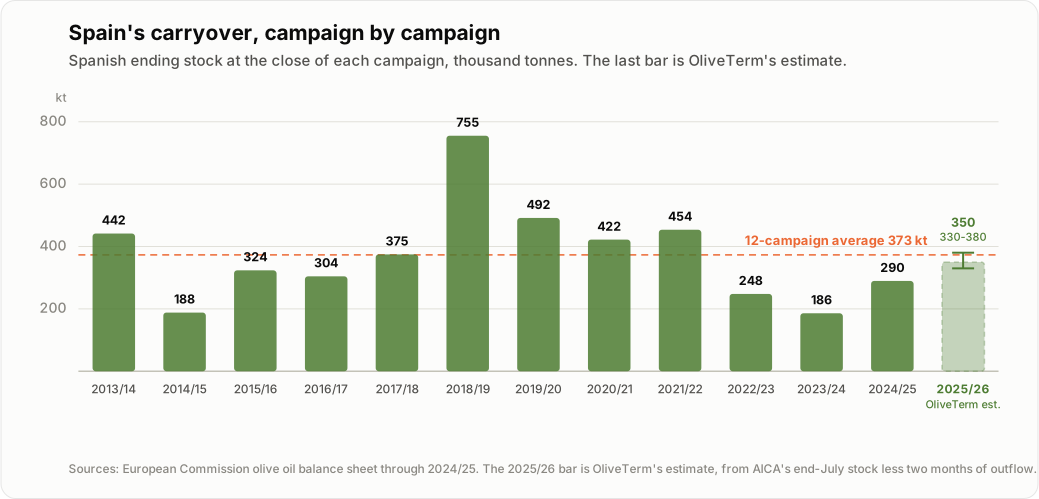
Spain has finished campaigns with stocks below 200,000 tonnes and has also carried more than 750,000 tonnes into a new season. The extreme on the high side came in 2018/19, when ending stocks reached roughly 755,000 tonnes and abundant supply contributed to a prolonged period of low prices.
At the other end, Spain closed 2023/24 with only around 186,000 tonnes. The important point, however, is that the supply crisis had already been underway by then. The 2023/24 campaign itself had opened with around 248,000 tonnes after the exceptionally poor 2022/23 crop.
Across the last twelve campaigns, ending stocks have averaged roughly 373,000 tonnes. Over the last five, the average has been closer to 320,000 tonnes.
A 350,000 tonne carryover would therefore sit somewhere in the middle. It would be more comfortable than the extremely tight years of the recent crisis, but it would not represent an unusually large surplus. Spain would enter 2026/27 with something close to a normal historical stock position.
That distinction matters. Looking only at the 568,692 tonnes currently sitting in tanks makes the market appear considerably more supplied than it is likely to be when the next campaign actually begins.
The more useful measure: months of cover
Carryover alone does not determine price. It matters because it combines with the new crop.
Add the opening stock to Spanish production and you get the total volume available to support domestic sales and exports over the campaign. Divide that by a normal level of annual demand and you get a simple measure of market tightness: months of cover.
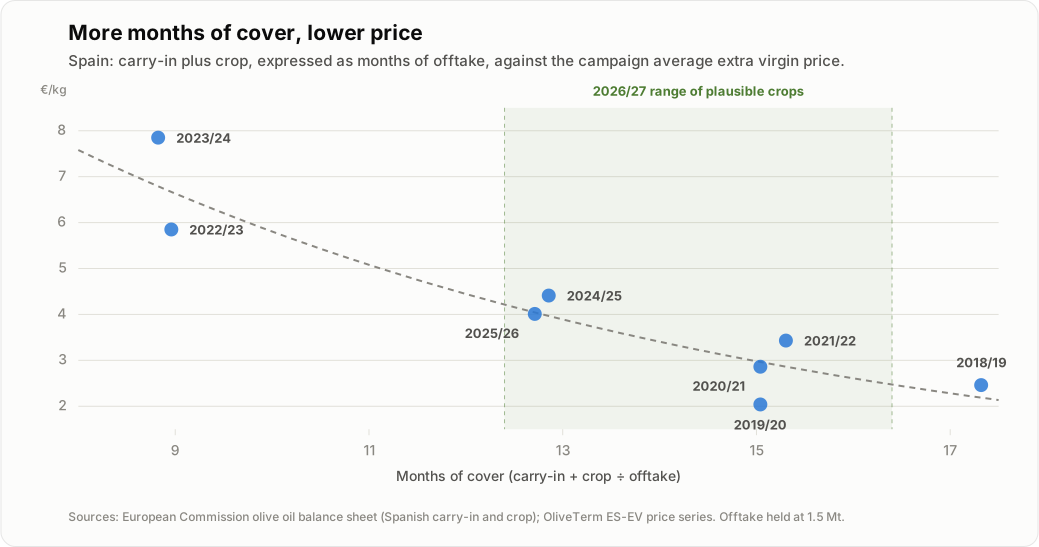
The historical relationship is strong. The exceptionally tight campaigns of 2022/23 and 2023/24 offered roughly nine months of cover and were associated with very high average prices. By contrast, the much more comfortable campaigns between 2019/20 and 2021/22 had around fifteen months of cover and significantly lower prices. The last two campaigns have sat somewhere between those extremes.
Across the eight campaigns covered by the OliveTerm price series, months of cover explains about 83% of the variation in campaign-average prices in our fitted model. That does not mean supply explains everything, nor does it mean the model predicts prices with 83% accuracy. Quality, expectations, international supply, demand and buyer behaviour all matter. But as a broad measure of whether the Spanish market is tight or comfortable, available supply does most of the work.
The model is therefore better used to identify a price environment than a precise target.
What is today's market pricing?
The relationship can also be read backwards.
Spanish extra virgin was trading around €3.51/kg on 17 August in the OliveTerm ES-EV series. On our fitted historical curve, that price corresponds to approximately 13.8 months of cover, equivalent to around 1.72 million tonnes of total Spanish availability.
If Spain enters the new campaign with a 350,000 tonne carryover, today's price is therefore consistent with a new crop of roughly 1.37 million tonnes.
That is a useful way of looking at the current market. Instead of asking whether €3.51 is high or low in isolation, we can ask what crop size would normally justify it. On this relationship, the answer is roughly 1.35 to 1.40 million tonnes.
There is still no official Spanish production estimate for 2026/27. Early sector expectations have generally pointed to a crop materially larger than the current one, with figures around 1.5 to 1.6 million tonnes frequently discussed in the market, but those estimates remain provisional ahead of the official Spanish aforo. The 1.55 million tonne figure used below should therefore be read as a scenario within that range, not as an official forecast.
What different crops would mean
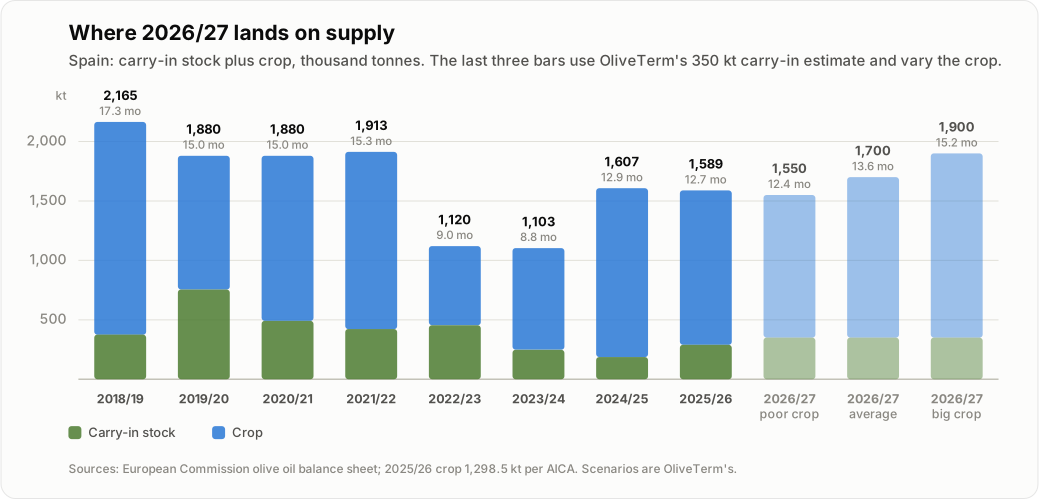
Holding the carryover constant at 350,000 tonnes gives a simple way of comparing scenarios.
A 1.20 million tonne crop would leave Spain with roughly 12.4 months of cover and corresponds to a campaign-average price of around €4.22/kg on the historical relationship.
At 1.35 million tonnes, cover rises to about 13.6 months and the fitted price falls to roughly €3.59/kg.
At 1.45 million tonnes, Spain would have around 14.4 months of cover, corresponding to approximately €3.23/kg.
And with a 1.55 million tonne crop, total availability would rise to around 1.90 million tonnes, or roughly 15.2 months of cover. The fitted campaign average falls to around €2.90/kg.
These numbers are scenarios, not forecasts. The model is deliberately simple and historical errors can approach €1/kg in either direction. More importantly, €3.51 is a single August price while the model produces an average across an entire October-to-September campaign.
The comparison is useful because it shows what the market appears to be assuming, not because it tells us exactly where prices will trade next spring.
What it means for buyers and sellers
For buyers, the current market does not look like one that has fully priced a very large Spanish crop. If production eventually reaches 1.5 million tonnes or more, the supply available during 2026/27 would be substantially more comfortable than the roughly 1.37 million tonne crop implied by today's price.
That creates a reasonable argument for patience ahead of the official crop estimate. A buyer who believes the summer heat has reduced Spanish production toward 1.35 million tonnes, however, would see the current market as much closer to fair value.
For sellers, the carryover is clearly more comfortable than it was during the supply crisis, but it should not be confused with the 568,000 tonnes visible in the July stock report. Much of that oil will leave the system before the campaign closes. A final stock around 350,000 tonnes would actually sit slightly below the longer-term historical average.
That means the new crop remains decisive. A Spanish harvest near or below 1.30 million tonnes would push the supply balance back toward levels historically associated with prices beginning with €4/kg. A crop above 1.5 million tonnes would create a very different market.
With the carryover becoming easier to estimate, the main uncertainty is increasingly the size of the crop that will sit on top of it. In the scenarios above, the difference between a 1.35 million tonne and a 1.55 million tonne Spanish harvest is worth around €0.70/kg in the fitted campaign-average price.
The next major repricing of the market is therefore unlikely to come from how much old oil Spain has left. It will come from how much new oil Spain is about to produce.
Method
All figures refer to Spain unless otherwise stated. The 2025/26 carryover used in this article is an OliveTerm estimate based on AICA stocks of 568,692 tonnes at 31 July and the expected net inventory draw during August and September. Total Spanish stocks fell by approximately 113,600 tonnes during July. A 350,000 tonne carryover is used as a working midpoint rather than an official forecast.
Months of cover are calculated as opening carryover plus new production, divided by 1.5 million tonnes of annual Spanish offtake and expressed in months. The 1.5 million tonne figure is used as a normalising constant rather than a demand forecast.
The latest AICA estimate places 2025/26 Spanish production at approximately 1.301 million tonnes. Historical production and stock figures are drawn from Spanish official sector balances. Prices use the OliveTerm ES-EV series, averaged across each October-to-September campaign. The fitted relationship uses eight campaigns.
This article is market analysis and does not constitute investment, commercial or legal advice. Provisional figures remain subject to revision.