

For most of the past two years, the olive oil market was focused on how high prices could go. Now the question is moving in the opposite direction: how low can prices fall before a large part of olive farming stops making economic sense?
OliveTerm Insight, August 15, 2026. Production cost figures are from the full 2026 update of AEMO's study, published in July 2026; the market reference is the Spanish pool weighted average price of 23 June 2026.
In July 2026, the Spanish Association of Olive Municipalities, AEMO, published the full update of its study on olive oil production costs, after presenting a summary of the results in June. The figures show just how different the economics are between traditional groves and more modern intensive systems.
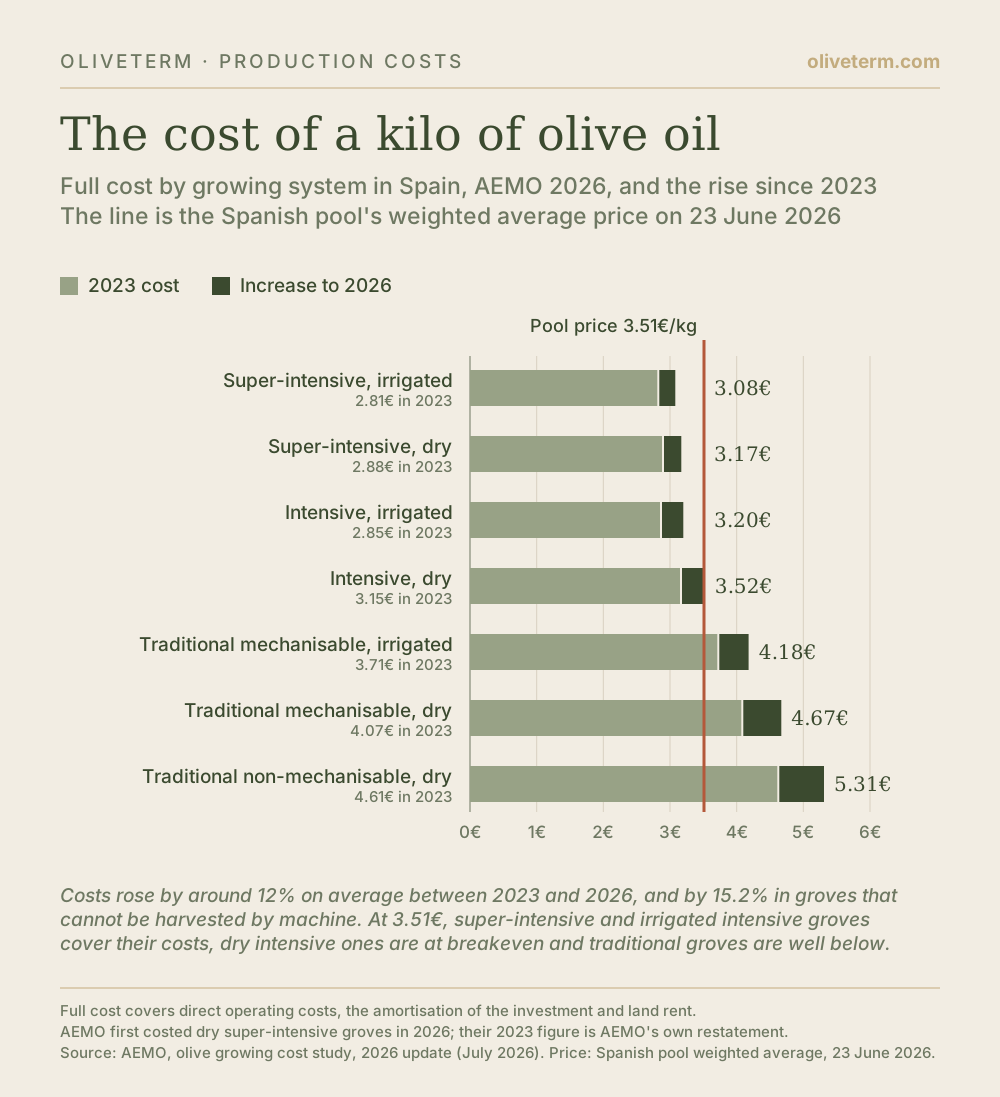
AEMO estimates that producing one kilogram of oil in a traditional non-mechanisable dry-farmed grove costs around 5.31€. Traditional mechanisable groves come in at 4.67€/kg in dry farming and 4.18€/kg with irrigation. Intensive systems are considerably cheaper, at 3.52€/kg in dry farming and 3.20€/kg with irrigation, while super-intensive groves are estimated at 3.17€/kg and 3.08€/kg respectively.
The main reason is productivity and mechanisation. An irrigated super-intensive hectare in the study produces around 10,800 kilograms of olives, compared with only 1,750 kilograms in a traditional non-mechanisable dry grove. Harvesting is also far cheaper when machinery can replace a large amount of manual labour, while higher yields spread the remaining costs across more production.
Costs have continued to rise. Compared with AEMO's previous 2023 study, production costs increased by around 12% on average, with the biggest increase, 15.2%, affecting traditional non-mechanisable groves. Labour is one of the main reasons, particularly in traditional orchards where harvesting remains difficult to mechanise.
Against a Spanish pool price of around 3.51€/kg in late June, the difference becomes important. Irrigated intensive and super-intensive systems can still operate above their estimated production costs, while intensive dry farming is roughly at breakeven. Traditional systems are much further away.
At 4.67€/kg, a traditional mechanisable dry grove is around 1.15€/kg below breakeven at that market price. For a non-mechanisable dry grove, the gap is closer to 1.80€/kg. These are averages, of course, and individual farms can have lower or higher costs depending on yields, land ownership, labour, irrigation and management. Producers selling organic, premium or branded oil may also achieve prices well above the bulk market.
But the broader problem remains. Much of European traditional olive farming is operating with a cost structure that is difficult to reconcile with current bulk prices.
That does not mean these groves disappear immediately. Agriculture can remain below full economic cost for years. Farmers may own the land outright, use family labour, receive subsidies or simply continue farming because the orchard has been in the family for generations. Supply therefore reacts much more slowly than it would in most industries.
Over time, however, low prices change the sector. The least productive traditional groves tend to receive less investment and some are eventually abandoned. At the same time, new capital moves towards intensive and super-intensive systems that can remain profitable at lower prices.
This creates a difficult dynamic. As more olive oil comes from lower-cost plantations, the average production cost of the sector falls. Prices that are unsustainable for a traditional grower may still be perfectly acceptable for a modern irrigated plantation. Low prices can therefore accelerate the transition towards more productive systems rather than simply reduce overall supply.
For traditional producers, the alternative is increasingly to compete on something other than price. Quality, origin and direct sales can all help move the selling price away from the bulk reference. Not every farm can follow that route, but a producer with a structural cost of 4.50€ or 5€/kg cannot sustainably compete with plantations producing close to 3€/kg purely by trying to become more efficient.
Although AEMO's study is Spanish, the issue extends across the Mediterranean. Portugal, Italy and Greece operate in a market heavily influenced by Spanish bulk prices, while many of their traditional groves face similar problems with low yields, fragmented land, difficult mechanisation and rising labour costs.
This is why the most important number for a producer is not simply today's olive oil price, but the difference between that price and their own real production cost, with everything included, down to the farmer's own time.
The 2022 to 2024 price spike tested the limits of demand. The current market is testing something quieter: which groves are still standing when the next campaign opens, and which ones nobody bothers to harvest.
Corrected on 28 September 2026: the cost figures and the chart now follow the full study AEMO published in July, rather than the summary of results presented in June, which put four of the seven systems slightly differently. The conclusions are unchanged.