

At one end, scale is getting bigger and more efficient. At the other, producers are selling origin, identity and differentiation. The increasingly uncomfortable place may be everything in between.
For a long time, the olive oil business appeared to offer plenty of room in the middle.
A company could buy or produce reasonably good olive oil, put it into a recognisable bottle, build relationships with distributors and supermarkets, and compete somewhere between the cheapest products on the shelf and the expensive bottles sold on origin, quality or prestige.
That middle ground still exists. But it is becoming harder to defend.
The olive oil industry is increasingly developing at two different speeds. At one end is a business built around scale: modern olive groves, mechanised harvesting, large mills, efficient bottling operations, international sourcing and private label. At the other is a business built around differentiation: estates, denominations of origin, distinctive varieties, early harvesting, organic production, design, provenance and storytelling.
Both models can work. The difficulty is being neither.
The scale machine
The first side of the industry is relatively easy to understand. Its objective is to produce, source, process and distribute olive oil as efficiently as possible.
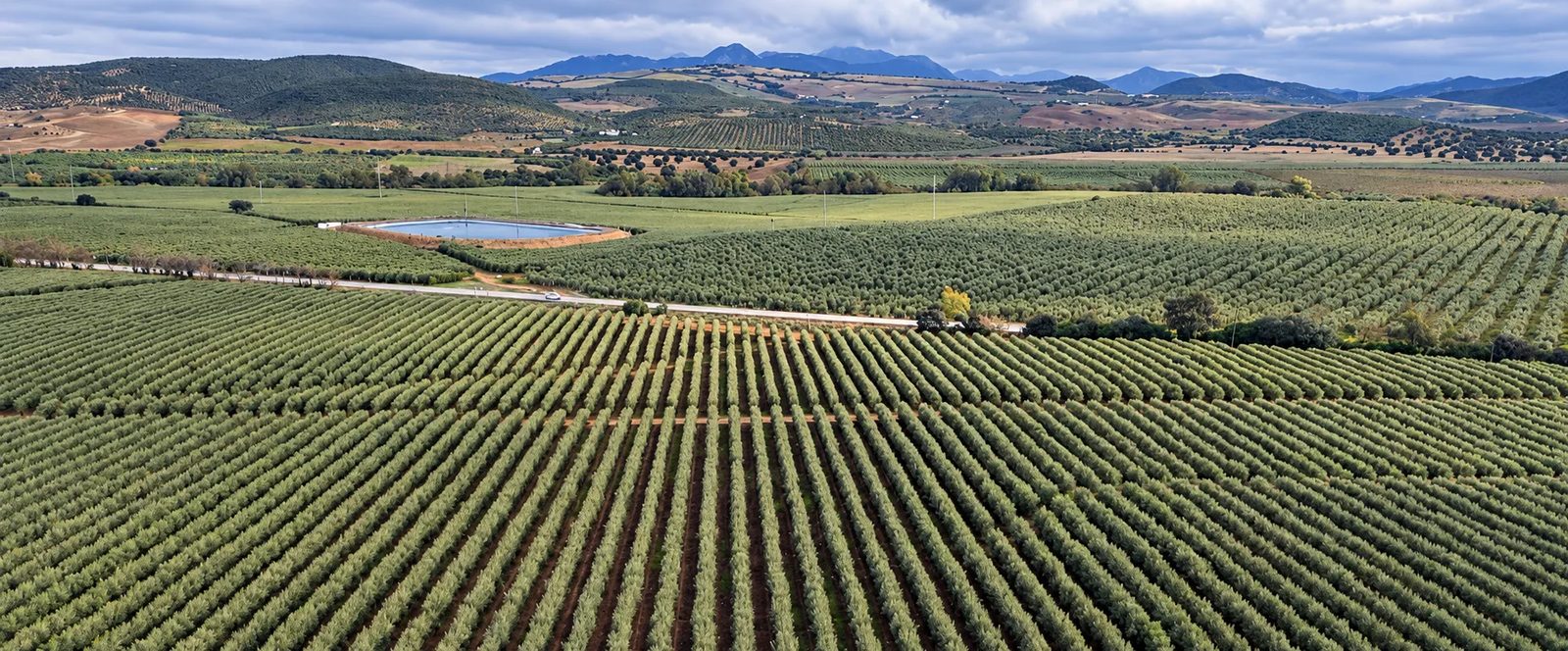
Olive growing itself has changed considerably. High-density and hedgerow systems have expanded across parts of Spain and Portugal, combining irrigation, mechanisation and much higher levels of productivity than many traditional groves. Mechanical harvesting, in particular, can dramatically reduce the amount of labour required at one of the most expensive stages of olive production. These systems require capital and are not suitable everywhere, but their economic logic is clear: more predictable production and greater output can be handled with fewer labour hours per kilogram.
Large volumes can move from highly mechanised groves into high-capacity mills, storage facilities and bottling plants capable of supplying supermarkets, foodservice operators and private-label customers across several markets. Oils can be sourced from different producing countries according to availability, price and desired characteristics. Packaging runs become larger. Procurement becomes more sophisticated. Logistics are optimised.
This model has become particularly powerful because it fits increasingly well with the way much of the food retail business operates. A large supermarket group does not simply need good olive oil. It needs large and reliable volumes, predictable specifications, competitive prices, dependable delivery and a supplier capable of responding when conditions change. When one harvest is poor, sourcing can move elsewhere. When prices rise sharply in one country, blends and origins can be adjusted. The ability to manage supply becomes almost as important as the oil itself.
Private label sits naturally within this system. Retailers already control the shelf, the customer relationship and much of the distribution infrastructure, which means they do not need to reproduce all the costs associated with building a traditional consumer brand. As retailer brands have improved in quality and presentation, the old assumption that private label is simply the cheapest and least desirable product on the shelf has also weakened. A consumer can now buy a well-presented extra virgin olive oil under a supermarket brand and reasonably expect a consistent product.
For companies operating at this end of the market, the competitive question is therefore relatively clear. Can they supply the required quality, at the required scale, at a cost that leaves enough margin for everyone involved? The individual bottle matters, but the system behind it matters just as much.
The other end of the market
At the opposite end, the logic changes almost completely. Here, the objective is not primarily to reduce the cost of each litre but to increase the value attached to it.
That value can come from many places. It may be a particular estate, a local variety, an early harvest, organic certification or a protected designation of origin. It may come from an unusual flavour profile, a family history, a distinctive bottle or simply from a brand that has become very good at making consumers care about where the oil comes from.
None of these things necessarily make the underlying agricultural business easier. In many cases, they make it harder. Harvesting earlier can mean sacrificing yield. Small lots can be less efficient to process and bottle. Premium packaging costs more. Selling directly to consumers requires marketing, fulfilment and customer service that a bulk producer never has to think about.
But the calculation is different because the producer is no longer trying to compete primarily on the price of the liquid inside the bottle. The aim is to make comparison more difficult.
A 6€ bottle of olive oil and a 20€ bottle may both technically be extra virgin olive oil, but the companies selling them do not necessarily see themselves as competing for the same purchase. The premium producer wants the consumer to think about origin, taste, harvest date, variety, design or experience before thinking about the price per litre. In other words, the business is trying to turn olive oil from a largely interchangeable food product into something with an identity.
The wine industry travelled much further down this road decades ago. Consumers became accustomed to paying radically different prices for products that, at the most basic level, serve the same purpose. Coffee has followed a similar path, moving from an everyday commodity towards a market where origin, processing method and producer can command significant premiums. Olive oil is not wine or coffee, and the comparison has limits, but the direction is familiar.
The problem is what sits between them
The pressure becomes more obvious when looking at the companies that fit neither model particularly well.
There are many olive oil businesses that are too small to achieve the efficiencies of the largest operators but are still selling products that are difficult for the average consumer to distinguish from dozens of others on the same shelf. They may produce very good oil, have competent packaging and maintain solid relationships with distributors, yet still lack a clear reason why the customer should pay more for their bottle rather than choose the retailer's own brand or another familiar name.
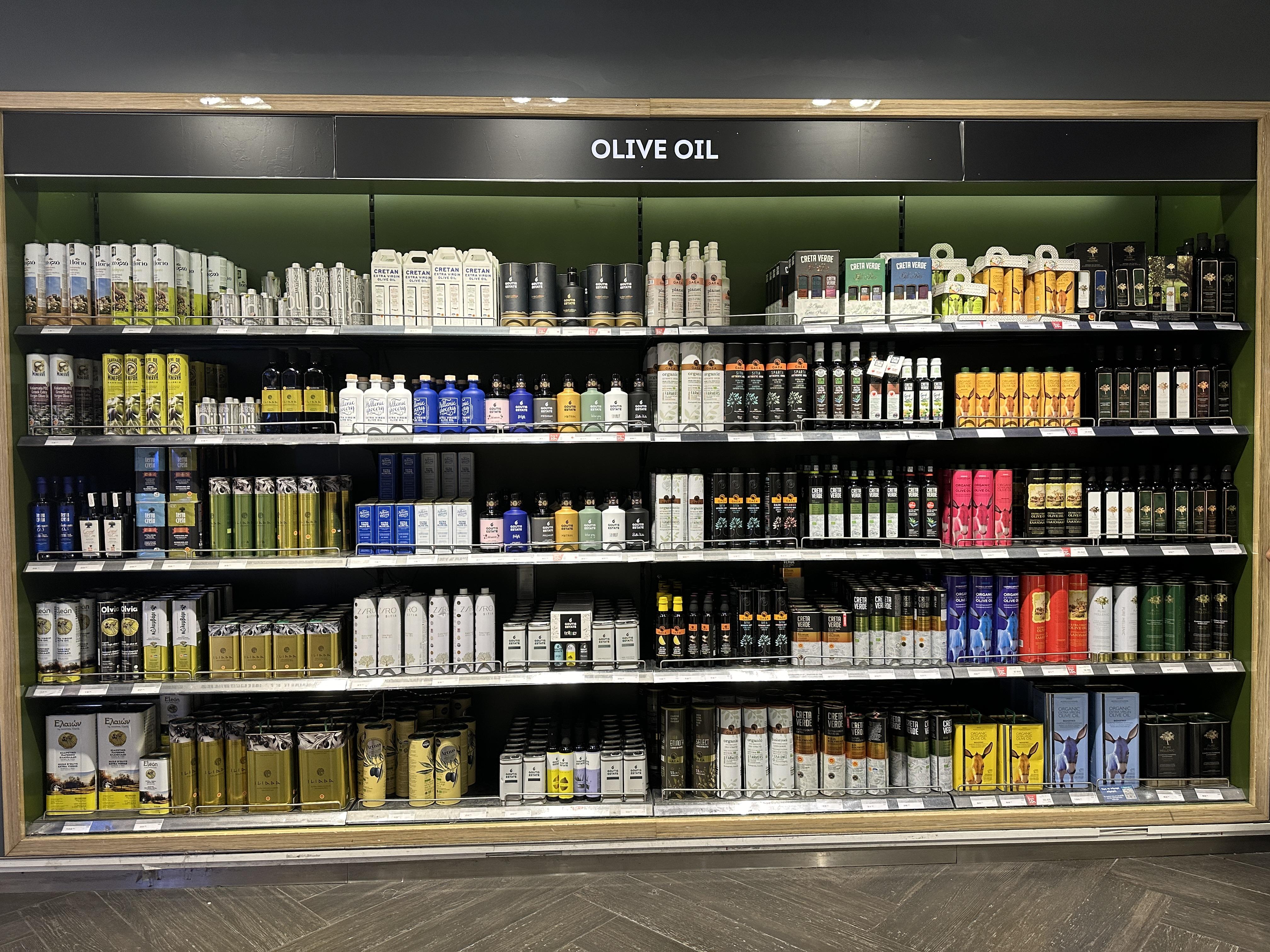
This is where the traditional middle of the market begins to look uncomfortable.
A company in this position faces costs that private-label suppliers can often spread across much larger volumes. It has to maintain a brand, produce labels and packaging, negotiate distribution, support sales and, increasingly, invest in digital marketing. Yet if the brand itself has limited recognition, those costs may not translate into meaningful pricing power. The company bears many of the expenses of differentiation without capturing much of its value.
At the same time, moving downmarket is difficult. Competing directly with large-volume suppliers means entering a business where a few cents per litre matter, where purchasing power matters and where utilisation rates, logistics and industrial efficiency can determine whether a contract is profitable. A medium-sized operator cannot simply decide to become a scale player because the economics of scale require precisely that: scale.
Moving upwards is not necessarily easier. Adding the word "premium" to a label or changing the shape of the bottle does not automatically create a premium product. Consumers have to perceive something genuinely different, and that usually takes time. Origin has to mean something. Quality has to be communicated. Distribution has to reach the right customer. The story needs to be credible, and the price premium needs to survive after the distributor and retailer have taken their margins.
This is why the middle is becoming more exposed. Its problem is not that the olive oil is poor. In many cases, it is excellent. The problem is that quality alone is increasingly difficult to use as a competitive position when good extra virgin olive oil is available across so much of the market.
A good product is not always a strategy
Olive oil remains an industry in which producers understandably spend enormous amounts of time discussing the product itself. Acidity, extraction temperature, harvest timing, filtration and sensory quality all matter, and the technical improvements made across the sector over the past decades have been considerable.
But those improvements also create a paradox. As more companies become capable of producing good olive oil, simply producing good olive oil becomes less unusual.
The same applies to many of the attributes that once helped products stand apart. Dark glass bottles are common. Attractive labels are common. Words such as "premium" and "selection" appear everywhere. Awards can help, but there are now so many competitions and medals that they do not always provide the level of distinction producers expect.
The challenge increasingly lies not only in making a better product, but in building a business around an advantage that is difficult for others to reproduce.
For the largest operators, that advantage may be the ability to buy, blend, bottle and distribute at a scale that smaller competitors cannot match. For another company it may be access to a particularly strong retail network. For a producer at the premium end, it could be an estate, a variety, a region, direct access to consumers or a brand with enough credibility to command a substantial premium.
The size of the company is therefore not what defines which side of the market it occupies. Large groups can operate premium brands while simultaneously producing enormous volumes for mainstream channels. Small producers can be highly differentiated, but they can also find themselves selling undistinguished oil into wholesale markets where their small size becomes a disadvantage rather than a virtue.
The real dividing line is whether the business has a reason to exist beyond simply making olive oil.
More production adds pressure
The issue may become more visible as production capacity expands. Modern plantations, better irrigation, mechanisation and improved agronomic management have increased the amount of olive oil that can reach the market when growing conditions are favourable.
That does not necessarily mean permanent oversupply, and the sector remains highly cyclical. But as more oil becomes available, competition for the consumer becomes more important. Companies that can compete through scale or give buyers a clear reason to choose their product are likely to be better placed when supply is abundant than those relying mainly on the fact that they produce good olive oil.
The middle is not disappearing
None of this means that every mid-sized olive oil brand is destined to fail, or that the supermarket shelf will eventually consist only of private label at one end and 30€ bottles at the other. Markets are rarely that tidy.
Established brands still benefit from decades of consumer recognition. Distribution networks create barriers of their own. Many shoppers do not always buy the cheapest olive oil, but neither do they want to study varieties, harvest dates and phenolic profiles before choosing a bottle. There will continue to be a large market for familiar, reliable products positioned somewhere between basic and luxury.
The point is not that the middle will disappear. It is that occupying it passively is becoming more difficult.
A company that once relied on good quality, respectable packaging and longstanding distribution may increasingly have to decide what else it brings to the market. Some will move towards greater scale, taking on private-label contracts, consolidating production or specialising in efficient bottling. Others will move in the opposite direction, narrowing their offer, investing more heavily in origin and brand, and accepting smaller volumes in exchange for higher margins. Some may discover that their strongest position is not on the supermarket shelf at all, but in foodservice, export, specialist retail or supplying other brands.
There is no single correct model, and the most successful companies may combine several of them.
What is changing is the tolerance for businesses without a clear one.
For much of the olive oil industry's history, making a good product and finding a route to market could be enough. In an industry with larger producers, stronger retailer brands, better informed consumers and an expanding premium segment, that proposition is becoming less secure.
As the industry becomes more efficient at producing and distributing olive oil, simply occupying the space between the cheapest products and the most distinctive ones may become harder to sustain. Companies will still find many different ways to compete, but those with a clear advantage, whether in cost, distribution, origin, brand or specialisation, are likely to be in a stronger position than those relying mainly on the quality of the oil itself.
The middle of the market will remain. It may simply become a much more demanding place to operate.