

Wine turned geography, grape varieties and vintages into a €39 billion premium market. Olive oil has the same raw materials; it just has not yet built the language to sell them.
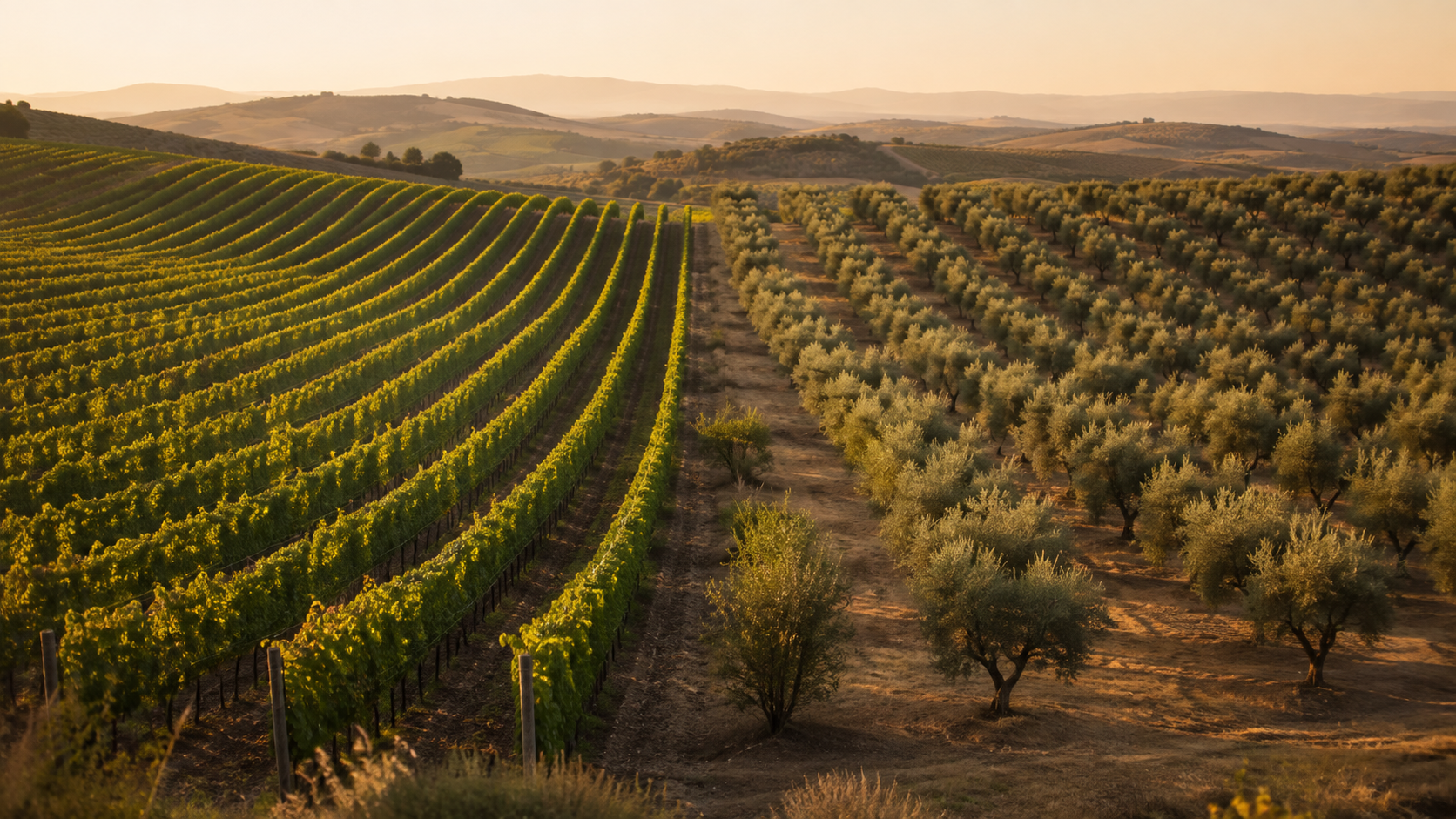
Olive oil and wine have remarkably similar foundations. Both begin in the field, both are shaped by climate, geography, varieties and production decisions, and both can range from standardised mass-market products to bottles sold on provenance, craftsmanship and scarcity. Yet commercially, wine has gone much further in turning those differences into something consumers understand and are willing to pay for.
A consumer does not need to know much about winemaking to understand that Bordeaux and Burgundy are different, or that Pinot Noir and Cabernet Sauvignon are not interchangeable. Even relatively casual wine drinkers often recognise a few regions, varieties or producers and use them as reference points when deciding what to buy.
Olive oil has never developed the same consumer language. For a large part of the market, the category still begins and ends with "extra virgin olive oil". Two bottles may come from different countries, different varieties, different harvest dates and completely different production systems, yet to an inexperienced buyer they can look like essentially the same product at two different prices.
Wine did not simply become better at producing premium products. It became better at explaining why one product was different from another. That may be one of the most important lessons for olive oil.
Wine turned geography into an economic asset
Few industries have been as successful as wine at monetising origin. Rioja, Champagne, Barolo, Burgundy or Napa Valley are not simply places where wine happens to be produced. The location forms part of the commercial identity of the product and, in many cases, directly affects what buyers are willing to pay.
The numbers suggest that this has real economic value. A European Commission study covering geographical indications in the EU found that GI wines generated around €39 billion in sales in 2017. More significantly, their average value premium was estimated at 2.85, meaning their sales value was on average 2.85 times that of comparable wines without a geographical indication. Agricultural products and foodstuffs also benefited from protected origin, but their average premium was considerably lower at 1.5.
Those figures do not mean that attaching a place name to a bottle automatically multiplies its value. What they show is how successfully wine has built commercial meaning around geography.
Olive oil already has the raw material to do something similar. Picual from Jaén, Koroneiki from Crete, Cobrançosa from Trás-os-Montes and Coratina from Puglia can produce markedly different oils. Climate, soils, altitude, harvest timing and processing decisions create further differences even within the same variety.
Much of that information, however, remains invisible outside the industry. Protected designations exist and many high-end producers already make provenance central to their positioning, but origin has not yet become a mainstream consumer reference point in the way it has for wine.
The issue is not a lack of diversity. It is that the market has not yet taught enough consumers what that diversity means.
Olive varieties could do what grape varieties did for wine
Wine also found a relatively simple way to make a complicated agricultural product easier to navigate: grape varieties.
A consumer does not need to understand vineyard management or fermentation to know that Sauvignon Blanc is likely to offer a different experience from Chardonnay. Cabernet Sauvignon, Pinot Noir, Riesling and Tempranillo have become shortcuts that help buyers navigate an otherwise complex category.
An Arbequina can offer a very different profile from an early-harvest Picual. Koroneiki, Galega, Cobrançosa and Coratina each bring their own characteristics. These distinctions are obvious to producers, millers, tasters and specialised buyers, but remain largely unknown to the person standing in front of a supermarket shelf.
That is a missed commercial opportunity. Varieties provide one of the easiest ways to explain that extra virgin olive oil is not a single flavour or style. A consumer might gradually learn that they prefer a softer Arbequina for some foods and a more intense Picual for others, just as wine drinkers learn which grapes suit their preferences.
There is no need to turn every buyer into an olive oil expert. Wine never turned every consumer into an oenologist. It simply gave people enough vocabulary to make differences feel understandable and relevant.
Harvest date could become olive oil's version of vintage
This is one area where olive oil could arguably take the wine model and improve on it.
Vintage is fundamental to wine because it reminds consumers that they are buying the result of a particular agricultural season. Weather changes, growing conditions differ and the year becomes part of the identity of the product.
Olive oil is particularly sensitive to time and freshness, yet the harvest itself often receives surprisingly little prominence in mainstream retail. Consumers may find a best-before date without immediately knowing when the olives were actually harvested.
That is an unusual situation for a product whose sensory characteristics gradually decline over time.
Making harvest year, or even harvest month, easier to identify could help reposition olive oil in consumers' minds. Instead of seeing it as a stable cooking ingredient that remains essentially unchanged until its expiry date, buyers would begin to understand it as a fresh agricultural product with a season.
This would also give producers another meaningful way to differentiate their oils. "2026 harvest" communicates something that a technical acidity figure cannot. It connects the bottle with a crop, a climate and a particular moment in time.
It does not mean that every newer oil is automatically superior or that older oil suddenly becomes worthless. The value lies in giving consumers useful information and allowing freshness to become part of the purchasing decision.
The experience around the product matters too
Wine's success has never depended entirely on what happens on the supermarket shelf. The industry built an ecosystem around the product where consumers could learn without feeling that they were attending a technical course.
People visit wineries, attend tastings, order different wines in restaurants and speak to sommeliers or specialist retailers. Over time, those experiences create familiarity with regions, varieties and producers.
Olive oil has professional tasting panels and a sophisticated sensory vocabulary, but most consumers rarely experience any of it. Many people use olive oil every day without ever tasting two oils side by side.
That makes premiumisation harder. Describing fruitiness, bitterness, pungency or freshness on a label can only go so far. Put two genuinely different oils in front of someone and much of the explanation becomes unnecessary.
There are already producers demonstrating what this could look like. At Herdade do Esporão in Portugal, a business strongly associated with wine also treats olive oil as part of the visitor experience. Its current tourism programme offers a guided visit to the olive mill followed by a technical tasting of three extra virgin olive oils.
It is a small example, but an instructive one. The producer is not merely selling a bottle. It is selling the opportunity to understand why the bottles are different.
Esporão also markets oils by variety, origin and harvest characteristics, including a monovarietal Galega oil, while its estate has around 100 hectares of organic olive groves and works with several Portuguese varieties. The model looks familiar because wine has been using it for decades: connect the agricultural origin, product, tasting experience and place under the same identity.
For olive-growing regions, the implications extend beyond individual producers. Jaén, Puglia, Crete, Alentejo and Trás-os-Montes have landscapes, gastronomy, history and local varieties capable of supporting a much larger tourism economy around olive oil. Wine regions have shown how an agricultural product can help turn an entire territory into a destination.
Olive oil has barely begun to exploit that potential.
Premium products need premium routes to market
The wine industry also created distribution channels capable of preserving differentiation. Supermarkets remain important, but premium wine is also sold through specialist merchants, restaurants, importers, wine clubs, direct-to-consumer channels and dedicated online retailers.
That matters because where a product is sold influences how it is perceived.
Premium olive oil producers can invest in early harvesting, sacrifice yield, process the fruit rapidly, preserve individual varieties and spend heavily on packaging, only to arrive on a supermarket shelf beside several other bottles carrying exactly the same broad description: extra virgin olive oil.
In that environment, much of the complexity built into the product disappears and price inevitably becomes more important.
Restaurants offer perhaps the clearest example of the gap. It is perfectly normal for a restaurant to have several pages of wines organised by region, producer, grape and vintage while putting one unidentified olive oil on every table. Wine is treated as a category to explore; olive oil is often treated as a condiment.
That is not inevitable.
A restaurant does not need a 40-page olive oil list, but offering two or three oils from different regions or varieties would immediately create another point of contact between premium producers and consumers. Specialist retail, tasting rooms, direct sales and curated online platforms could do the same.
If the industry wants consumers to recognise differences, it also needs places where those differences can actually be presented.
Storytelling only works when there is something behind it
There is one aspect of the wine model that olive oil should approach carefully.
Premiumisation can easily become an exercise in packaging and romantic language. Ancient trees, family traditions, Mediterranean sunsets and pictures of stone mills are already everywhere in olive oil marketing. Simply producing more storytelling will not necessarily create more value.
The strength of the wine model is not storytelling alone. It is the combination of story with identifiable product characteristics.
The region can be verified. The grape variety is declared. The vintage exists. The estate can be visited. The consumer can taste the difference.
Olive oil has the opportunity to build the same connection between narrative and substance. A producer talking about Cobrançosa from Trás-os-Montes, for example, has something much more tangible to communicate than a generic claim about "Mediterranean tradition". The same is true for a specific harvest, grove, production method or local variety.
The strongest olive oil brands of the future may therefore be those that make their products easier to understand rather than simply making their bottles look more expensive.
Olive oil does not need to become wine
There are obvious limits to the comparison. Olive oil is used as an ingredient and staple food, whereas wine occupies a different place in consumption. Purchase frequency, serving size, regulation and the economics of the two industries are not the same.
The point is not that olive oil should copy wine bottle by bottle.
The more useful lesson is that wine became exceptionally good at monetising agricultural diversity. It turned regions into commercial identities, varieties into consumer vocabulary, harvest years into meaningful information and rural landscapes into destinations. At the same time, it built distribution channels capable of keeping those differences visible all the way to the final customer.
Olive oil already possesses almost all of those ingredients. Its challenge is connecting them.
For the premium end of the industry, the next stage of value creation may therefore depend less on producing yet another technically excellent extra virgin olive oil and more on making consumers understand why that oil is different from the bottle next to it.
Wine spent decades building that language. Olive oil still has room to build its own.
Follow olive oil prices, origin markets and industry data across the major producing countries on OliveTerm.