

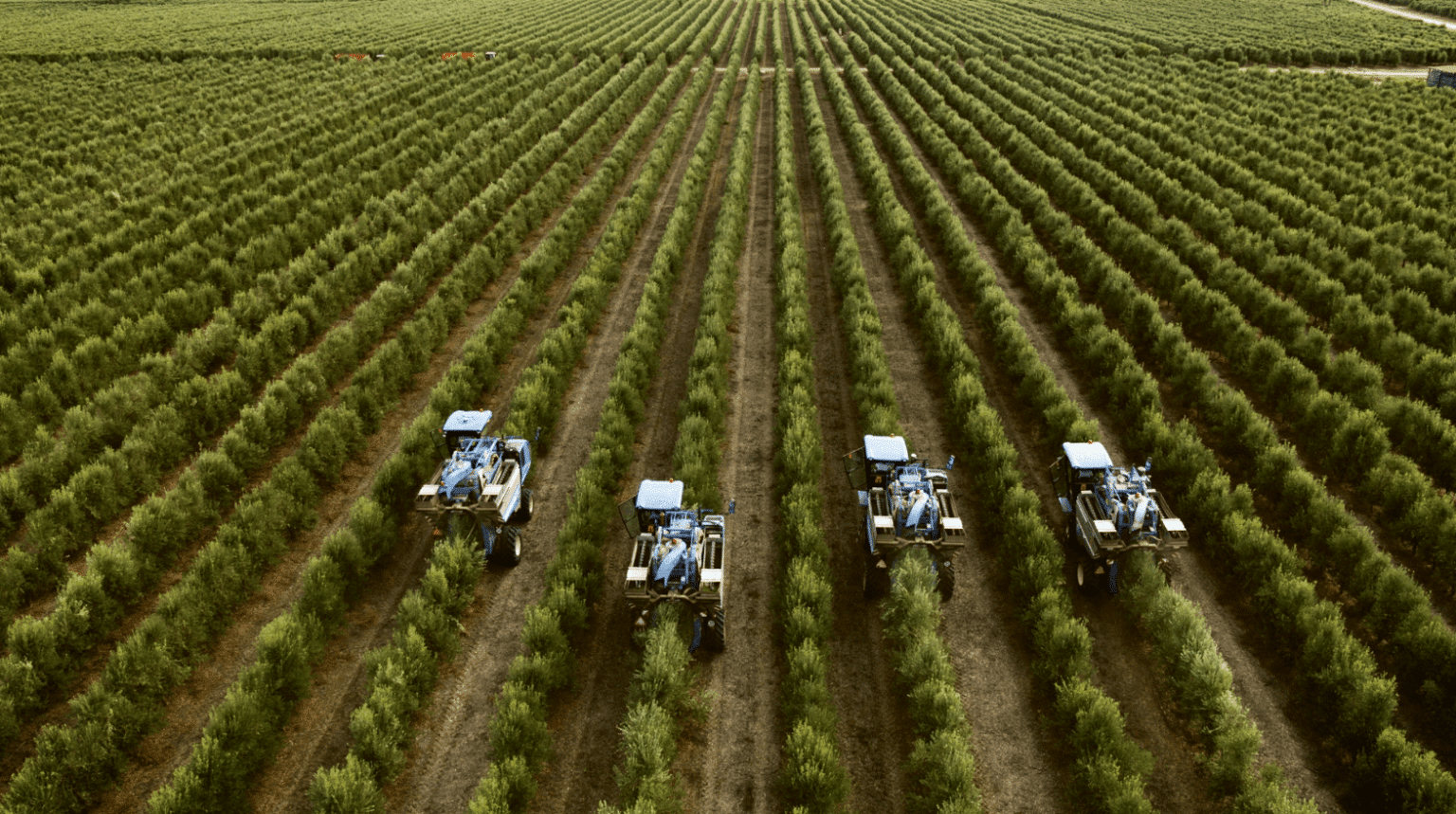
Super-intensive olive grove in the Alentejo. Image: António Pedro Santos / Lusa
In the summer of 2026, Deoleo was put back on the market. The group behind Carbonell, Bertolli, Carapelli, Koipe and Hojiblanca began receiving non-binding offers after years spent restructuring its finances and rebuilding profitability. The ownership structure is more complicated than it first appears. Alchemy holds almost 41% of Deoleo Holding, while another 51% belongs to listed company Deoleo S.A., where CVC controls close to 57%. Once that stake is traced through to the holding company, CVC's economic interest is closer to 30%. Any sale therefore requires both funds to play an important role.

Industrial buyers have been circling. Italian groups Coricelli and NewPrinces, French oils group Lesieur and Spanish cooperative Dcoop have all been reported among the interested parties, although not every name has made a firm offer for the whole company. Coricelli, for example, was reported to have submitted a proposal involving specific Deoleo assets. The process could still take several forms, from a full sale to transactions involving individual businesses or brands.
The transaction gives the sector a rare opportunity to look at a question that is usually hidden behind production statistics and supermarket brands: who actually controls the olive oil business once the oil begins moving away from the farm? The answer is surprisingly mixed. Farmer-owned cooperatives, family-controlled industrial groups and international investment funds all own important parts of the chain, but they approach the business in very different ways.

The cooperatives: huge volumes, fewer global brands
Dcoop is the clearest example of how large the cooperative model has become. Based in Antequera, the group brings together thousands of farming families and a wide network of cooperatives across southern and central Spain. Dcoop describes itself as the world's largest producer of virgin olive oil, with average production of around 200,000 tonnes per year. In 2025, the wider group recorded turnover of approximately €1.42 billion. Its olive-related businesses generated €875.3 million, around 63% of group revenue, including €723.2 million from olive oil.
That scale comes with an ownership structure that looks very different from a normal multinational. Dcoop is ultimately owned by the farmers and cooperatives behind it. The growers supply their olives to member mills, while the organisation combines those volumes and carries out activities further down the commercial chain. Instead of one family or investment fund owning the company, value is distributed through a cooperative structure involving tens of thousands of farming families.
Dcoop is also much more present downstream than the image of a bulk producer might suggest. It owns 50% of US group Pompeian, whose extra virgin olive oil brand leads its category in the United States. The relationship dates back years and gives Dcoop direct exposure to one of the world's most valuable consumer markets rather than leaving it entirely dependent on selling bulk oil to third parties.
What the cooperative has never controlled is a portfolio of European and international brands comparable with Deoleo's. That is what makes its interest in the company so important. Combining Dcoop's production base with brands such as Carbonell, Bertolli and Carapelli would connect a huge pool of farmer-owned production directly with one of the strongest consumer brand portfolios in olive oil. It would be a major step towards vertical integration.
Whether that combination would make financial and organisational sense is another matter. Buying Deoleo would mean integrating a complex international company, its brands, distribution networks and financial obligations into a cooperative structure whose first responsibility remains its members. The logic is easy to understand. Executing it would be much harder.
The bottlers: brands without needing to own the groves
At the other end of the chain sits Deoleo. Its strength is not agricultural land. The company buys oil from producers and suppliers, blends and packages it, manages brands and places the finished product into retail networks around the world. Its competitive advantage is therefore less about producing olives and more about sourcing, distribution and shelf space.
After years of financial trouble, the business has recovered considerably. Deoleo finished 2025 with revenue of €821 million, EBITDA of €50 million and net profit of roughly €20 million. Sales volumes increased by 11%, while comparable net financial debt fell to €86 million. Those numbers are a large part of the reason why the owners are trying to sell now rather than during the more difficult years of the company's restructuring.
Sovena shows what a different model can look like. The Portuguese group, controlled through Nutrinveste, remains family-owned and has built much of its international scale through private label. Sovena describes itself as the world's largest supplier of private-label olive oil, working with retailers and customers that sell the product under their own brands. At the same time, it owns consumer brands of its own, including Oliveira da Serra in Portugal and Andorinha in Brazil.
Unlike a pure bottler, Sovena also moved significantly upstream. Its activities cover agricultural production, sourcing, transformation, packaging and distribution. The group's most recently published detailed sustainability figures reported more than 8,400 hectares of olive groves across Portugal, Spain and Morocco, alongside mills and industrial operations. That makes Sovena one of the clearest examples in Europe of a large olive oil group operating across several stages of the chain rather than relying entirely on external production.
The difference between Sovena and Deoleo says something about how scale can be built in this industry. Deoleo concentrated heavily on global brands and distribution, eventually carrying a debt burden that required a major financial restructuring. Sovena developed around private label, industrial capacity and greater vertical integration while remaining in family ownership.
Neither model is inherently better. They simply create different kinds of power. Deoleo controls brands that consumers know. Sovena controls large private-label relationships and a significant part of the physical chain behind the bottle.
The funds: olive groves become an investment asset
A third type of owner has become much more visible over the past decade: institutional capital.
Modern olive plantations, particularly irrigated and highly mechanised ones, have many characteristics that attract agricultural investment funds. They can be operated at scale, harvesting is increasingly mechanised, costs can be modelled more easily than in fragmented traditional groves and, where water is secured, production becomes more predictable. That has turned parts of the Iberian olive sector into an investable agricultural asset rather than simply a collection of farming businesses.
Innoliva is one of the best examples. Cibus acquired a controlling stake in the company in 2017. Under its ownership, the group's agricultural footprint grew from roughly 4,300 hectares to more than 8,300 hectares across a broader portfolio that included olive oil, table olives and almonds. In 2023, Cibus sold Innoliva to Fiera Comox, a Canadian institutional investment manager. Innoliva itself currently reports around 8,000 hectares of olive groves in Spain and Portugal.
The ownership history is almost as interesting as the hectares. A large Iberian olive producer moved from a food and agriculture investment fund based in London to a Canadian institutional investor. A business that would once have been viewed simply as an agricultural company had become part of an international portfolio of real assets.
Other investors have followed similar strategies. The Beka & Bolschare Iberian Agribusiness Fund initially built around 1,200 hectares of olive groves in Portugal with access to irrigation from Alqueva. Further acquisitions took the area managed in the Alentejo to around 1,550 hectares by 2025. The portfolio is focused on modern, mechanised agriculture and also includes investments in almonds and other permanent crops.
The trend has continued beyond those names. In 2026, for example, the SDG Farmland Fund acquired another approximately 400 hectares of irrigated olive orchards near Alqueva, adding them to an existing Portuguese agricultural platform. Institutional ownership is still small compared with the total European olive-growing area, but it is becoming increasingly visible in the segment where capital requirements and productivity are highest.

It would be wrong to say these investors are taking over European olive farming. Most of the sector remains in the hands of individual growers and farming families. It would also be wrong to suggest that funds alone determine the market price of olive oil. Production, stocks, weather, consumption, quality and commercial behaviour remain much more important to short-term price formation.
What institutional investment does change is the competitive benchmark. Capital tends to favour irrigated, mechanised and high-density production where yields and costs can be controlled more closely. As more of that production enters the market, traditional farms with higher structural costs increasingly compete against businesses built around very different economics.
What the ownership map actually means
At farm level, European olive oil remains remarkably fragmented. Hundreds of thousands of farmers grow olives across Spain, Italy, Greece, Portugal and other producing countries. Even in Spain, by far the largest producer, the physical ownership of olive groves is spread across an enormous number of individual farms.
Commercialisation becomes much more concentrated once the oil leaves those farms.
Cooperatives such as Dcoop aggregate production that would otherwise be divided among thousands of growers. Groups such as Deoleo control brands, marketing and international distribution without needing to control a comparable amount of farmland. Sovena combines private label, brands, industrial capacity and agricultural production. Investment funds are gradually building positions in the modern production systems where capital requirements are greatest and costs can be reduced through scale.
These are not the only important players. Groups such as Acesur, Migasa, Borges, Salov and others remain significant parts of the European industry, while large retailers themselves exercise considerable influence through private label. The point is not that a handful of companies own European olive oil. They do not.
The more interesting point is that ownership changes depending on where you look in the chain.
The farmer may own the trees. A cooperative may aggregate the oil. Another company may refine or bottle it. A brand owner may determine how it reaches consumers. A supermarket may control access to the shelf. Behind one bottle can sit several completely different owners, each controlling a different stage of the economics.
That is why the Deoleo sale is so interesting. If an industrial bottler buys the group, consolidation continues at the branded end of the market. If Dcoop eventually succeeds, one of the world's largest farmer-owned production organisations would gain direct control of a major global brand portfolio. If another financial investor acquires it, those brands remain, at least for another investment cycle, financial assets held with an eventual exit in mind.
For producers and traders, these structures have practical consequences. The person buying the oil may look like one customer, but behind that purchase can sit a much larger industrial, cooperative or retail organisation. Different buyers have different access to capital, different storage capacity, different margins and very different reasons for being in the market.
The same applies at the production end. A traditional family grove, a large cooperative member and an institutionally owned irrigated hedgerow plantation may all sell olive oil into the same market, but their cost structures and investment horizons are completely different.
Europe's olive oil sector therefore remains both fragmented and concentrated at the same time. The land is still divided among a vast number of growers. Further down the chain, however, capital, brands, bottling capacity, distribution and access to consumers sit in far fewer hands.
The trees may belong to hundreds of thousands of farmers. The business built on top of them is much smaller than that ownership map suggests.