

Scale is reshaping Iberian olive-oil milling. But a single volume threshold cannot explain why small plants survive, why some remain profitable or why others eventually disappear.
Photo: ACECASA
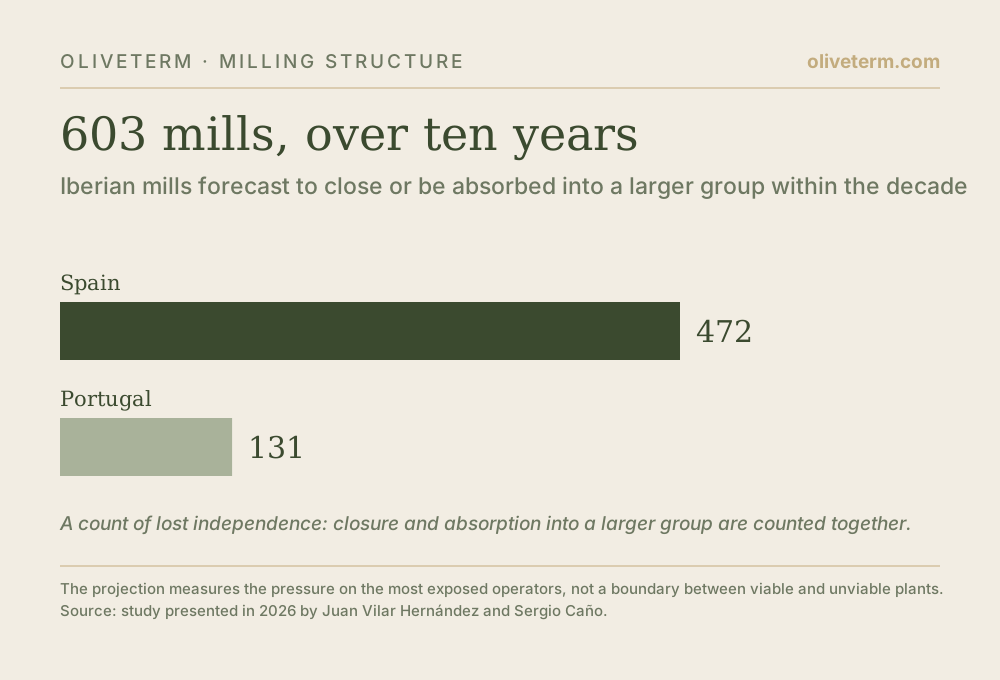
A study presented this year by Juan Vilar Hernández and Sergio Caño offers a stark forecast for the Iberian olive-oil industry. Over the next decade, it argues, 603 mills could disappear through closure or integration into larger groups, including 472 in Spain and 131 in Portugal.
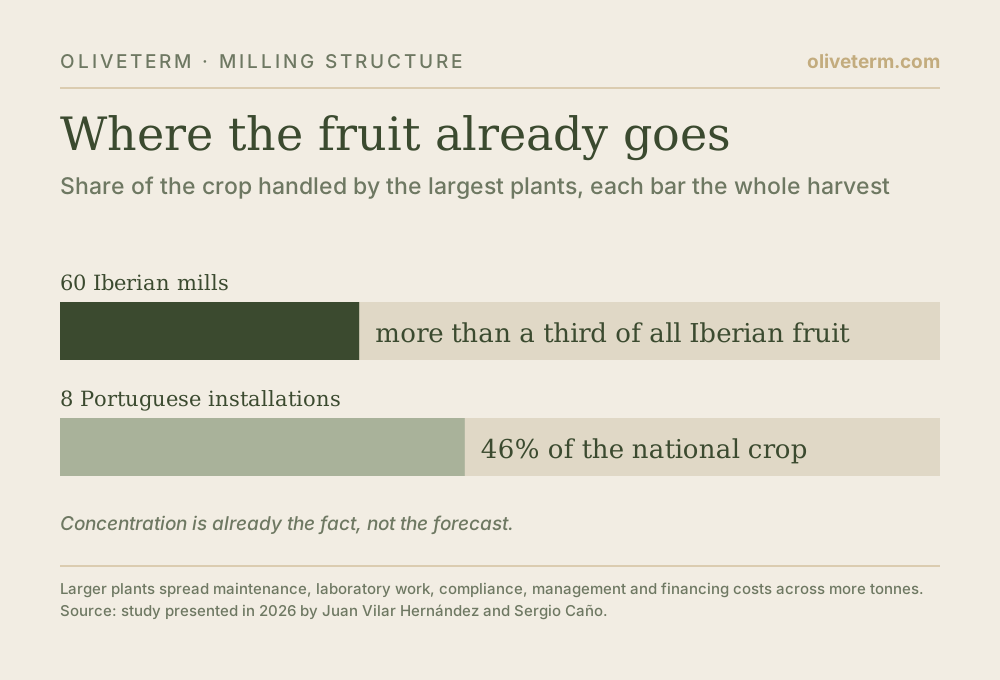
The direction of travel is nevertheless difficult to dispute. Milling is concentrating rapidly: 60 plants process more than a third of all Iberian fruit, while in Portugal eight installations account for 46% of the national crop. Larger mills can spread maintenance, laboratory work, environmental compliance, management and financing costs across more tonnes. They can employ specialised staff, negotiate harder with suppliers and buyers, and keep modern lines working closer to their intended load. In weak campaigns they also have the balance sheet and commercial reach to draw fruit from a wider area. Small and mid-sized mills face a genuine squeeze between rising fixed costs and an olive supply that cannot expand merely because more capacity is chasing it. Some will close, and others will lose their independence.
Yet throughput cannot be treated as a universal verdict. A tonnage figure says little about who owns the incoming fruit, what the mill charges, how much debt it carries or how much value it retains after extraction. Volume is an important determinant of cost, but it cannot establish by itself whether a plant creates or destroys value. The forecast is therefore better read as a measure of the pressure facing the industry's most exposed operators than as a precise boundary between viable and unviable plants.
That qualification does not disprove the forecast. It defines what the projection can and cannot show. A factory buying fruit, assuming price risk and selling anonymous bulk oil has different economics from a toll mill paid to process fruit owned by growers. Both differ again from a plant integrated with its own groves, a cooperative maintained as infrastructure for its members or a mill earning part of its margin from storage, bottling and direct sales. Similar machinery can sit inside fundamentally different businesses. Throughput matters to all of them, but the volume required to break even depends on their fixed costs, revenue mix, financing burden and ownership model.
The real question is not whether scale matters. It plainly does. It is whether scale alone determines which mills have an economic reason to exist. To answer that, viability has to be considered at three levels. A mill must first cover the cash cost of the campaign. Over time it must also pay for depreciation, maintenance and the eventual replacement of its equipment, rather than remain nominally profitable while consuming its capital. Finally, it must be capable of surviving a change of ownership or generation. A plant can pass the first test and fail the second; it can pass both and still close because nobody wants to take it over. Throughput influences all three, but it settles none of them by itself.
The number behind the tariff
For a small mill, the most useful calculation is the full cost of processing one tonne of olives at the volume it can realistically expect. Energy, water, labour, maintenance, cleaning, effluent treatment, insurance, administration, depreciation and financing all belong in that calculation. The denominator matters just as much. Dividing costs by the nameplate capacity of a line produces a comforting fiction if the plant never processes that volume. At the same time, relying on a single poor campaign can make a viable installation look hopeless. A sensible cost model should show the result at several levels of throughput and across a normal crop cycle, including a weak year, an average year and a strong one. What matters is not one historic cost per tonne, but how quickly that cost rises when fruit becomes scarce.
Revenue per tonne also needs to be measured properly. A mill may charge a cash tariff, retain a share of the oil as payment, buy the fruit outright or combine processing with storage, filtration, bottling and the sale of by-products. Each model places different risks on the operator and produces a different margin from the same quantity of olives. A tariff that appears low may still be profitable if other revenues are captured; a seemingly generous price may be inadequate once working capital and commodity risk are included. The common practice of setting the tariff by looking at the mill down the road avoids an awkward conversation with growers, but it says nothing about whether the price covers the plant's own costs. Two neighbouring mills may charge the same amount while one owns its buildings and equipment outright and the other is servicing a recent investment.
This is why tax accounts are not enough. They show whether the legal entity made or lost money over the year, but often reveal little about where the result came from. Reception, milling, storage and bottling should be treated as separate cost centres, with energy, labour and maintenance allocated on a defensible basis. Where the mill belongs to an integrated farming business, the grove and the plant also need separate accounts and a clear internal price for the fruit or processing service. Otherwise the farm can subsidise the mill, or the mill can subsidise the farm, without the owner knowing which activity is genuinely earning a return. The same problem can arise in cooperatives, where a low milling charge may benefit members while weakening the institution expected to renew the equipment on their behalf.
Cash flow adds another layer. Fruit arrives within a compressed period, while payments to growers, energy bills and campaign wages fall due well before all the oil is sold. A mill that buys olives or settles members quickly carries a much heavier financing burden than one that only provides a processing service, even when their accounting margins look similar. Credit should therefore be arranged before the campaign, settlement schedules should reflect the sales cycle, and the business should know how much oil it can afford to hold. Forced selling is the real danger. A mill obliged to dispose of bulk oil immediately after harvest surrenders the ability to choose its buyer or timing; repeated often enough, a liquidity constraint becomes a permanent transfer of margin to better-financed businesses further down the chain.
Management does not require an elaborate dashboard. A limited set of measures, followed consistently, is enough to expose most weaknesses: tonnes processed per working hour and per campaign day, extraction yield by variety and maturity, stoppage hours, energy consumed per tonne, oil remaining in pomace, gross margin by activity, the average time between sale and payment, and the proportion of growers who return the following year. The value lies less in the sophistication of the indicator than in comparing it across campaigns. A mill that knows these numbers can decide whether it needs more fruit, a higher tariff, better maintenance or a different commercial model. One that does not know them can only respond to pressure by cutting prices or buying more capacity.
The economics of proximity
Small mills rarely beat the largest plants on pure processing cost. Their strongest defence lies elsewhere, in the combination of location, accumulated knowledge and trust. An olive crop is not an anonymous flow that changes destination every year in response to a marginal difference in the milling tariff. For the grower, choosing a mill means entrusting the value of a year's crop to the business that will weigh the fruit, process it, calculate or verify the yield, store or purchase the resulting oil and eventually settle the account. Each stage creates room for uncertainty, particularly when the grower cannot observe everything happening inside the plant. Where the same people deal with one another campaign after campaign, much of that uncertainty recedes. Trust has an economic value because it reduces the cost of attracting supply, limits disputes and makes the relationship less vulnerable to a temporary offer from a competitor.
Location is what allows much of that trust to be built. A mill embedded in a producing area accumulates knowledge that is difficult to reproduce from a central office: the characteristics of individual groves, the behaviour of local varieties, the usual volumes and harvesting practices of each supplier, and the expectations of the families behind them. Farmers, in turn, know who owns and operates the plant. They can see how the business behaves in a difficult harvest, whether it applies the same rules to everyone and whether the person promising payment will still be there when the account falls due. If something goes wrong, they can speak directly to someone with the authority to resolve it. In a sector where reputation travels quickly through villages and producer networks, that accessibility can matter as much as a small difference in price.
Geography also changes the practical organisation of the campaign. A nearby plant makes it easier to deliver several smaller loads, return machinery and trailers quickly to the grove, react to rain or frost and adjust harvesting dates without turning every change into a logistical exercise. These advantages are particularly relevant in traditional regions, where production is fragmented across many holdings and the crop is assembled through hundreds of small daily decisions. A large mill may own the faster line and the larger reception yard; the local mill may still be easier to work with. That convenience does not appear in a calculation of industrial cost per kilo, but it affects where fruit actually goes.
Cultural proximity reinforces the advantage. A shared understanding of local varieties, harvesting habits, family lots, payment customs and the rhythm of the campaign permits arrangements that would be difficult to standardise across thousands of suppliers. This is not an argument for preserving every local practice or excusing poor management in the name of tradition. It is recognition that repeated relationships create information and coordination that have commercial value. A slightly lower tariff may attract a grower for one campaign, whereas an unexplained yield, a late payment or a dispute handled badly can keep that grower and several neighbours away for years. Conversely, a mill that behaves predictably during a difficult season often secures loyalty that no advertising budget could buy.
Proximity is not permanent protection. Large groups can establish capable local teams, retain familiar staff and offer farmers both scale and accessibility. Nor is being nearby a business model in itself. The advantage only becomes defensible when it is translated into a better service: transparent weighing and yield calculations, clear reception rules, predictable settlement, direct access to decision-makers, flexibility over small lots and consistent treatment from one campaign to the next. Multi-year agreements can formalise the relationship, but they cannot manufacture trust where it does not exist. The most useful commercial measure for a local mill is therefore not the number of growers in its database, but the share of meaningful volume that returns each year and the reasons why the rest leaves.
Fruit is consequently less mobile than a simple consolidation model suggests. Growers do not invariably choose the plant with the lowest theoretical processing cost; they choose the operator they trust with the crop and the service that best fits the way they farm. A mill losing 15% of its growers every year has a commercial problem long before it has an engineering one. Conversely, a local plant with a stable supplier base can remain viable below the study's throughput benchmark because it offers something broader than processing capacity. Proximity does not remove the economies of scale enjoyed by a large operator, but it helps explain why the cost curve alone cannot predict which mills will retain enough fruit to survive.
Capacity, utilisation and the oil already in the fruit
Olive milling is seasonal infrastructure, not a factory designed to operate at a steady rate throughout the year. Equipment that stands still outside the harvest is not necessarily surplus; the relevant question is whether the line is appropriately sized for the volume and concentration of fruit arriving during the weeks when it must be processed. Some spare capacity has an economic purpose. It allows the plant to absorb days compressed by weather, avoid turning away loyal growers and recover after a breakdown without losing the remainder of the crop. Judged solely by annual operating hours, that resilience looks like waste. During a difficult campaign, it can be the service that preserves the customer base.
The problem begins when the capacity buffer becomes a permanently underfunded asset: expensive machinery financed for volumes that the catchment area cannot supply, maintained throughout the year and used at full load for only a handful of days. The correct object of analysis is therefore the campaign's load curve. How many hours does the plant run near its efficient rate? How often is fruit refused or left waiting because reception exceeds throughput? How much of the installed line remains idle even at the seasonal peak? A mill that is congested for ten days may have a peak-capacity problem; one that runs below half-load throughout the campaign has a supply problem. The machines can look identical while the investment decision is entirely different.
Where the constraint is a narrow rush of deliveries rather than a shortage of olives in the district, extending the effective milling window can raise throughput with limited capital. Harvest calendars can be agreed with larger growers, early and late varieties can be encouraged where local agronomy permits, and commercial terms can be adjusted to reduce the concentration of deliveries. Temperature-controlled reception may provide limited flexibility in some cases, provided fruit quality is protected. The arithmetic illustrates the value: a plant running for 30 days at 50 tonnes a day processes 1,500 tonnes; at 40 days it processes 2,000. With, for example, fixed campaign costs of 120,000€, the fixed cost per tonne falls from 80€ to 60€ even though the line has not become faster.
There are clear limits to this approach. Mills supplied mainly by super-intensive groves face a harvest window compressed by agronomy and mechanical harvesting, while others already process close to the biological output of their surrounding area. Incentives cannot make late fruit appear where no suitable varieties exist, and spreading the campaign must not come at the expense of oil quality. In those cases, the honest options are to bring fruit from farther away, share capacity with another operator, remove excess equipment or accept that the plant serves a smaller market and price its service accordingly. The right answer emerges only after installed capacity is compared with actual hourly use, the regional crop and the loyalty of the supplier base.
Before pursuing another million kilos, the mill should also ask how much oil it is failing to recover from the fruit it already handles. In a plant processing 1,500 tonnes of olives, one percentage point of extraction yield represents 15 tonnes of oil. Better control of malaxation time and temperature, equipment condition, settings for different fruit and systematic pomace analysis can therefore be worth more than many conventional cost reductions. The financial benefit, however, depends on the business model. A mill that buys fruit or retains oil as payment captures part of the improvement directly; a pure toll mill may pass most of it to the grower, but gains a stronger reputation and a reason for suppliers to return. Either way, a plant that does not analyse its pomace is managing one of its largest potential losses by guesswork.
The long route out of bulk
Selling in bulk is not inherently a failed strategy. A disciplined mill can earn a satisfactory return from bulk oil if it controls quality, segregates lots, chooses its counterparties and is not forced to sell at the least favourable moment. The weak position is anonymous bulk: oil with no documented attribute, no customer commitment and no reason to command anything beyond the prevailing market quotation. In that model the mill takes production, quality and financing risk, then hands most of the differentiation margin to whoever blends, bottles and distributes the product. Moving away from that position does not necessarily require a consumer brand, but it does require the oil to become more than an interchangeable volume in a tank.
An own brand is one possible route, though it is routinely mistaken for a shortcut. The shelf price of a bottle bears little resemblance to the net margin left for the producer after glass, caps, labels, cartons, certification, sales commissions, transport, promotions, samples, retailer terms, returns and unsold inventory. Bottling also lengthens the cash cycle: money that could have been recovered through a bulk sale remains tied up in packaging and finished stock while the business learns to find customers. A higher price per litre can therefore coexist with a lower return on capital. The relevant question is not how much the bottle sells for, but how much contribution remains after the full cost of reaching the customer and how quickly that money returns.
The sensible route begins before the label is designed. Fruit must be controlled at reception, separated by variety, origin or grower where useful, and subject to standards that the mill is willing to enforce. Ground fruit may need to be rejected, traceability records must be credible and production decisions must be consistent with the quality claim eventually made. This is often harder socially than technically, because differentiation requires telling some suppliers that not every load belongs in the same product. Without that discipline, a premium brand becomes a marketing promise unsupported by the contents of the bottle.
The next step should be deliberately limited, perhaps 5–10% of production, so that the mill can learn the real economics of selling without placing the entire crop at risk. That volume is enough to test whether customers reorder, which channels pay on time, what packaging is genuinely required and how much service each sale consumes. Only after this should the producer choose one credible point of distinction, such as a protected origin, certified organic production or a serious early-harvest programme. Each carries a cost: organic production requires certified supply and a conversion period, while early harvesting sacrifices extraction yield and must earn a premium large enough to compensate for it. Collecting several labels at once may add expense without adding demand.
Distribution remains the decisive constraint. There is no shortage of millers convinced that their oil is exceptional; reliable routes to customers are much scarcer. Restaurants, specialist retailers, direct online sales, private-label contracts and niche exports demand different volumes, margins, labels, payment terms and levels of support. A brand should expand only after one of these channels shows repeatable demand. Otherwise the mill has exchanged the price risk of bulk oil for the inventory and customer-acquisition risk of packaged oil. For operators without the capital or aptitude to build distribution, differentiated bulk, contract bottling or a stable private-label relationship may produce a better return than a consumer brand. The objective is to retain more value, not to place the mill's name on every litre.
Scale without disappearance
The case for greater scale is strongest where the activity adds no value by remaining separate. Laboratory testing, regulatory monitoring, insurance, specialist maintenance, purchasing, energy procurement, digital traceability, export administration and even bottling can often be shared across several mills. A local plant does not need its own export department to reach foreign customers, just as it does not need to operate a dedicated laboratory to verify its oil. Pooling these functions allows fixed costs to be spread across more volume while leaving fruit reception, extraction and the relationship with growers close to where production occurs.
Shared scale also carries costs. Joint commercial structures require governance, common quality rules and a willingness to surrender some autonomy. A group cannot promise consistent oil if each member applies different reception standards, and collective purchasing loses value when decisions are delayed by local rivalries. The arrangement works when local functions that benefit from proximity remain local, while activities with genuine economies of scale are centralised. It fails when integration adds another administrative layer without changing purchasing power, market access or cost discipline.
For that reason, the sector's likely reorganisation cannot be measured only by counting open mills. Some plants will close, some will become reception points feeding a larger extraction centre, some will merge operationally, and others will continue milling locally while purchasing and selling through a group. These outcomes have different consequences for employment, growers, installed capacity and regional competition. Combining them under a single figure may be useful as a measure of lost independence, but it reveals less about how much milling infrastructure will actually disappear.
The 2027 compliance test
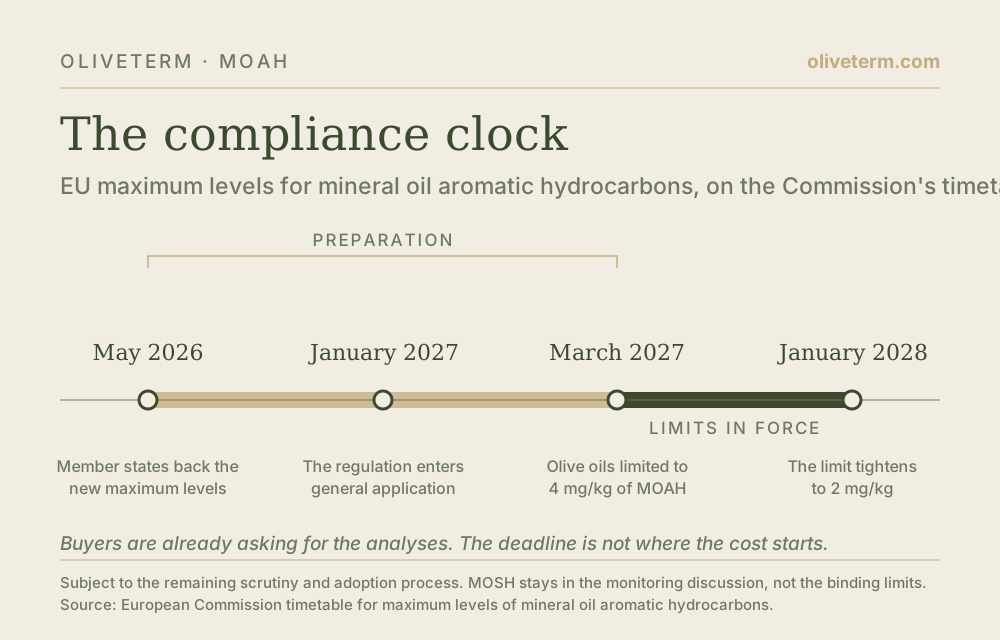
The coming European limits on mineral oil aromatic hydrocarbons, or MOAH, show more clearly than a theoretical throughput threshold how regulation can reinforce the advantages of scale. In May 2026, EU member states backed new maximum levels. Subject to the remaining scrutiny and adoption process, the European Commission's timetable would bring the regulation into general application in January 2027, with a specific limit for olive oils of 4 mg/kg from March 2027, tightening to 2 mg/kg in January 2028. MOSH, the saturated fraction, remains part of the wider monitoring and mitigation discussion, but the proposed binding maximum levels concern MOAH.
The commercial burden is arriving before the formal deadline. Some premium buyers and retail chains already request analytical results, traceability records and evidence of preventive measures. Mineral-oil contamination can enter through lubricants used in harvesting or processing machinery, processing aids, food-contact materials, packaging or the surrounding environment. A mill can therefore maintain an immaculate extraction line and still receive contaminated fruit or introduce a problem later in storage and bottling. Effective prevention must extend from the grower's harvesting equipment through reception, production, tanks and final packaging.
Most of the resulting expense is fixed or only loosely related to volume. Replacing unsuitable lubricants, reviewing contact materials, training staff, documenting procedures and designing a defensible sampling plan weigh proportionally more on a mill processing 1,500 tonnes than on one processing 20,000. This is the clearest mechanism by which low throughput becomes dangerous: not because a small volume is intrinsically unviable, but because an expanding stack of unavoidable costs must be recovered from fewer tonnes. A mill that was comfortably profitable under yesterday's requirements can fall below economic break-even without losing a single grower.
Small mills face a particular problem at the farm gate. They can issue protocols, but cannot easily police every lubricant, harvesting machine or transport container used by a dispersed base of independent growers. A contaminated load may therefore enter an otherwise well-run plant before the operator has had any realistic opportunity to intervene. Yet proximity can make that weakness more manageable. Mills that know their suppliers, explain the risks before harvest, separate lots and test according to a credible sampling plan can turn compliance into a commercial asset. For many premium buyers, sensory quality is no longer enough if a batch arrives without traceability or reliable evidence on contaminants. A small mill that can repeatedly supply oil with results comfortably within the required limits, documented origin and disciplined handling offers something more valuable than a low processing cost: lower procurement risk. That does not guarantee a premium, but it can qualify the mill for buyers and contracts that remain closed to less controlled supply.
When there is no viable defence
For some installations, none of these measures will be enough. A mill with no secure fruit of its own, a shrinking supplier base, obsolete equipment, weak accounts, no differentiated product and a business confined to low-margin toll milling may no longer have a credible future as an independent operator. Raising the tariff can accelerate the loss of growers; cutting it deepens the deficit; investing adds capital to a market that cannot fill the existing line. In that position, closure is not a failure of imagination. A local merger, conversion into a reception and logistics point or an orderly sale while the assets retain value may be the least destructive outcome.
Other mills will fail for a reason absent from any cost curve: succession. A plant can cover its expenses, retain loyal growers and operate sound equipment, yet still close because the next generation does not want the work and no outside buyer can understand a business that resides largely in the owner's memory. Better management cannot create a successor, but it changes what can be transferred. Organised accounts, documented processes, clear ownership of assets, contracted relationships and a route to market turn a collection of machinery into a business that someone else can value. Without them, even a profitable mill may be worth little beyond the land and equipment.
This is why a low-volume plant can appear viable for years while moving slowly towards closure. It may pay current bills but make no provision for replacing the decanter, renovating storage or meeting the next regulatory demand. The owner supplies management without charging for it, family labour fills gaps and old equipment continues because it has already been paid for. Such a mill is operationally alive but economically consuming itself. The study's warning is most persuasive in these cases, where low throughput is not the immediate cause of closure but prevents the business from renewing the assets on which its survival depends.
Consolidation is therefore real, and smaller mills should not mistake history or local loyalty for permanent protection. Fixed costs are rising, the largest operators are gaining share and a plant without reliable supply will not be saved by sentiment. But neither should an average throughput benchmark be confused with the line between life and death. Mills survive because they combine an adequate tariff, cost control, liquidity, extraction performance, loyal growers and some means of retaining value beyond anonymous processing. They disappear when enough of those foundations fail, or when nobody is willing to carry them into the next generation.
Throughput benchmarks remain useful as warnings rather than sentences. They ask whether a plant has enough volume to support its present cost base, while the more important question is whether that cost base, the commercial model and the ownership structure are appropriate for the fruit the mill can realistically retain. Scale is one answer, but so are better management, deeper local relationships, shared services and differentiated output. The future of Iberian milling will be shaped by all of them.
Sources: the consolidation forecast and the Iberian concentration figures come from the study presented this year by Juan Vilar Hernández and Sergio Caño. The MOAH timetable follows the European Commission's maximum levels for mineral oil aromatic hydrocarbons, backed by EU member states in May 2026 and still subject to the remaining scrutiny and adoption process.