

Spanish farm data suggest that one litre of olive oil embodies about 0.132 litres of agricultural diesel before it reaches the mill. Across the 1.405–1.649€ per litre price range reported in Spain in September 2026, the immediate cash outlay is 0.19–0.22€ per litre of oil. Where VAT is recoverable, the comparable cost falls to approximately 0.15–0.18€, or around 4–5% of full production cost. The average, however, conceals profound differences between groves.
Diesel is one of those agricultural inputs whose importance is easy to overlook while its price is stable. It disappears into tractor work, pruning, fertilising and plant protection; when harvesting is outsourced, it disappears again inside the contractor's invoice. In 2026, it has become much harder to ignore. Spain's Ministry of Agriculture reported a tax-inclusive weighted agricultural-diesel price of 1.405€ per litre on 7 September, compared with 0.950€ on 26 January, a rise of almost 48% within the same official series. ASAJA Málaga subsequently reported a public-pump quote of 1.649€. That second figure should be understood as a reported high point rather than a national average or a directly comparable continuation of the Ministry series, but it captures the pressure faced by farms buying fuel at the wrong place and the wrong moment. The surge followed renewed disruption in Middle Eastern oil markets, where the conflict affected Gulf supply flows and refinery operations, tightening both crude and refined-product markets.
The question for the olive sector is therefore more useful when expressed in litres of oil rather than litres of fuel: how much diesel cost sits inside the production of one litre of olive oil? Using five seasons of field data from 11 olive-growing systems in Jaén, OliveTerm calculates that the study-weighted farm consumes approximately 0.132 litres of diesel for every litre of oil produced. Put more intuitively, producing 1,000 litres of olive oil requires about 132 litres of farm-stage diesel. Across the reported price range of 1.405–1.649€ per litre, that fuel costs approximately 185–217€. The same result can be stated at bottle scale: the gross diesel component lies between 0.19€ and 0.22€ per litre of olive oil, equivalent to approximately 0.20–0.24€ per kilogram, the unit more commonly used in Spanish origin-price quotations.
Those figures are substantial, but they need to be read correctly. They are not a claim that every Spanish farm consumes exactly the same amount of fuel, nor do they mean that a 0.10€ increase in production cost will automatically add 0.10€ to the retail price. The 0.19–0.22€ range measures the cash paid when the fuel is purchased and includes the 21% VAT applied in mainland Spain and the Balearic Islands. For a farm entitled to deduct that VAT, the comparable fuel cost is approximately 0.15–0.18€ per litre of olive oil, before any excise refund or temporary support. On that basis, diesel represents around 4–5% of full production cost and 5–6% of day-to-day operating cost. The gross figure remains important because the tax is paid before it is recovered: diesel is both a cost exposure and a demand on working capital at the most cash-intensive point of the campaign.
From field work to a litre of oil
The physical estimate comes from a 2024 study published in the Journal of Cleaner Production, covering 5,738 hectares of olive groves in Jaén and drawing on average results from the five campaigns between 2017/18 and 2021/22. The researchers examined 11 systems, from extensive rainfed groves to irrigated super-intensive plantations, and recorded both the diesel consumed in field operations and the oil obtained. Once the systems are weighted according to their importance in the study, the representative hectare uses about 117 litres of diesel and yields approximately 890 litres of olive oil. Dividing the first number by the second produces the central coefficient: 0.132 litres of diesel per litre of oil. This is more informative than fuel use per hectare because the farmer does not sell hectares. The economic value of every field operation ultimately depends on the volume of oil over which its cost can be spread.
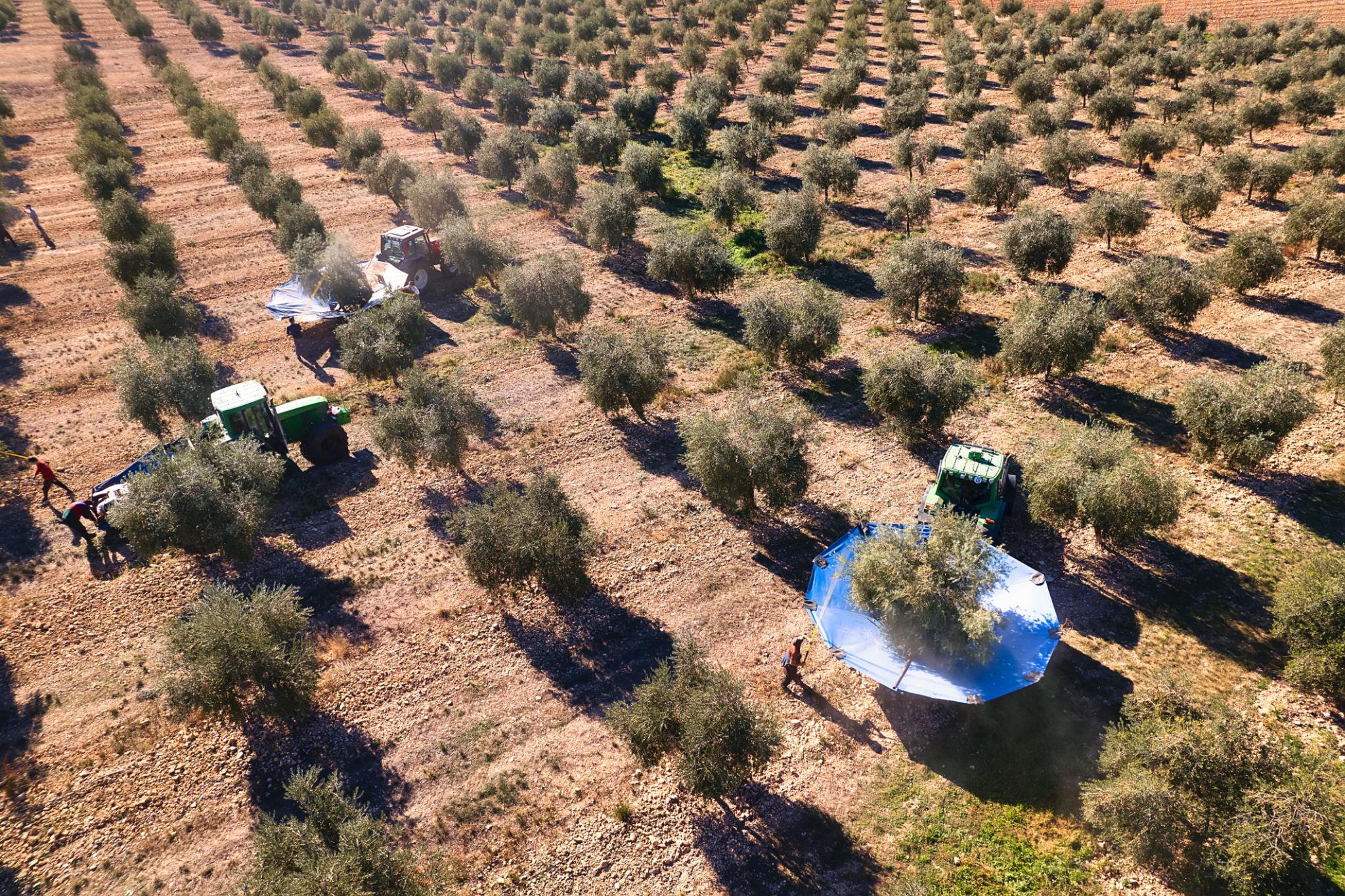
Harvesting dominates the calculation, accounting for about 72% of the diesel used. The remainder is consumed by soil management, pruning, fertilising and plant-protection work. This distribution also explains why a farmer's fuel receipts may understate the operation's true exposure. Many growers hire external contractors for harvesting or other machinery-intensive tasks. In that case, the contractor buys the diesel and passes the cost through in the service price; the farm's accounts record a harvesting invoice rather than a purchase at the pump, but the economic burden remains with the grower. OliveTerm's estimate includes that embedded fuel. It excludes petrol used by some portable harvesting equipment, so it should not be read as an inventory of every liquid fuel consumed on the farm, and it does not attempt to measure the indirect effect of energy prices on fertilisers, replacement parts or machinery.
By comparison, direct diesel consumption inside the mill is almost immaterial in the study. It reports 0.74 litres of diesel for every tonne of virgin olive oil produced, which at current prices is worth roughly one-tenth of a euro cent per litre of oil. Most mills use electricity as their principal source of power, although some facilities with insufficient grid capacity continue to depend on diesel generators, either as backup or as part of their supply during the milling campaign. The study's low average should therefore not be read as evidence that diesel is irrelevant to every mill. Across the sector, however, the fuel exposure measured here remains principally a farm-stage problem, created by the mechanical work required to manage and harvest the grove rather than by the transformation of olives into oil.
One average, several olive-growing economies
The coefficient of 0.132 litres is a useful reference point, but it is not a biological constant and should not be presented as a new national survey. Slope, planting density, access for machinery, irrigation, harvesting method and yield all change the answer. To make the production systems directly comparable, the table below applies the lower end of the reported range, the 1.405€ weighted Spanish price, to each of the selected systems in the Jaén study:
| Olive-growing system | Diesel per litre of oil | Diesel cost per litre of oil |
|---|---|---|
| Extensive rainfed | 0.052 L | 0.07€ |
| High-slope rainfed | 0.156 L | 0.22€ |
| High-slope irrigated | 0.261 L | 0.37€ |
| Intensive irrigated | 0.217 L | 0.30€ |
| Super-intensive irrigated | 0.306 L | 0.43€ |
| Study-weighted scenario | 0.132 L | 0.19€ |
The table should not be mistaken for a ranking of overall competitiveness. An extensive rainfed grove can consume little diesel per hectare and per litre yet still have a high total production cost because its land, labour and fixed work are divided by a modest volume of oil. A modern irrigated plantation may carry a much larger fuel bill, particularly when harvesting is highly mechanised, while remaining cheaper overall because it produces more and uses labour more efficiently. In other words, diesel intensity and economic efficiency are not the same thing. The important question is not simply how much fuel a grove burns, but how much saleable oil that fuel helps to produce and which other costs the production system avoids. This is why a single sector average is useful for measuring broad exposure but inadequate for judging an individual farm.
Yield introduces a second layer of variation, and it can be even more important than the production system. Some diesel use rises with the crop: harvesting a large quantity of fruit normally requires more machine time than harvesting a small one. Other work must be carried out almost regardless of the eventual yield. Tractors still pass through the grove, pruning still takes place and the holding still has to be maintained. When the crop disappoints, those litres of diesel are divided by fewer litres of oil. OliveTerm's sensitivity analysis suggests that a 30% fall in yield could raise diesel consumption per kilogram of oil by roughly 12–43%, depending on how closely harvesting fuel adjusts to the smaller crop. This is not a forecast for the coming campaign, but it demonstrates why the same fuel price can be manageable in a productive year and destructive in a poor one. The pump price creates the pressure; the yield determines how concentrated that pressure becomes.
Putting the fuel bill in context
To place the fuel bill in context, OliveTerm compared the physical calculation with the production-cost study published by the Spanish Association of Olive Municipalities, AEMO, in July 2026. After matching the production systems as closely as the two datasets allow, the study-weighted benchmark is approximately 3.71€ per litre of olive oil when operating expenses, land rent and plantation amortisation are all included. For a like-for-like comparison with costs stated without recoverable VAT, the diesel component is approximately 0.15–0.18€ per litre of oil, equivalent to around 4–5% of that full cost. If the comparison is limited to operating expenses, estimated at about 2.97€ per litre, the share rises to around 5–6%. These percentages do not add a new fuel charge on top of AEMO's estimate: fuel is already contained in its machinery rates. The exercise isolates the portion of the existing cost structure that is directly exposed to diesel prices, while the higher gross figures describe the farm's immediate cash requirement.
The change since the beginning of the year makes the pressure easier to see. Keeping the comparison within the Ministry's weighted Spanish series, agricultural diesel rose from 0.950€ per litre on 26 January to 1.405€ on 7 September. Using the same physical coefficient, the gross diesel cost inside a litre of olive oil increased from approximately 0.13€ to 0.19€. The like-for-like increase is therefore about 0.06€ per litre of oil before VAT recovery or temporary aid, equivalent to roughly 6,000€ across 100,000 litres of production. The later 1.649€ public-pump quote lifts the embedded gross cost to approximately 0.22€ per litre, but it is better treated as a high-price exposure scenario than as the endpoint of the national weighted series. Six cents can appear small beside the shelf price of a bottle, but the grower measures it against a margin that may already be narrow and must finance it while harvesting services and other campaign expenses are also falling due.
Whether any of that increase reaches consumers depends on the olive oil market, not on an automatic cost-plus formula. Origin prices are shaped above all by the expected harvest, carry-over stocks, quality, demand and the willingness of producers and holders to sell. In a tight market, growers and mills may be able to defend their margins by passing on part of the fuel increase. In a well-supplied market, buyers have less reason to accept a higher price and the cost is more likely to remain on the farm. Retail prices can react later still because packers and distributors work with inventories, contracts and promotional calendars. Diesel changes the price at which production is viable; it does not dictate the price at which oil will trade.
The timing of the expense is almost as important as its final value. Fuel and contractor invoices are paid during the campaign, while the oil may be sold weeks or months later. VAT deductions, excise refunds and emergency support may reduce the eventual net burden, but they do not necessarily finance the purchase when the tractor or harvester needs to move. Unless extended, Spain's temporary agricultural-diesel support expires on 30 September, just as the olive harvest approaches. The current scheme covers up to 70% of the difference between the weekly agricultural-diesel price and its pre-conflict level, subject to a ceiling of 0.20€ per litre, but it is settled after purchase rather than applied as a fixed discount at the pump. Its expiry would therefore raise the farmer's eventual net burden without producing an automatic overnight increase of a predetermined amount. This makes the diesel surge both a cost problem and a working-capital problem, particularly for smaller growers and for holdings entering the harvest after a weak season.
The most defensible conclusion is therefore precise rather than dramatic. In the study-weighted Spanish scenario, one litre of olive oil requires about 0.132 litres of farm-stage diesel. At the prices observed in September 2026, the farm pays approximately 0.19–0.22€ in gross terms; where VAT is recoverable, the comparable cost is about 0.15–0.18€, or roughly 4–5% of full production cost. That is not enough to explain the price of olive oil on its own, but it is large enough to erode margins, intensify the consequences of a poor crop and influence when a grower can afford to harvest or sell. Diesel does not determine the olive oil market; it helps determine how much of the market price is left for the farmer.
Methodology and limitations
OliveTerm calculated the physical coefficient from the weighted diesel consumption and oil output reported across the 11 systems in the Fernández-Lobato et al. study. Diesel mass was converted at 0.835 kilograms per litre and olive oil output at 0.915 kilograms per litre. The resulting study-weighted values are approximately 117 litres of diesel and 890 litres of oil per hectare, or 0.132 litres of diesel per litre of oil. The 1.405–1.649€ price range combines the tax-inclusive weighted Spanish agricultural-diesel price published directly by the Ministry of Agriculture for 7 September with the later public-pump quote reported by ASAJA Málaga. These are not two observations from an identical price series: the lower figure is a weighted Spanish benchmark and the upper figure is a reported high point, not an official national maximum. The net-of-VAT range divides each gross price by 1.21; it does not deduct any excise refund or temporary aid, whose final value and timing depend on the applicable scheme.
The underlying field data come from Jaén and cover five historical campaigns, so the result is an analytical benchmark rather than a measured 2026 average for Spain as a whole. The estimate includes diesel used by contractors but excludes petrol, mill electricity, packaging and post-mill logistics. For the AEMO comparison, the low-yield system was matched to non-mechanisable traditional rainfed olive groves; high-slope and extensive systems to the nearest mechanisable traditional rainfed or irrigated category; medium-density and intensive systems to AEMO's intensive categories; and super-intensive systems to its hedgerow categories. The 3.71€ full-cost and 2.97€ operating-cost benchmarks were then weighted by the oil output of the 11 study systems. Because the two studies do not use identical samples or classifications, the resulting shares are analytical scenarios rather than audited farm accounts. Applying the calculation to Portugal or another producing country would require local production-system weights, yields, machinery practices, fuel prices and tax rules.
Sources
- AEMO, Aproximación a los Costes del Cultivo del Olivo, updated July 2026
- Fernández-Lobato et al., "Environmental impact of the most representative Spanish olive oil farming systems", Journal of Cleaner Production, 2024 (open full text)
- Spanish Ministry of Agriculture, weekly agricultural-energy report, 26 January 2026
- Spanish Ministry of Agriculture, weekly agricultural-energy report, 7 September 2026
- ASAJA Málaga, reported public-pump high point
- Spanish VAT Act, general 21% rate
- Royal Decree-law 7/2026, Middle East crisis response and temporary fuel VAT reduction to 30 June
- Royal Decree-law 18/2026, agricultural-diesel support to 30 September