

Olive oil production capacity has expanded steadily through new planting, irrigation and more productive farming systems. The harder question is whether demand can continue growing quickly enough to absorb what those investments are capable of producing.
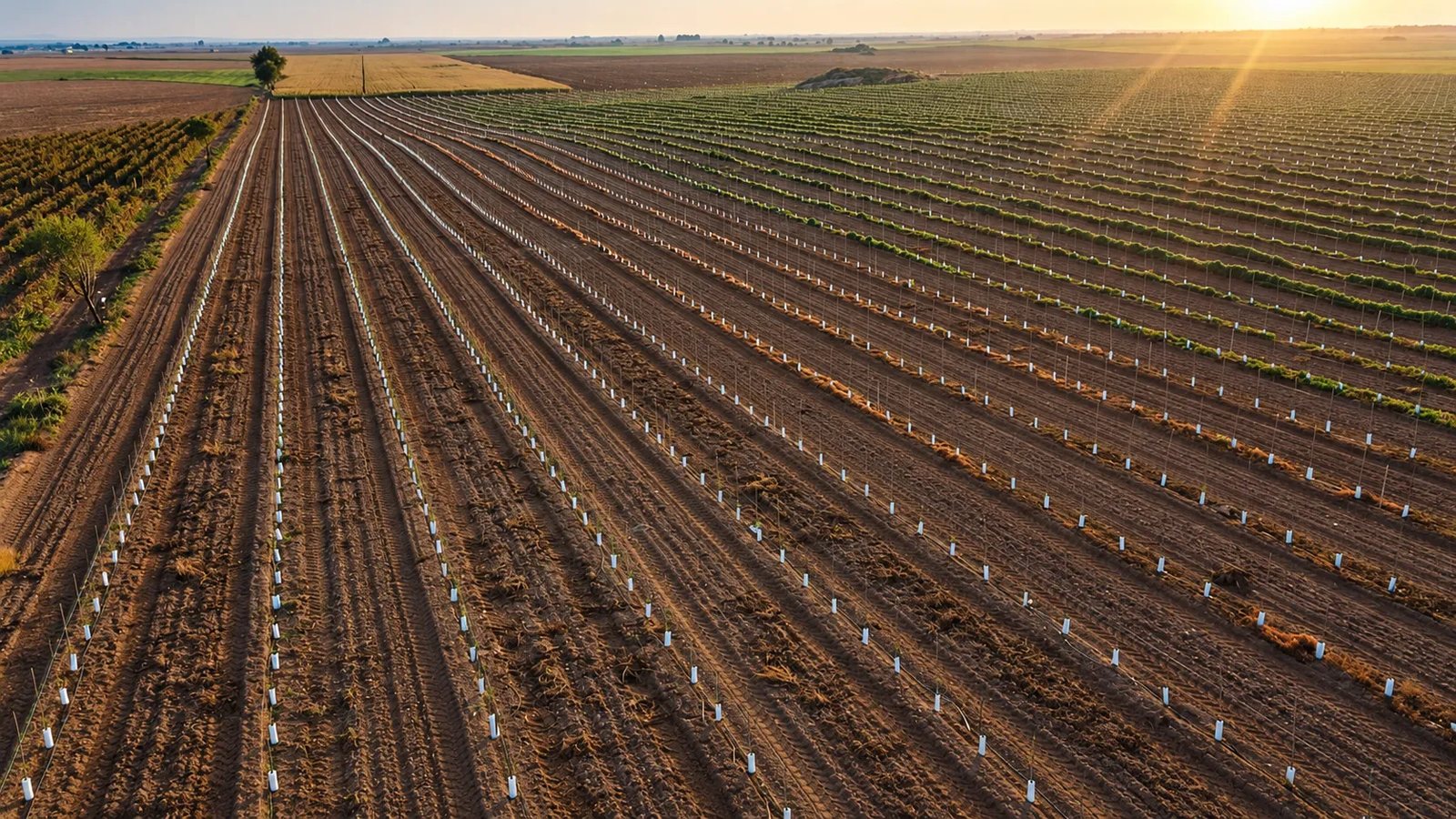
Photo: ISAGRI
An olive grove planted today is an investment in what the olive oil industry may look like ten, twenty or thirty years from now. Land is prepared, irrigation is installed, trees are planted and processing capacity is often expanded years before the orchard reaches its full productive potential. Once that capacity exists, it becomes part of the market for a long time. Across the olive oil industry, thousands of decisions of this kind have accumulated. Some involve entirely new plantations, others the conversion of existing groves to more productive systems or the addition of irrigation to land that was previously dependent on rainfall.
The numbers already show how large that transformation has been. According to FAO data compiled by Portugal's agriculture ministry planning office, the GPP, the world's olive-growing area increased from around 7.2 million hectares in 1986 to 11.1 million hectares in 2024, an expansion of 53.7%. Production has grown faster. Averaged over three campaigns to smooth out the swings between big and small crops, world olive oil production rose from about 1.8 million tonnes at the start of the 1990s to 3.2 million in the three latest campaigns, an increase of about 75% on International Olive Council figures, while the area grew by about half over the same span. The industry has not only expanded the area under olive trees, it has also become better at producing from it.
So far, the market has largely managed to absorb the result. World consumption has almost doubled since 1990/91 and has become far less dependent on the traditional consuming countries of southern Europe. But the next stage of that expansion may be more demanding. The industry is continuing to invest in assets that will produce for decades, while the demand required to justify those investments must be created consumer by consumer, market by market.
That is the tension at the centre of this piece. The question is not whether the world already produces too much olive oil, but whether the productive capacity now being built can keep growing at roughly the same pace as the market for the oil it produces.
The productive base is changing
Looking only at the number of hectares can understate what is happening.
A hectare of traditional rain-fed olive trees and a hectare of a modern irrigated hedgerow plantation may occupy the same space on an agricultural map, but they represent very different productive capacities. Tree density, irrigation, cultivar, pruning, mechanisation and agronomic management can all change the amount of fruit harvested and the regularity with which it is produced.
Portugal offers a particularly clear example. The country had about 381,000 hectares of olive groves in 2025, but the composition of that area has changed considerably. Agricultural census data show that by 2019 around 51,300 hectares were already hedgerow groves, with more than 1,500 trees per hectare, and that this area had increased by 359% in only ten years. Around 96% of Portugal's hedgerow olive area was concentrated in the Alentejo, reflecting the central role the region has played in the modernisation of the sector.
Portugal is an especially visible case, but the broader direction is not unique to it. Investment in modern olive cultivation has taken place across parts of Spain and in newer or expanding production regions in Australia, the United States and elsewhere. Existing orchards are also being managed more intensively, while improvements in harvesting, irrigation, plant material and milling allow more of the crop to be collected and processed efficiently. Olive cultivation has also expanded beyond the Mediterranean, even though the region still accounts for around 97% of the world's olive-growing area, according to the GPP.
This helps explain why the long-term expansion in olive oil production has been greater than the increase in planted area alone would suggest. It also changes the significance of future planting. If much of the additional acreage entering the industry is designed around higher productivity, an extra 100,000 hectares today may ultimately add considerably more supply than 100,000 hectares added several decades ago.
Demand has kept up before
There is a good reason not to treat that development as inherently problematic. Olive oil has repeatedly found consumers for volumes that would once have seemed difficult to sell.
Global consumption has almost doubled since the beginning of the 1990s, and the geography of that consumption has changed. The European Union accounted for just over 70% of world olive oil consumption in 2004/05; in recent seasons its share has been closer to 45%, the IOC says. The growth has come from elsewhere: of the 1.55 million tonnes added to world consumption since 1990/91, more than four fifths came from outside the EU.
Demand, in other words, is not fixed. Thirty years ago the world market could not have absorbed today's production, yet new consumption was created as the product became more widely distributed and more familiar outside the Mediterranean.
OliveTerm has looked in detail at how much room remains. In The 1.4% Oil we estimated that olive oil accounts for roughly 4–5% of the part of the global culinary-oil market it can realistically contest, rather than simply comparing its output with every tonne of vegetable oil produced for food, fuel and industrial uses, and we have looked at where the next 500,000 tonnes of demand could come from.
This piece asks something different. Potential market size tells us that additional demand can exist. It does not tell us how quickly it will appear.
In The 1.4% Oil we described supply as the slow side of the market, and it is: growers cannot answer a price signal with oil for several years. The same slowness works in reverse. Once planted, a grove keeps producing for decades whatever the price. Demand answers price much faster, but a rebound mostly brings back consumers who had cut back, while new ones arrive a household at a time. A new orchard can be designed around expected yields and cost structures with reasonable precision. Predicting how quickly households in Brazil, the United States, northern Europe or Asia will take up olive oil is a much less exact exercise.
None of this makes the investment irrational. Agricultural capacity and consumer adoption are simply built through very different processes.
A large harvest shows where the pressure goes
The current market gives some indication of how that relationship works.
The IOC estimates that the world produced around 3.57 million tonnes of olive oil in 2024/25 while consuming approximately 3.22 million tonnes. For 2025/26, which runs to the end of September, its estimates are around 3.44 million tonnes of production and 3.25 million of consumption. On a simple calculation, production therefore exceeds consumption in both campaigns.
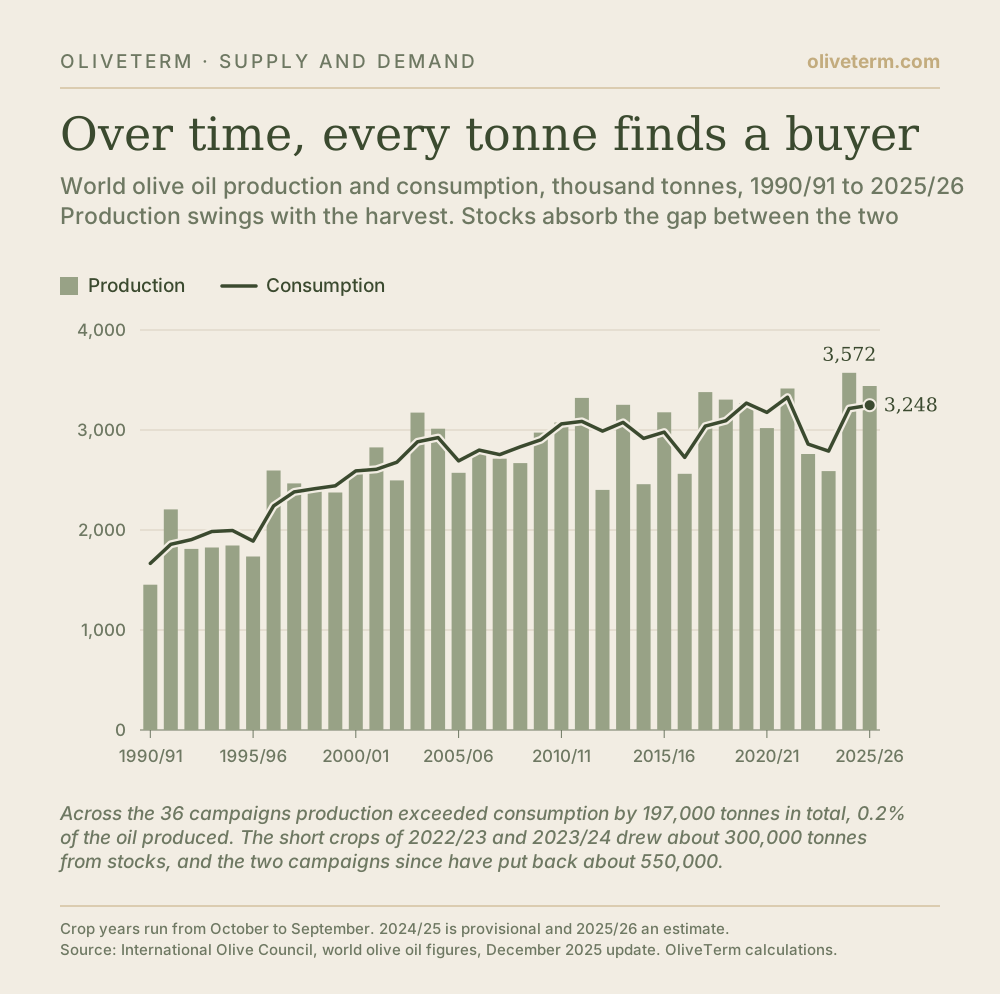
Those numbers should not be interpreted as evidence of structural oversupply. Stocks had been drawn down during the two previous short crops, and inventories are a necessary part of a market in which production can fluctuate dramatically from one year to another. A season in which output exceeds consumption can simply rebuild the buffer that allows the industry to operate through the next poor harvest. On the same simple arithmetic, though, the buffer is already back: the short crops of 2022/23 and 2023/24 drew about 300,000 tonnes from stocks, and the two campaigns since have put back about 550,000.
The more revealing question is what happens if large harvests become more frequent. The next campaign may offer an early test: the Spanish sector's first indication for 2026/27 was above 1.4 million tonnes, and Spain has drafted a mechanism to withdraw oil from the market when opening stocks and the new crop together exceed 120% of the average of the previous six campaigns.
If productive capacity continues to expand and several major producing countries experience good conditions at the same time, the industry could regularly find itself with more oil available than consumers would have bought at the prices that prevailed during scarcity. In that situation, the adjustment does not normally come from trees suddenly producing less. It comes through inventories, competition between sellers and eventually price.
That adjustment can itself bring demand back. The recent cycle demonstrated this quite clearly. After very high prices and limited availability pushed world consumption down during 2023/24, the recovery in production was accompanied by a strong recovery in consumption. The IOC estimates that global consumption increased by more than 15% in 2024/25, to around 3.22 million tonnes.
It would be too simple to attribute all of that increase to lower prices, but affordability clearly matters. Olive oil becomes easier to introduce into everyday cooking when the price gap with alternative oils narrows. Existing consumers also become less cautious about how much they use. In that sense, higher production contains part of its own solution: if it places downward pressure on prices, it can enlarge the group of consumers for whom olive oil makes economic sense.
For the industry as a whole, that mechanism can support long-term growth. For an individual producer, however, the experience can be much less comfortable. The price that stimulates additional consumption is not necessarily the price on which a new orchard's original business plan was based.
The issue is not consumption alone, but the price at which it appears
This is where comparing tonnes produced with tonnes consumed stops being enough.
There will almost always be a buyer for olive oil at some price. The more important issue is whether the market can absorb expanding production at prices that continue to support the economics of the investment behind it.
A world capable of consuming four million tonnes of olive oil at substantially lower prices is not economically equivalent to a world capable of consuming four million tonnes while maintaining today's producer margins. Both represent demand growth, but they create very different outcomes for growers, mills and companies that have invested in additional capacity.
Modern olive production has been designed partly around this reality. Higher yields, mechanised harvesting and greater operational efficiency are intended not only to increase production but also to reduce the cost at which each kilogram can be produced. That gives efficient plantations more room to remain profitable if competition for buyers intensifies.
Traditional production systems often have a different cost structure and may depend more heavily on quality, origin, subsidies or higher market prices. The effect of an abundant market is therefore unlikely to be uniform across olive-growing regions or business models.
The market is already giving a preview. The cost study that AEMO, the Spanish Association of Olive Municipalities, published in July puts the full cost of a kilo of oil, land rent and the amortisation of the plantation included, at 3.08€ in an irrigated hedgerow grove, 3.17€ in a rain-fed one and 3.20€ in an irrigated intensive grove, against 4.18€ to 4.67€ in mechanisable traditional groves and 5.31€ where the trees cannot be harvested by machine. At the average origin price the study used, about 3.26€/kg across extra virgin, virgin and lampante, only those first three cover their costs.
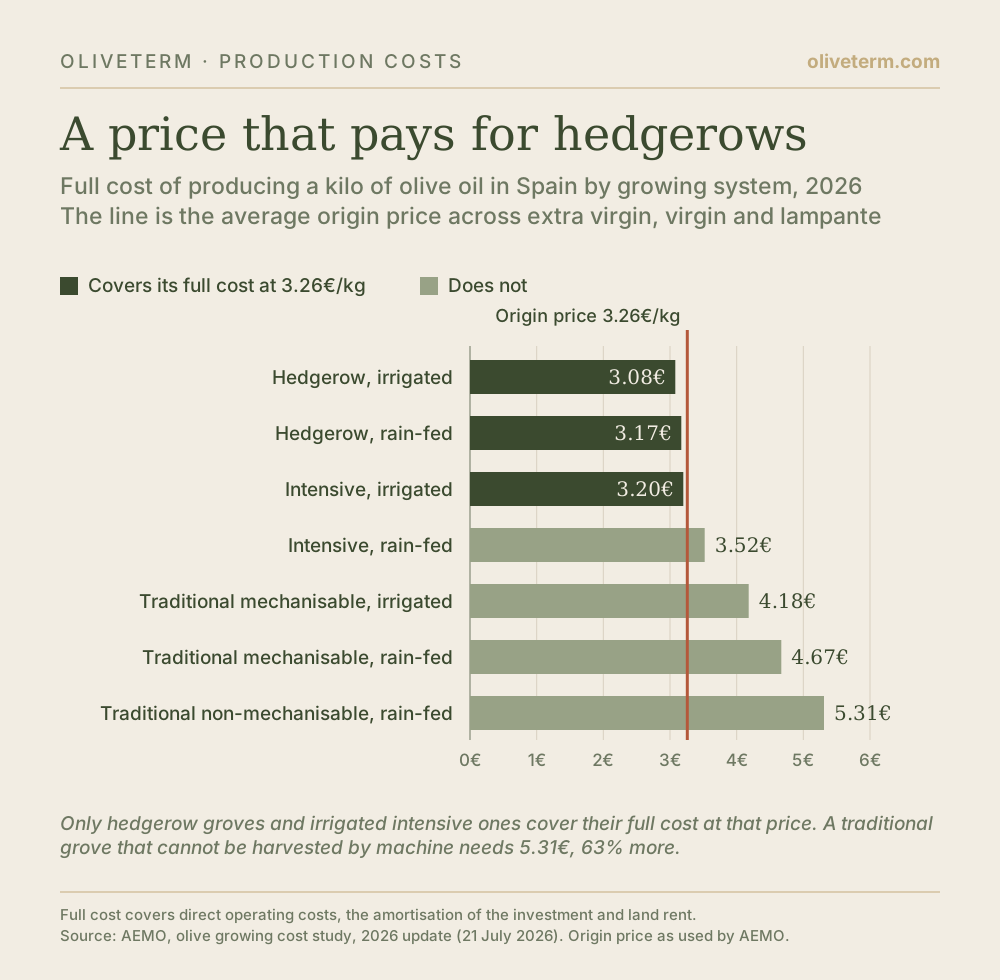
The oil is finding buyers, but at a price that pays for hedgerow groves and not for traditional ones.
This is one reason why the debate about future production cannot be reduced to the number of trees being planted. What matters is also what those trees cost to operate, what yields they can reliably deliver and at what olive oil price their owners remain willing to invest further.
A prolonged period of lower prices would eventually influence new planting decisions. Projects that look attractive at higher long-term olive oil prices can look very different if market expectations fall substantially. At that point, the market begins to regulate future capacity before the trees are planted. The first capacity to go, though, is unlikely to be the newest. At prices that barely cover a hedgerow grove's costs, it is the traditional groves that stop paying, which is why low prices can speed up the move to modern systems rather than simply reduce supply.
There is no evidence yet that the world has reached its limit
It would be premature to conclude that olive oil is approaching saturation.
The long-term consumption record suggests the opposite. The category has expanded far beyond its Mediterranean base, and the IOC's December figures still show consumption growing outside its traditional markets. Countries outside the IOC's membership, among them the United States, Brazil, Japan and China, consumed an estimated 1.036 million tonnes in 2024/25, up 19% on the previous campaign.
What deserves more attention is the sequence in which that growth occurs.
Olive oil production is no longer expanding only through gradual increases in traditional groves. New agricultural systems can add meaningful volumes once they reach maturity, and investment decisions made across several countries accumulate into a global productive base that is larger than any single project suggests.
New demand builds more gradually. It may ultimately absorb everything the industry can produce, but periods in which supply moves ahead of consumption are entirely plausible. When that happens, price becomes the bridge between the two.
That is not necessarily a crisis. Lower prices can open markets that high prices keep closed and can encourage existing consumers to use olive oil more frequently. Over time, that process may be exactly what allows a larger industry to find a larger audience.
But it also means that planting decisions cannot be separated from assumptions about future demand. The fact that the world is capable of consuming more olive oil does not mean that every additional litre will be absorbed at the price producers would prefer.
The next test
For several decades the olive oil industry has shown that it can grow its output. The area under olive trees has expanded, productivity has improved and modern farming systems have pushed potential output higher. At the same time, consumption has spread into countries that once played little role in the market.
The next test is whether those two trends continue to move together.
There may be enough consumers in the world for considerably more olive oil. The harder part is creating them before the new trees reach full production.
Sources
- International Olive Council: World olive oil figures (world production and consumption by crop year since 1990/91, and consumption by group of countries; December 2025 update)
- International Olive Council: Olive sector statistics, December 2025 and forecasts (production and consumption in 2024/25 and 2025/26; consumption in countries outside the IOC)
- International Olive Council: Olive sector statistics, January/February 2026 (long-term consumption growth, the 2024/25 recovery and the EU's share of world consumption)
- GPP: Panorama dos números do olival e azeite (world olive area from FAO data, the Mediterranean's share, and Portugal's hedgerow groves in the 2019 agricultural census)
- GPP: Cultivar No. 35, English edition (Portugal's olive area in 2025)
- FAO: FAOSTAT, crops and livestock products (world olive area by year, for the three-year averages)
- ASAJA Jaén: AEMO actualiza su Estudio de Costes del Cultivo del Olivo (AEMO's 2026 full cost per kilo of oil by growing system and its 3.26€/kg reference price)
Three-campaign averages, the balance between production and consumption and the shares of consumption growth are OliveTerm calculations from IOC and FAO figures.