

The industry has spent decades learning how to produce more olive oil. The next 500,000 tonnes of demand will not come from the world's biggest populations, but from households that can already afford to buy it.
The olive oil industry has spent decades learning how to produce more. New orchards, irrigation, mechanisation and the spread of intensive growing have raised the volume a normal crop year can put on the market. The harder question now sits on the other side of the ledger: can consumption keep pace?
Global consumption is estimated at 3.248 million tonnes for 2025/26, according to the International Olive Council. Adding another 500,000 tonnes would take the market to roughly 3.75 million tonnes, about 15% above today's level. That is a big number, but not a fantastical one over a long enough horizon; global consumption has almost doubled since 1990/91. What has become genuinely difficult is saying where the growth will come from.
It will not come from the traditional heartland. The European Union accounted for just over 70% of world consumption in 2004/05; its share has since fallen to around 45%, and per-capita consumption in Spain, Italy and Greece is already among the highest anywhere. The countries that built the olive oil market are, in relative terms, shrinking within it.
The instinctive next move is to reach for a map of the world's largest populations: Brazil's 213 million people, or the billion-plus each in China and India, where even tiny per-capita increases multiply into enormous volumes. The arithmetic is seductive but misleading: what matters is not headcount but how many households can actually afford olive oil, find it on a shelf, know what to do with it, and choose it over cheaper oils they already cook with every day. On that measure, the industry's biggest theoretical markets are not necessarily its best growth markets.
The United States remains the obvious starting point
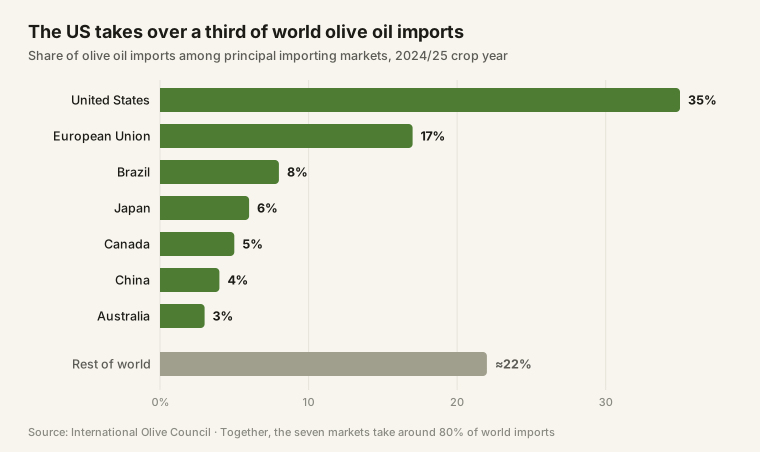
Any serious discussion of future demand starts in the United States, and not because of its population. The US accounts for roughly 35% of imports among the principal importing markets tracked by the IOC, by far the largest single share, and it already has what every emerging market lacks: supermarket distribution, restaurant usage, established brands, importers, and tens of millions of households for whom olive oil is a normal purchase.
That existing base changes the economics of growth. Persuading a household that already buys olive oil to buy one more bottle a year is a much cheaper proposition than creating a consumption habit from nothing, and when a market already measured in hundreds of thousands of tonnes shifts structurally by 10 or 20%, the added volume is enormous. An extra 50,000 or 100,000 tonnes of American demand requires no revolution in culinary culture, just modest movement across a very large installed base.
The recent data urge some caution. The IOC reported that US purchases fell 1.6% in the first three months of 2025/26, making the country an exception to the increases recorded across most major importing markets in the same window. A single soft quarter does not undo the structural case, but it is a reminder that American growth cannot simply be pencilled in.
Brazil shows why population can be deceptive
Brazil looks, on paper, like one of the industry's great opportunities. It imported 80,768 tonnes in the 2024/25 crop year, and shipments jumped 40.5% in the first six months of 2025/26 compared with the same period a year earlier. Those figures deserve attention, and careful handling.
Note what happened just before the jump: Brazilian imports in 2024/25 actually slipped 0.5% from the previous year. A market that dips one campaign and surges 40% the next is not steadily expanding; it is responding to prices, exchange rates and household budgets. Brazilian demand has always behaved this way.
The constraint is affordability. Brazil's GDP per capita was about US$10,700 in 2025, and for a large share of its 213 million people olive oil is an expensive imported fat competing with much cheaper soybean and sunflower oil. Crucially, nobody has to buy it: a household under pressure keeps cooking, just with a cheaper oil, reserving olive oil for particular uses or dropping it entirely. The addressable market is therefore far smaller than the population suggests, and doubling it, from roughly 80,000 tonnes to 160,000, would take more than marketing. It would take a substantially larger middle class.
Brazil will contribute to the next 500,000 tonnes. It is unlikely to be the answer to them.
China: an option, not a base case
China stretches the same logic further. No olive oil conference is complete without the calculation that a spoonful per Chinese consumer would transform global demand, and mathematically that is unarguable. Commercially, the record says otherwise: after years of anticipation, China represents around 4% of imports among the major markets the IOC tracks, against 35% for the United States.
Access to consumers is not the bottleneck; the bottleneck is giving olive oil a role in kitchens organised around wok cooking, familiar flavours and deeply embedded fats. Rising incomes alone have not done it, because price is only one of the obstacles; cooking methods, taste, distribution and understanding all have to move too. China may yet reshape world consumption, and even modest per-capita usage would create serious volume, but the timing has resisted every forecast made so far. For market analysis, China is best treated as a long-dated option on demand, not as a base-case assumption.
India is a longer-term proposition still
If China tempts forecasters into population arithmetic, India practically demands it: now the world's most populous country, with a growing middle class and a vast edible-oils market. Yet olive oil remains a rounding error in the Indian fats market, and India does not appear among the seven markets the IOC identifies as covering roughly 80% of world imports: the United States, the European Union, Brazil, Japan, Canada, China and Australia.
The gap between those two facts is the point. A market that could eventually consume enormous quantities and a market that can absorb meaningful additional supply today are different things, and conflating them has led the industry astray before. Even strong growth from India's current base would barely register in the global balance for years, because olive oil there competes against oils that are cheaper, familiar and woven into regional cuisines.
Smaller wealthy markets punch above their weight
If population predicts demand poorly, the industry should be paying more attention to markets it usually treats as footnotes.
Australia imported 42,272 tonnes in 2024/25, up 46% on the previous crop year, and grew another 12.5% in the first three months of 2025/26. It will never consume hundreds of thousands of tonnes; its population is too small. But it combines high purchasing power, modern grocery retail, a food culture already comfortable with Mediterranean cooking, and a domestic olive industry that keeps the category visible. Canada offers a similar profile, Japan has a mature imported-oil market, and Northern Europe pairs high incomes with per-capita consumption well below Mediterranean levels.
An extra 10,000 tonnes in each of ten such markets does exactly what an extra 100,000 tonnes in one giant market would do to the global balance, and the portfolio version is considerably more plausible than betting everything on a single breakthrough.
Eastern Europe: slow, unglamorous, durable
Europe itself still contains a growth market, because Europe is not economically or culturally uniform. Consumption across much of Central and Eastern Europe remains far below the Mediterranean, and as incomes converge and Mediterranean food keeps spreading through everyday diets, olive oil can win share of the cooking-fat budget without the cultural leap required in Asia. Poland, Czechia and Romania will not suddenly behave like Spain, and no single year will look spectacular; but a decade of small annual gains across a dozen countries adds up, and these markets sit next door to the world's dominant production region, with none of the logistical friction of Latin America or Asia. If olive oil becomes a broadly European habit rather than a narrowly Mediterranean one, the volume becomes meaningful.
The Middle East, and the value of wealthy households
The Middle East resists treatment as a single market: some countries have olive oil cultures and production going back millennia, while the higher-income Gulf states combine strong purchasing power, large expatriate populations and sophisticated food retail. Their populations are small next to Brazil or India, but affordability, the binding constraint everywhere else, barely applies to a significant share of their consumers. The wider lesson generalises: ten million households that can comfortably afford olive oil are often worth more to this industry than a hundred million for whom it is a luxury. Demand analysis has to weigh spending power alongside headcount.
Producing countries can also consume more
One further source of demand tends to be overlooked because it never crosses a border. The IOC's long-term data show that consumption growth outside the EU has been supported partly by other IOC member countries, including producers. As industries develop in Türkiye, North Africa and the eastern Mediterranean, local availability builds distribution, local brands and consumer familiarity, and some of the new production gets absorbed at home. A tonne consumed in a producing country balances the market exactly as well as a tonne shipped to New Jersey, and as production diversifies geographically, this domestic absorption may matter more each year.
Price remains the biggest variable
None of this can be separated from price, and the most recent campaign is the proof. The IOC estimates that consumption rebounded to 3.215 million tonnes in 2024/25, an increase of 426,500 tonnes, or 15.3%, as supply recovered and prices came down from historic highs. Growth is then expected to slow to about 1% in 2025/26, reaching 3.248 million tonnes.
That 426,500-tonne rebound is almost exactly the volume this article has been discussing, which makes it tempting to read as proof that demand can be conjured quickly. It should be read the other way around. Most of it was not new demand but returning demand: consumers who had cut back during the price spike, coming back when olive oil became affordable again. Temporary recovery helps clear a big crop; structural growth changes the size of the market permanently. The industry's real task is the second one: building markets where consumption holds when prices rise again, not merely when they fall.
The next 500,000 tonnes will probably come from everywhere
There is no new country waiting to become the next United States. The next half-million tonnes are more likely to accumulate across a portfolio: the US remains the strongest single candidate, combining scale, purchasing power and an established habit; Brazil keeps growing in its volatile, price-sensitive way; Australia, Canada, Japan and Northern Europe add smaller but economically solid volumes; Eastern Europe compounds slowly; the Gulf contributes pockets of high-income demand; and producing countries absorb more of their own output. China and India remain the industry's great demographic possibilities, and remain unproven as foundations for any forecast.
The realistic conclusion is less spectacular than the population arithmetic, but more useful. The next 500,000 tonnes will come not from the world's biggest populations but from households that already have the income, the distribution and the culinary context to make olive oil a regular purchase. That is the difference between market potential and market demand, and for an industry now capable of producing well over three million tonnes in a normal campaign, it is the distinction that will matter most. Orchards can be planted and mills expanded on a known schedule.
Consumers are harder to build.
Sources
- International Olive Council: Olive sector statistics, January/February 2026 (world consumption 2024/25 and 2025/26 estimates; US imports in early 2025/26)
- International Olive Council: Olive sector statistics, June/July 2026 (Brazil imports 2024/25 and first half of 2025/26)
- International Olive Council: Olive sector statistics, April 2026 (Australia imports 2024/25 and early 2025/26)
- International Olive Council: World trade in olive oil and table olives (import shares of the seven principal markets)
- International Olive Council: Consumption up everywhere but EU (EU share of world consumption since 2004/05; long-term growth since 1990/91)
- IMF World Economic Outlook / World Bank (Brazil GDP per capita, 2025)