

Information available at 30 September 2026. Prices in €/kg; balance quantities in thousand tonnes (kt), unless otherwise stated.
September ended with a clearer prospect of a larger Spanish harvest, but limited evidence that sales were accelerating enough to absorb it comfortably. The Andalusian forecast gives buyers a stronger reason to expect more oil over the coming months. For producers, it leaves a more difficult question: whether additional volume will compensate for lower prices and the cost of bringing the crop into the mill.
The national crop estimate and the declarations that establish Spain’s opening stocks are expected in October. Buyers will also begin receiving fresh oil, giving them a firmer basis for judging yields and quality. Until then, negotiations depend heavily on expectations of the crop still on the trees.
Andalusia’s aforo is a starting point
The Junta’s first estimate, presented on 29 September, puts Andalusian olive oil production at 1,261,200 tonnes, from 6,849,200 tonnes of milling olives. Jaén and Córdoba account for nearly three-quarters of the projected oil, giving conditions in those two provinces considerable influence over the regional result. [2]
| Province | Forecast oil production, kt |
|---|---|
| Jaén | 575.0 |
| Córdoba | 339.7 |
| Seville | 142.0 |
| Granada | 106.7 |
| Málaga | 59.4 |
| Cádiz | 14.6 |
| Huelva | 12.8 |
| Almería | 11.0 |
| Andalusia | 1,261.2 |
Source: Junta de Andalucía, aforo for 2026/27, presented on 29 September. All quantities refer to olive oil. The Junta’s document puts the regional forecast 29.3% above the previous campaign’s final production of 975.5 kt; agency reports of the presentation gave 23.9%, a figure the document does not support. [2]
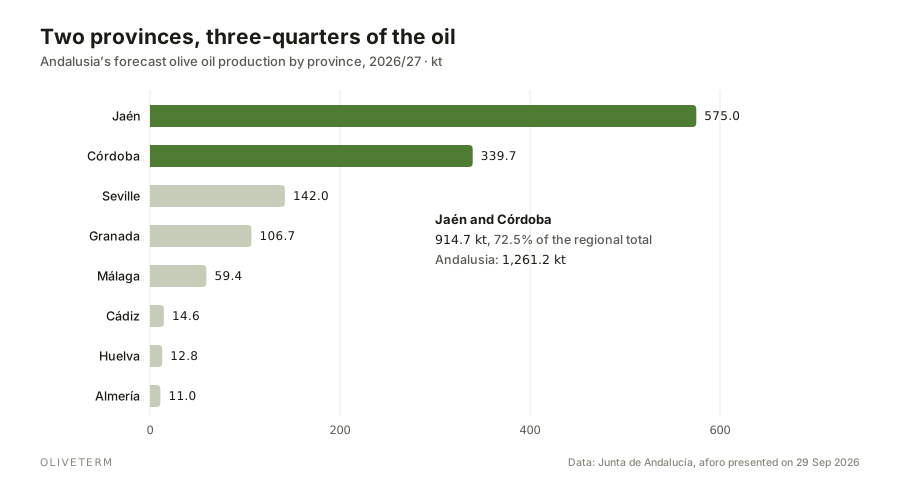
Figure 1. Jaén and Córdoba together account for 72.5% of the regional forecast. Source: Junta de Andalucía aforo, 29 September.
Winter rainfall supported the development of the crop, while subsequent heat constrained its potential. ASAJA Córdoba warns that continued dryness during oil accumulation could reduce extraction yields. The organisation estimates that a three-percentage-point fall in oil yield would reduce Córdoba’s output by around 60,000 tonnes. Such a change in one province would materially alter the regional forecast. [3]
Growers must now weigh further oil accumulation against labour availability, harvest weather and the quality they intend to produce. Rain before picking may improve the outcome, while prolonged dryness could leave a sizeable fruit crop delivering less oil than expected. OliveTerm uses a provisional Spanish production range of 1.5–1.6 million tonnes, pending MAPA’s national estimate.
The regional aforo implies an average oil yield of around 18.4%. At the forecast fruit volume, a one-percentage-point change in that yield would alter oil production by approximately 68.5 kt, according to OliveTerm’s calculation. That is more than half the 100 kt span of the Spanish working range, indicating how much the remaining oil accumulation can matter to the national volume ultimately offered to buyers.
Prices eased before the harvest was measured
OliveTerm’s Spanish extra virgin estimate stood at 3.35€/kg on 29 September, with virgin at 3.15€/kg and lampante at 2.98€/kg. Every tracked origin edged lower in the last week of September, by one to three cents. Italy retained a substantial premium, while Portugal, Greece and Tunisia traded closer to the Spanish benchmark. [1]
| Origin and category | OliveTerm estimate, 29 September | Change since 21 September |
|---|---|---|
| Spain, extra virgin | 3.35€ | −0.02€ |
| Spain, virgin | 3.15€ | −0.02€ |
| Spain, lampante | 2.98€ | −0.02€ |
| Italy, extra virgin | 4.76€ | −0.01€ |
| Portugal, extra virgin | 3.63€ | −0.02€ |
| Greece, extra virgin | 3.52€ | −0.02€ |
| Tunisia, extra virgin | 3.65€ | −0.03€ |
Source: OliveTerm origin-price board, estimates dated 29 September, compared with the board of 21 September. [1]
The official reference moved even less. The European Commission’s weekly price for extra virgin in Jaén held between 3.41€ and 3.43€/kg in the three weeks to 20 September; the week of the aforo has not yet been published. [1]
Spanish extra virgin carried a 0.37€/kg premium over lampante, while Italy’s extra virgin quotation was 1.41€/kg above Spain’s. The drift lower is consistent with buyers anticipating more supply, alongside the influence of existing inventory and purchasing schedules. For a bottler with adequate cover, the prospect of fresh oil can make immediate buying less urgent. A producer preparing for harvest faces expenditure before most of the new oil has been sold, giving the two sides different reasons to favour or resist a quick transaction.
Reports from Córdoba describe labour shortages and higher fuel and crop-protection costs. [4] Their effect on margins will differ by grove type, mechanisation and oil yield. A higher yield can reduce the harvesting cost per kilo of oil, but a lower selling price can cancel that gain. Growers also have to fund the additional work needed to collect and process a larger fruit crop.
Spain carries more oil into the new campaign
The Junta estimates that Spain will begin 2026/27 with 374.3 kt of stocks, compared with 289.7 kt a year earlier: 84.6 kt more oil carried into the new harvest. [2] The published SIMO balance put Spanish physical stocks at 569.3 kt at the end of July [5], and AICA’s provisional figures put them at 475.4 kt at the end of August. [14] The Junta’s estimate therefore implies roughly 100 kt leaving storage, net of imports, during September; the September declarations will confirm the closing inventory.
Spain’s provisional SIMO figures show a recovery from the drought-affected campaigns, alongside a slowdown against the preceding season. Through July, 2025/26 total market sales reached 1,238.5 kt, comprising exports of 833.4 kt and an apparent domestic market of 405.1 kt. The combined total was 3.6% below the same period a year earlier, although 8.2% above the previous four-campaign average. Exports were down 4.2% year on year and the apparent domestic market was down 2.4%. [5]
Exports accounted for roughly two-thirds of those reported sales, leaving Spain’s ability to absorb a larger crop heavily dependent on overseas orders. Lower prices may encourage purchases, but bottlers’ existing cover and the pace of sales through their distribution networks will influence when they return to the bulk market. The published figures give little evidence so far of buying accelerating towards a new high.
A bigger harvest needs stronger sales
A larger Spanish crop would give buyers more choice and make oil easier to source. For growers and mills, the benefit depends on selling that extra oil at a price that covers their costs. If buying remains slow, more oil will stay in storage and producers needing money for the harvest may have to accept lower offers.
The published Spanish sales figures through July were running below last year’s pace. [5] There is room for a recovery towards the stronger annual volumes seen in earlier campaigns, [6] especially if lower prices encourage households and food businesses to use more olive oil. More overseas buying would also help Spanish producers find a market for the new crop.
A better Spanish harvest could reduce the need to buy oil from other producing countries, easing some of the pressure within Spain. Bottlers may still buy abroad where prices or particular qualities suit their needs. The balance will depend on how quickly buyers increase their purchases and how much oil producers can afford to keep in storage.
Mediterranean supply is moving at different speeds
Portugal and Greece are preparing for recovery, while Tunisia’s producers’ chamber describes a smaller crop after a record season. Turkey’s earlier outlook points towards an increase, and Italy retains a higher origin price alongside concerns about existing inventory.
| Country | 2026/27 production outlook, kt | Source and date | Status |
|---|---|---|---|
| Portugal | Around 177 | Olivum, reported by Lusa, 23 September | Preliminary industry estimate |
| Greece | 280–330; around 300 commonly cited | Greek industry representatives, reported 21 September | Preliminary sector outlook |
| Tunisia | Around 300 | National producers’ chamber, reported 3 September | Industry estimate |
| Italy | 240–260 | OliveTerm range based on Federolio’s expected decline, 28 September | Indicative range |
| Turkey | 400 | USDA/FAS Ankara, 9 March | Early forecast |
Sources: Portugal [7], Greece [8], Tunisia [9], Italy [13], Turkey [10]. The estimates come from different organisations and dates. Turkey uses a November-start marketing year.
Olivum expects Portuguese production to approach the approximately 177 kt associated with 2024/25, following its estimate of 160 kt for 2025/26. The association also reports earlier maturity under high temperatures, potentially bringing some harvesting forward. [7] Greek industry estimates range from 280 kt to 330 kt, with approximately 300 kt widely cited. [8] A recovery in both countries would bring more fresh oil to buyers also considering the Spanish crop. Earlier Portuguese harvesting could affect the sequence in which that supply reaches the market, while Spain’s lower quotation provides a nearby benchmark for bulk negotiations.
Tunisia’s producers’ chamber expects approximately 300 kt against last season’s record 500 kt, attributing the decline to alternate bearing. [9] If realised, that fall would offset part of the increase expected elsewhere. Turkey’s early March FAS post outlook points in the other direction, forecasting production of 400 kt for 2026/27, alongside domestic consumption of 320 kt and exports of 90 kt. [10] The Tunisian estimate concerns the new crop; oil carried forward also enters its export supply. Turkey’s figures remain an early forecast for a marketing year beginning in November.
Italy requested EU agricultural-reserve support in September, citing approximately 233 kt held in the country in July, against 162 kt a year earlier. These stocks include oil from different origins. Commissioner Christophe Hansen said reserve support should be a last resort. [11] Financing that inventory while meeting the costs of another harvest can leave operators short of cash. Italy’s premium over Spain may support the value of some parcels, but it does not remove the expense of carrying unsold oil.
India offers a longer-term trade opening
The EU-India agreement advanced on 11 September when the Commission proposed Council authorisation for signature and conclusion, following the completion of negotiations in January. Its negotiated provisions would remove Indian olive oil tariffs of up to 45%, either at entry into force or over a five-year staging period. [12] The September step concerns approval of the agreement; tariff reductions remain prospective. For exporters, implementation would create room to reach new buyers, although translating access into orders would also require suitable pricing and distribution. India’s eventual contribution to demand will depend on those commercial arrangements as well as the tariff timetable.
October will test yields and the pace of buying
| Conditions through October–December | Likely effect on the market |
|---|---|
| Lower yields and stronger sales: extraction results reduce the expected crop while domestic sales and exports improve. | Less oil accumulates in stock, easing pressure on sellers and supporting firmer origin prices. |
| The crop broadly follows the working range: Spanish production reaches 1.5–1.6 million tonnes and sales improve gradually. | A larger volume reaches the market; the pace of buying determines whether harvest pressure eases as the campaign progresses. |
| More oil and slower sales: stronger yields or larger crops coincide with limited demand growth. | Stocks accumulate faster, and producers needing cash face greater pressure to accept lower prices. |
Conditional scenarios, not production or price forecasts.
Monthly Spanish sales will show whether buying is keeping pace with new production. A sustained improvement in domestic sales and exports would support the view that lower prices are helping absorption. During the harvest, weather can also interrupt deliveries or bring more oil to market at once, changing the volume buyers are offered before the annual balance is settled.
| Timing | Information to watch | What it clarifies |
|---|---|---|
| Early October, expected | MAPA national crop estimate | Spain’s production outlook and its regional breakdown |
| Mid-October, expected | AICA September declarations | Actual carry-over and the updated 2025/26 campaign balance |
| By 31 October, expected | Spain’s 2026/27 marketing standard | Whether mills can be required to keep part of the crop off the market in a surplus year; any decision to apply it is due by 15 November [15] |
| October onward, locally variable | First mill returns in Spain, Portugal and Greece | Extraction yields, quality and the pace of new supply |
| Monthly through the campaign | Spanish domestic sales, exports and imports | Whether demand and sourcing are keeping pace with the harvest |
Mills needing cash for the harvest will have less room to wait if sales remain slow. That could give buyers with adequate cover more time to negotiate, even while the final size of the crop is uncertain. Producers’ bargaining position will depend on their ability to hold oil as well as on the amount they produce.
Methodology
OliveTerm prices are origin estimates dated 29 September. Individual transactions vary by specification, quality and delivery terms; the changes shown cover the last week of September and do not measure the full September return. Spanish market data use MAPA/SIMO reporting; “sales” means apparent domestic market plus exports, including oil entering other countries’ bottling and distribution systems. The Spanish campaign runs from October to September.
Early mill yields vary by location and picking date and cannot, on their own, establish the result for a province.
Sources
- OliveTerm origin-price board and price methodology, estimates dated 21 and 29 September; European Commission Agri-food Data Portal, weekly olive oil prices for Jaén, to the week ending 20 September.
- Junta de Andalucía: aforo of the olive crop, 2026/27, presented on 29 September, from the Junta’s aforo index, including its estimate of Spanish opening stocks; Europa Press reporting of the regional presentation, 29 September.
- ASAJA Córdoba’s response, reported by Europa Press, 29 September.
- Cordópolis: provincial forecasts, carry-over and costs, 29 September.
- MAPA/SIMO monthly market report, data to 31 July 2026, hosted by Cooperativas Agro-alimentarias.
- MAPA definitive Spanish balances: 2024/25 and 2021/22.
- Lusa/Observador: Olivum’s Portuguese outlook, 23 September.
- Greek City Times: Greek industry crop expectations, 21 September.
- Gnet: Tunisian producers’ chamber estimate, 3 September.
- USDA/FAS Ankara, Oilseeds and Products Annual, TU2026-0009, 9 March, olive oil assessment.
- Council of the EU: Italian agricultural-reserve submission, 25 September, and ANSA: Hansen’s response, 28 September.
- European Commission: EU-India agreement and September procedural update and negotiated tariff provisions.
- OliveTerm: 28 September week ahead, including the Italian crop range based on Federolio’s expected decline.
- MAPA: AICA production, movement and stock data, provisional figures to 31 August 2026.
- MAPA: draft marketing standard for 2026/27, July 2026, articles 4, 5 and 9.