

China has 1.4 billion people and buys about 53,000 tonnes of olive oil a year. The gap between those two numbers says more about how food habits work than any marketing plan could.
When OliveTerm recently asked where the next 500,000 tonnes of global olive oil demand could come from, no country made the arithmetic look better than China. With more than 1.4 billion people, even a tiny increase in consumption per person would move the global market. The reality is stubbornly different: the International Olive Council puts Chinese consumption at around 53,000 tonnes a year, roughly 1.6% of the 3.25 million tonnes the world is expected to consume in 2025/26.
That gap between theoretical potential and actual demand has persisted for years, and it keeps China permanently on conference slides about the industry's future. The demographic opportunity is obvious; turning that population into habitual consumers has proved anything but. The main obstacle may be simple: olive oil entered China as an imported premium product, and it has largely stayed one. It never became a fat people cook with every day.
Entering an already established market
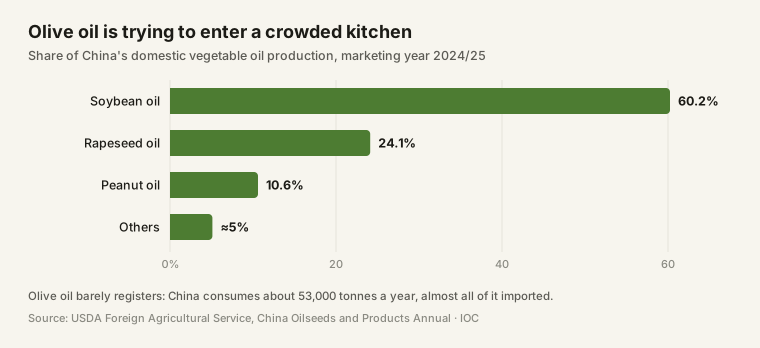
China was never an empty cooking-oil market waiting for a new product. Its food system already runs on enormous quantities of vegetable oil: soybean oil alone accounts for around 60% of domestic vegetable oil production, according to USDA estimates for the 2024/25 marketing year, with rapeseed oil at roughly 24% and peanut oil around 11%. Olive oil is therefore not being asked to fill an empty niche; it is being asked to displace oils that are available at scale, generally cheaper, and woven into the way families already cook.
Switching from one brand of olive oil to another is an easy consumer decision. Switching the oil a kitchen runs on is a different order of change, because cooking habits are built through families, recipes, availability and years of repetition. The Mediterranean proves the point in reverse: consumption is exceptionally high precisely where olive oil has been part of everyday food culture for generations. Expecting the same process to run quickly, in the opposite direction, in a country with entirely different culinary traditions was always ambitious.
Premium positioning created value, but limited volume
Olive oil's identity in China as an imported, healthy, relatively premium product is not a failure. It introduced the category, supports better margins and gives olive oil a clear identity next to commodity oils on the shelf. The problem is that the same positioning sets a ceiling: a product associated with health, gifting and specific dishes can build a profitable niche without ever becoming a mass-market cooking fat, and for the global olive oil balance the difference between those two outcomes is enormous. A consumer buying one small bottle occasionally contributes very little volume; a household cooking with olive oil routinely contributes many times more over a year.
Spread across the whole population, China's 53,000 tonnes work out to a few dozen grams per person. Consumption is not actually spread that way, of course: a smaller group of urban, higher-income households consumes substantially more, while much of the country consumes virtually none. That concentration is precisely the diagnosis. Olive oil has found consumers in China; it has not yet found the Chinese kitchen.
Price matters
Rising prices make all of the above harder. In producing countries, many households treat olive oil as close to essential and absorb increases within limits. Chinese households face no such constraint: with familiar substitutes on every shelf, a consumer without an established habit has little reason to pay significantly more for a product used occasionally. Emerging demand of this kind is therefore more fragile than demand in mature Mediterranean markets, and the lesson extends well beyond China: demographics identify theoretical potential, but effective demand depends on purchasing power, relative prices, distribution and habit. China is simply the clearest illustration of the difference.
The long-term opportunity has not disappeared
None of this argues for writing China off. The market is small but moving: the IOC's 53,000-tonne estimate for 2025/26 is itself a 28% increase on the previous crop year. A market of that size does not need to become Mediterranean to matter; doubling it would add roughly 50,000 tonnes of global demand, and a move towards 150,000 or 200,000 tonnes would materially change international trade. Unlike a genuinely undeveloped market, China already has import channels, brands, retailers and consumers familiar with the product, and the IOC continues to identify it as a potential growth market.
Some Chinese consumers already buy olive oil, so the real question is whether usage can move from occasional to habitual. That shift tends to be generational rather than promotional: food habits change as incomes rise, international cuisines become familiar and imported products slowly find uses inside local cooking rather than arriving alongside it. The industry has often looked at China's 1.4 billion people and seen an enormous market waiting to happen. The more realistic reading is an enormous market that still has to be built, and building it will be slow.
It is also why, if Chinese consumption ever does start to move meaningfully, the global olive oil balance will feel it.
Sources
- International Olive Council: Olive sector statistics, January/February 2026 (China consumption 2025/26 and year-on-year change; world consumption estimate)
- USDA Foreign Agricultural Service: China Oilseeds and Products Annual (soybean, rapeseed and peanut oil shares of domestic vegetable oil production, MY 2024/25)
- OliveTerm: Where Will the Next 500,000 Tonnes of Olive Oil Demand Come From?