

At the end of April 2026, Spain held 863,338 tonnes of olive oil. The distribution of that stock reveals an industry carrying substantial financial risk while lacking most of the instruments used to manage it elsewhere.
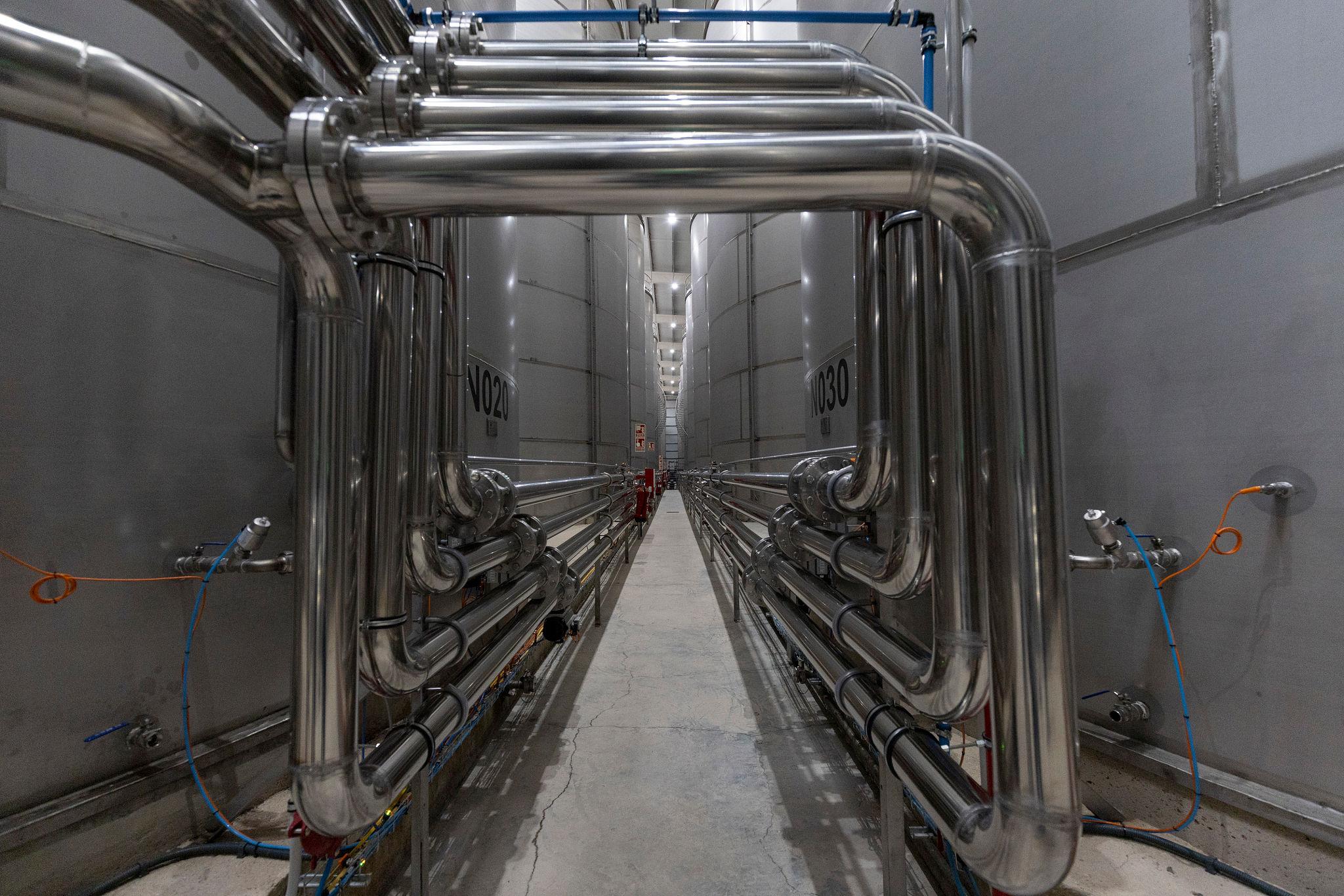
Industrial olive oil storage facilities. Photo: © Acesur
Of that total, 600,269 tonnes sat with cooperatives and mills, compared with 254,325 tonnes held by packers and 8,744 tonnes at the Patrimonio Comunal Olivarero. Almost seven in every ten tonnes were therefore held at the production end of the chain, where access to capital and treasury expertise varies widely and is often more limited than among the largest bottlers. The location matters because a decision to retain oil affects financing costs, cooperative reserves and, in many cases, the final amount paid to growers. If a cooperative rejects an offer of 4.20€/kg because it expects to sell later at 5.00€/kg, it has taken a view on the market. The oil remains inside a physical tank, but the decision is financial.
Stock held at mills is not automatically speculative. Cooperatives need working inventories, commercial groups must fulfil supply agreements, and different qualities have to be separated and sold throughout the year. Storage is a normal part of the olive oil business. The distinction appears when oil is held beyond immediate operational requirements mainly because managers expect a higher price. At that point, storage and price exposure become inseparable. A rising market rewards the decision, while a falling market reduces the value of the oil and the eventual settlement available to members. When the stock is financed through a working-capital facility, interest continues to accumulate in either direction.
The sector uses a different vocabulary. It speaks of retention, price defence and the orderly release of supply. Those terms often describe legitimate commercial objectives, but they can also obscure the economic substance of the decision. A balance sheet sees inventory, financing costs, quality risk and an uncertain selling price. Taken together, those elements amount to a long position in olive oil. Financialisation in this case has not arrived through investment funds or outside speculators. It has developed quietly inside the ordinary management of stocks, credit lines and producer settlements.
The risk inside the tank
In a common cooperative model, the mill receives fruit from its members, processes it and advances part of the expected settlement before all the resulting oil has been sold. The final amount owed to growers depends on later sales, while the cooperative uses working capital to fund advances and operating expenses. Every additional week of storage leaves the business exposed to the market value of unsold oil and adds to the cost of financing it. Proper storage can protect quality for a considerable period, but it cannot remove the cost of time or the possibility that the market will move against the holder before the oil is sold.
Other commodity industries can separate the decision to produce or hold an asset from the decision to remain exposed to its price. A copper producer can sell futures on the London Metal Exchange against expected output. Some gold miners sell part of their future production forward or use options to establish a minimum price. Grain farmers and coffee exporters apply the same principle through their own benchmark contracts. Production continues, inventories are held and customers are supplied, while the financial position offsets part of the loss if market prices fall. That protection has a cost and can reduce the benefit of a price rise. Its purpose is to make cash flow, debt service and investment less dependent on the price available on a particular day.
Olive oil has no liquid equivalent. A mill holding oil in tank therefore combines two decisions that mature commodity markets can keep separate: when to sell the physical product and how much price risk to carry while waiting. A hedge would still leave differences between the benchmark contract and the particular quality or location of the oil, a problem known as basis risk, but it would allow the broad market exposure to be reduced. Without that option, choosing a later selling date also means accepting the full movement of the physical market until that date arrives.
Public derivatives markets impose a daily discipline on this exposure. Positions are valued every day, limits are established and cash may have to be provided when the market moves against the holder. Physical inventory does not create the same immediate signal. An economic loss can remain uncrystallised while the oil stays in storage, even as financing costs continue to rise. It eventually appears through a lower selling price, a weaker settlement to members, an impairment or a gradual reduction in cooperative reserves. By then, the connection with the original decision to retain the oil may be difficult to identify.
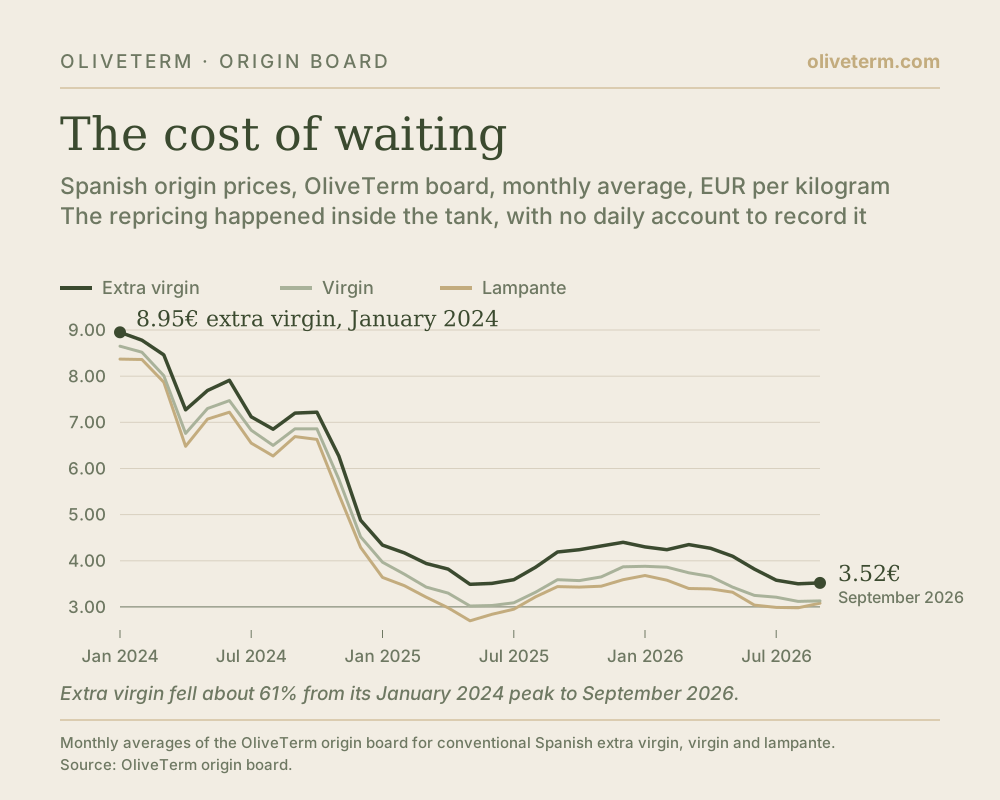
The last price cycle showed the size of that exposure. During the first five months of the 2025/26 campaign, Andalusian origin prices averaged 4.38€/kg for extra virgin, 3.74€/kg for virgin and 3.51€/kg for lampante, well below the historic levels reached in early 2024. The same repricing is visible on the OliveTerm origin board, where conventional Spanish extra virgin averaged 8.95€/kg in January 2024 and 3.52€/kg in September 2026. These averages do not reveal when each operator produced or acquired its stock, but they show the scale of the repricing that took place across the market. A business that repeatedly postponed sales during the decline absorbed a reduction in the value available from its oil while continuing to carry the associated storage and financing costs.
The wider supply position offered little reason to treat the decline as a temporary accounting issue. Spanish production for 2025/26 closed at 1,298,503 tonnes, 8.6 per cent below the previous campaign's 1,421,097 tonnes. The European Commission estimated EU production at slightly below 2.1 million tonnes, down 5 per cent year on year but still 9 per cent above the five-year average. Consumption was expected to return to around 1.4 million tonnes, while exports were forecast to rise by 6 per cent to 794,000 tonnes. Production was returning towards more normal levels and the market was functioning, but many stockholders remained unwilling to sell at prevailing prices. The difference between the available price and the price they hoped to receive extended the period for which the position had to be financed.
What the MFAO actually proves
The olive oil sector has already attempted to build the missing infrastructure. The Mercado de Futuros del Aceite de Oliva began operating in Jaén on 6 February 2004 under the supervision of the CNMV. It remains the only regulated exchange created specifically for olive oil futures. In September 2013, shareholders approved the end of its status as an official secondary market and pursued its conversion into a multilateral trading facility. Negotiations over integration with Bolsas y Mercados Españoles produced no agreement, and trading ceased on 18 November 2014. The board later moved towards liquidation, shareholders approved the dissolution in March 2016, and the CNMV subsequently revoked the market's authorisation.
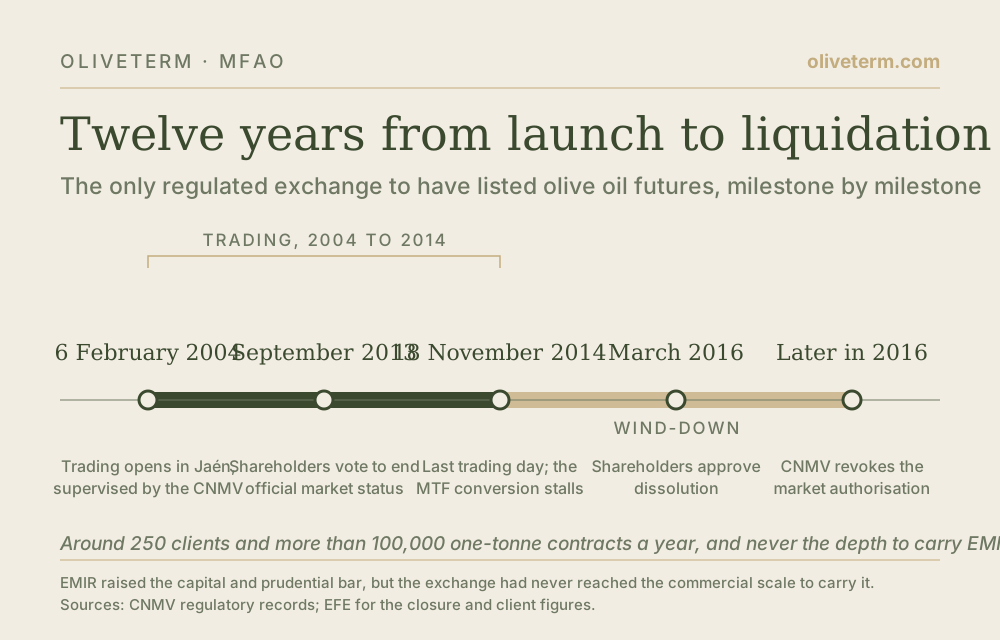
The immediate cause was the European Market Infrastructure Regulation, or EMIR. The rules introduced much heavier capital, governance and authorisation requirements for central counterparties. The MFAO was a small regional exchange operating its own clearing structure, and the cost of meeting the new requirements was out of proportion to its revenue base. Describing the closure as a regulatory event is therefore accurate, but it does not provide a complete explanation of why the venue could not survive or find a viable home inside a larger exchange group.
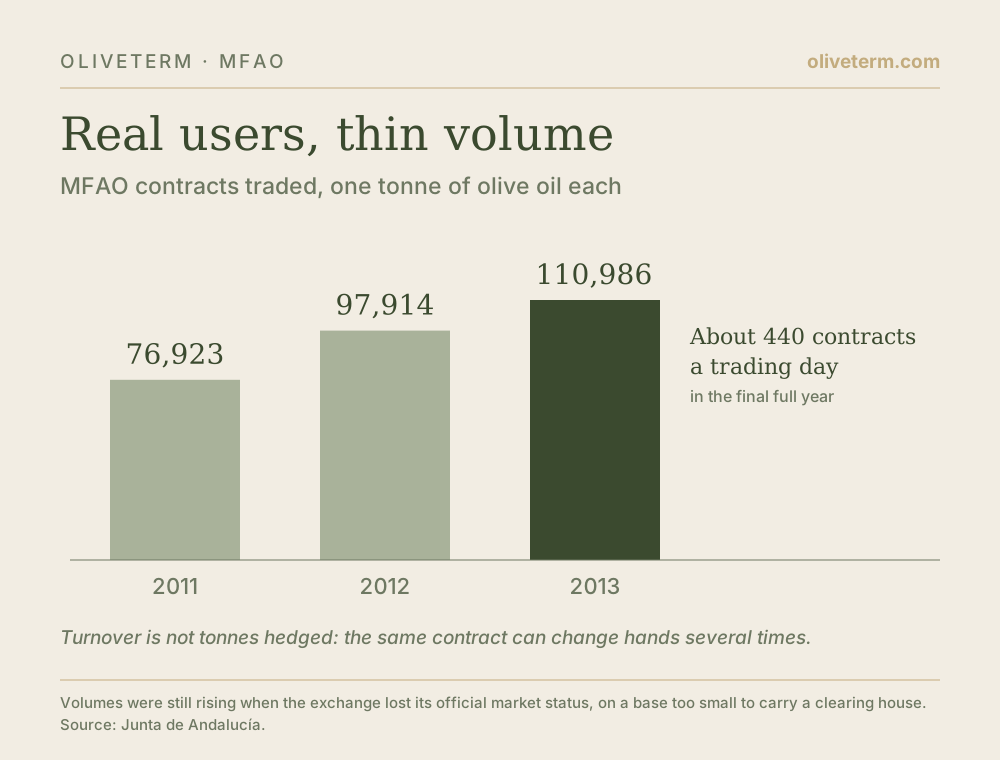
The MFAO did have activity. It recorded 110,986 contracts in 2013, up from 97,914 in 2012 and 76,923 in 2011, and reported a profit of 48,800€ after two loss-making years. Contemporary accounts of its closure said it had approximately 250 clients and an annual average of more than 100,000 contracts. Each contract represented one tonne of olive oil. Those figures establish that there were genuine users, but they also reveal the limited depth of the market. An annual total of around 111,000 contracts corresponds to roughly 440 contracts per trading day if evenly distributed, and turnover cannot be read as an equal volume of physical oil being hedged because the same contract may change hands several times.
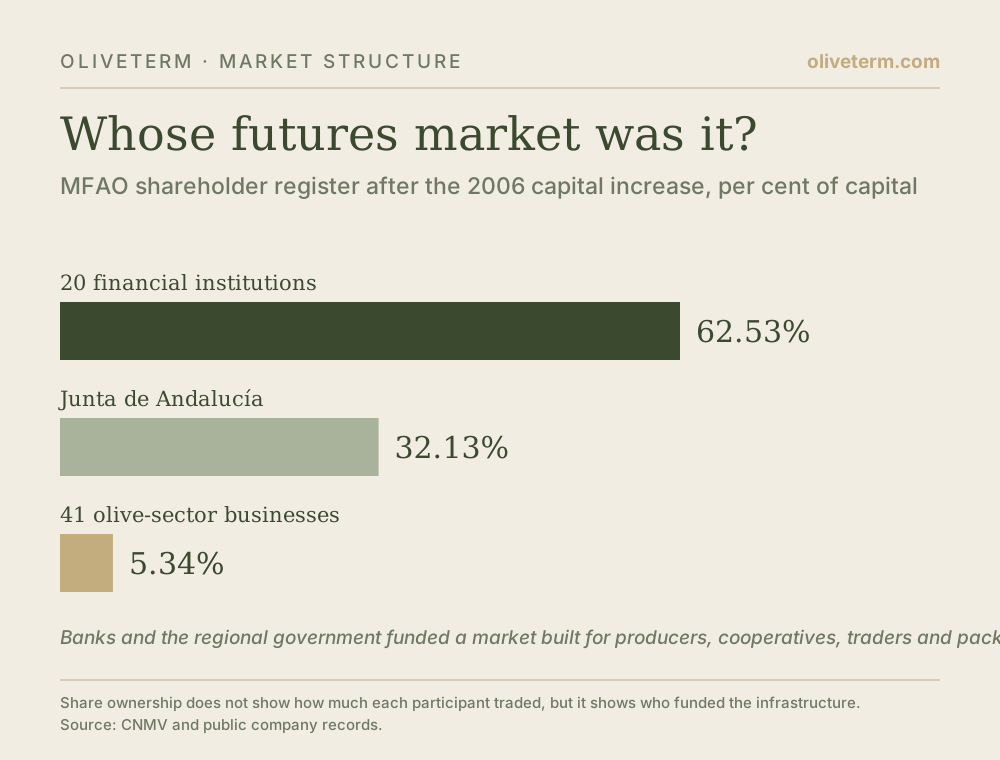
The ownership structure points in the same direction. Following the 2006 capital increase, 20 financial institutions held 62.53 per cent of the company, the Junta de Andalucía held 32.13 per cent, and 41 olive-sector businesses held a combined 5.34 per cent. Share ownership does not reveal how much each participant traded, but it does show who was prepared to commit capital to the infrastructure. Banks and the regional government financed almost the entire venue, while the industry for which it had been created supplied little more than one twentieth of its equity.
Why an olive oil contract remains difficult
Scale is the first obstacle. Global olive oil production is normally close to 3 million tonnes, while the largest vegetable-oil markets produce tens of millions of tonnes each year. A useful futures market generally needs turnover several times larger than the physical volume beneath it because participants must be able to enter and leave positions without moving the price sharply. The MFAO's annual volume was small even in relation to Spanish production. Financial investors could add liquidity, but a market dominated by speculative capital would struggle to retain the confidence of the physical businesses whose prices it was supposed to represent.
Standardisation presents a second problem. A futures contract needs a deliverable product or settlement reference that market participants regard as interchangeable. Olive oil grades are defined through chemical analysis and, for virgin categories, sensory assessment. Two oils that both qualify as extra virgin can carry very different commercial values because of origin, variety, flavour profile, traceability and customer requirements. The MFAO dealt with this by using a technical specification for bulk oil, including parameters such as acidity and wax content. That created a tradable contract, but the resulting price could not perfectly represent the higher-value extra virgin segment that provides much of the market's commercial signal.
A cash-settled contract could avoid physical delivery, but it would transfer the problem to the index used for settlement. That index would need enough verified transactions, clear rules for different qualities and regions, independent governance and protection against manipulation. Existing price references are valuable indicators of the physical market, but converting one into the settlement price for financial contracts would bring a different level of scrutiny. Any weakness in the underlying data would become a weakness in the derivative itself.
The structure of the industry also leaves an uneven need for the contract. Producers and cooperatives have a natural interest in protecting themselves against falling prices, while bottlers and other buyers may want protection against increases. The largest packers already negotiate bilateral supply agreements and may see limited advantage in moving those positions onto a transparent public order book. Producers are more fragmented, and many of the smaller businesses that would benefit from price protection have limited capacity to manage collateral, daily margin requirements and specialist treasury operations. The participants with the greatest need for a public hedge are often the least equipped to use one continuously.
Geographical concentration adds another difficulty. Andalusia can account for a large share of global output in a normal campaign, leaving a physically delivered contract exposed to disruptions or attempts to control deliverable supply. Cash settlement removes the need to deliver oil into an approved warehouse, but it increases dependence on the quality of the reference index. None of these obstacles is necessarily fatal on its own. Together, they explain why more than a decade without the MFAO has produced private commercial solutions but no credible replacement exchange.
Spain and Portugal: different balance sheets
Spain's most visible financial exposure sits in campaign stocks. Its cooperative structure places large volumes of oil in organisations that must balance the interests of members, commercial customers and lenders. Cooperative capital can be patient, but working capital has a price and a renewal date. A decision to retain oil therefore affects both the eventual producer settlement and the amount of credit the organisation needs to carry into the next campaign. The risk is concentrated in the period between production and sale.
Portugal's recent expansion has brought more irrigated intensive and super-intensive groves, larger integrated operators and, in some projects, institutional capital. The Portuguese sector cannot be reduced to that model because family businesses, cooperatives and traditional groves remain important. The narrower distinction is still useful. A greater part of the financial exposure associated with newer Portuguese projects sits in long-lived assets, establishment costs, irrigation infrastructure, debt and expected cash flows over many years. One weak campaign can be absorbed within a long investment period, while changes in financing costs or long-term assumptions can alter the economics of the entire project.
The two structures are beginning to converge. Spanish cooperatives are consolidating and professionalising their commercial operations, while larger Portuguese growers are integrating milling, storage, packaging and exports. The result is a group of operators capable of holding both productive assets and substantial inventories on the same balance sheet. These businesses have the strongest practical reason to develop sophisticated risk management, but they also have the scale to negotiate private forward contracts and tailored banking facilities. Their ability to solve the problem bilaterally reduces their incentive to finance a public market available to everyone else.
What is likely to emerge instead
The next stage of olive oil's financialisation is more likely to develop through bank balance sheets than through an exchange. Inventory facilities can use oil in approved storage as collateral, with lenders applying an advance rate that determines how much they are willing to finance against its current value. The rate can change as prices, quality, concentration or the age of the stock changes. A cooperative may therefore believe that it controls the timing of a sale while the practical limit is being set by the amount its bank is prepared to lend against the oil.
Bilateral forward contracts are also likely to become more important. A producer group and a bottler can agree today on a price or pricing formula for future delivery, potentially linked to a recognised physical-market index. This provides some of the economic function of a futures contract without requiring a public order book or clearing house. Large integrated businesses can go further by managing currency risk, interest rates and parts of their commodity exposure through related vegetable-oil markets. These proxy hedges remain imperfect because olive oil prices do not always move with other oils, but they can reduce particular risks within a wider portfolio.
These private arrangements reproduce parts of a derivatives market while leaving price discovery and access largely unchanged. A large operator can employ treasury specialists, negotiate with several banks and distribute its exposure across customers, currencies and products. A smaller cooperative remains more dependent on a single inventory, a limited number of buyers and the conditions attached to its credit line. Within the cooperative model, losses that are not absorbed by reserves will eventually influence the amount available for distribution to members.
Where this leaves the sector
A liquid, exchange-traded olive oil futures market is unlikely to emerge before 2030. A pilot contract or a small electronic venue remains possible, particularly if supported by a large exchange, but the structural conditions required for continuous two-sided liquidity have changed little since the MFAO closed. The physical market remains small, extra virgin olive oil is difficult to standardise, supply is geographically concentrated, and the operators capable of anchoring a public contract already have access to private alternatives.
The next useful reform is internal risk control. Every decision to retain stock beyond ordinary commercial requirements should include the current market value of the oil, its financing and storage costs, realistic downside scenarios, a review date and a named decision-maker. This would not require a cooperative to sell whenever prices decline. It would make the cost and ownership of the decision visible before the final settlement is calculated.
Sources: Spanish stock data from AICA figures reported by Cooperativas Agro-alimentarias de España; Spanish production data from AICA's June market balance; origin prices from the Observatorio de Precios y Mercados de la Junta de Andalucía; European figures from the European Commission's summer 2026 short-term outlook. MFAO volumes from the Junta de Andalucía, with closure and client figures from EFE and regulatory records from the CNMV. Comparative hedging references from the London Metal Exchange, World Gold Council, CME Group and ICE. The price-cycle chart uses OliveTerm origin board monthly averages for conventional Spanish extra virgin, virgin and lampante, which is our own series rather than the Andalusian panel.