

Back in July, we wrote that the slide still had not found its floor. It may have found one now, almost exactly where our base case suggested it would.
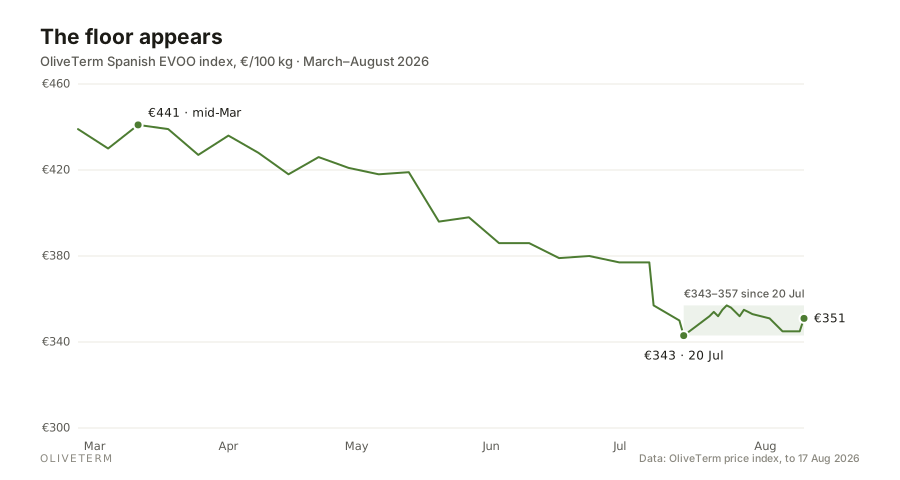
The price action is fairly straightforward. Our Spanish index peaked just above €440/100 kg in mid-March, fell steadily through the spring and reached a low of €343 on 20 July. Since then, something unusual has happened: very little. For four weeks, prices have stayed inside a narrow €343–357 range, sitting at €351 as of 17 August. A month of sideways trading does not make a new trend, but after four months in which almost every bounce was sold within days, simply seeing the market stop falling is significant.
This is not a recovery, though. AICA's July data show Spanish market outgoings of 95,266 tonnes during the month, bringing cumulative outgoings for the campaign to almost 1.17 million tonnes. The floor has therefore appeared without any obvious surge in physical demand. August is traditionally a quiet month in the Spanish market, turnover falls and many operators step back, so part of the stability probably comes from sellers becoming less willing to follow prices lower rather than from buyers suddenly returning in force.
The stock situation in Spain helps explain why that floor has been able to hold. Cumulative outgoings for the campaign reached 1.168 million tonnes by the end of July, and the oil still held by mills, packers, operators, refineries and the Fundación Patrimonio Comunal Olivarero amounted to roughly 569,000 tonnes. Based on the pace of market outgoings and the remaining weeks of the campaign, Oliveterm currently estimates that Spain will enter 2026/27 with a carry-over above 300,000 tonnes. That is our estimate rather than an official closing figure, and it will become much clearer once August and September data are available. The basic picture is still one of balance rather than scarcity: enough oil remains to prevent buyers from becoming nervous, but not so much that sellers have to clear stock at any price.
Across the main producing countries, the latest readings look like this:
| Country | Stocks (t) | vs last year |
|---|---|---|
| Spain | 569,000 | +10% |
| Italy | 216,800 | +48% |
| Tunisia | 125,000 | +17% |
| Greece | 99,000 | +17% |
| Turkey | 58,000 | −42% |
| Portugal | 33,000 | −13% |
Spain's figure is AICA's official reading for 31 July; the rest are Oliveterm estimates built on the latest official and industry data, tracked and updated in the OliveTerm Pro terminal.
Around the Mediterranean
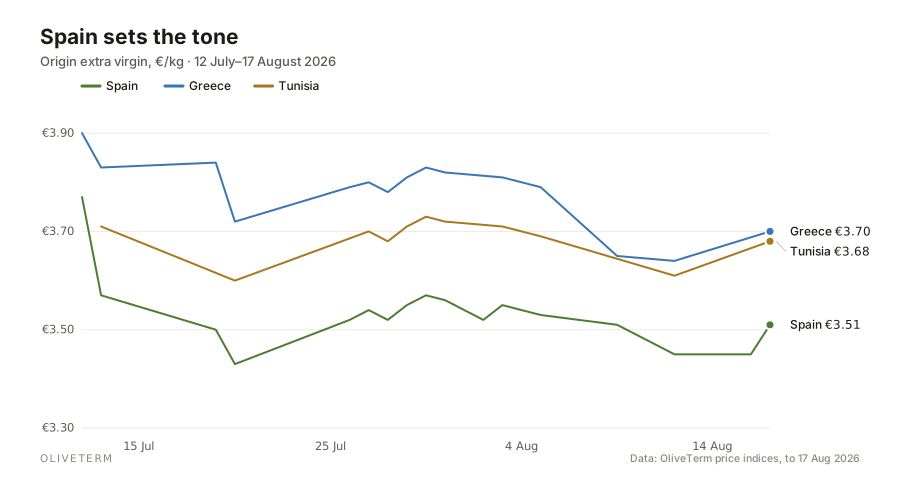
Outside Spain, Greece has continued to soften gradually. Market indications in mid-August placed Greek extra virgin in the mid-€3.60s to low €3.70s per kilo, down from the levels seen earlier in July. The movement has been orderly rather than dramatic, and Greek oil continues to trade above the lower end of the Spanish market.
Tunisia has been more stable. Sfax extra virgin was still being quoted around €3.60–3.70/kg in August, broadly the same range seen through much of July. The gap between origins is now much narrower, and the Spanish market is increasingly setting the tone for the region.
The fires and the fields
The fires have dominated the Spanish news cycle in August, and the scale of the damage is severe. Official MITECO figures show that 254,730 hectares of forest land had been affected by fire by 17 August, with 42 large forest fires recorded during the year. It has been an exceptionally demanding season for firefighting services, although the total area burned at that point was still below the 295,580 hectares recorded over the same period in 2025.
None of that, however, translates into an olive oil supply story. The burned area is overwhelmingly forest and scrubland, and while growers in the affected zones have taken real losses — in some cases severe ones — the productive olive surface touched by fire this summer remains a small fraction of Spain's roughly 2.7 million hectares of groves. Damage on that scale is devastating for the producers concerned and immaterial to the national balance, which is why the physical market, for all the headlines, has barely moved.
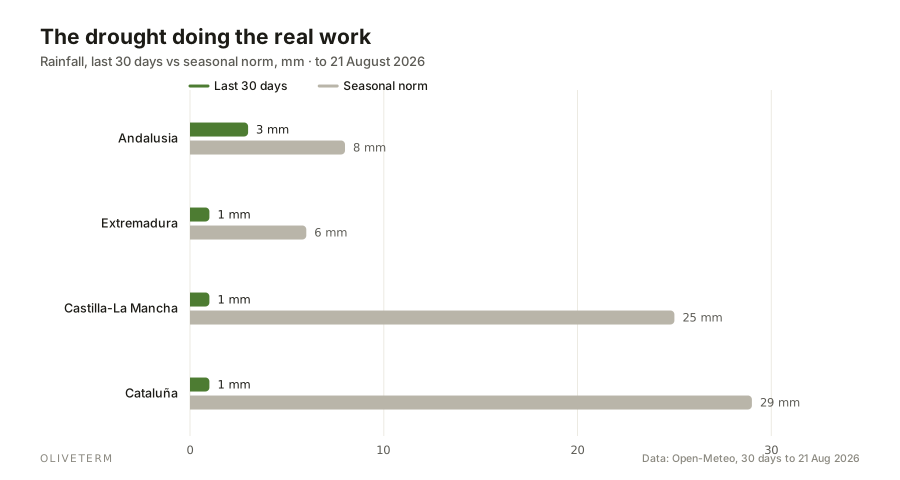
The more relevant issue for the next crop remains the weather. Late summer has stayed very dry across important parts of Andalusia and Castilla-La Mancha, with rainfall over recent weeks running well below seasonal norms, and the pressure on dryland groves is building accordingly. After a favourable spring, the question is increasingly how much of the fruit set survives the final part of summer in non-irrigated areas. We are deliberately avoiding attaching regional percentage losses to the crop at this stage. There are field reports of stress and fruit drop, but there is not yet a reliable enough national picture to turn those observations into a Spanish production number.
That leaves the market in much the same tension we described in July, only slightly further along. Prices still imply a sizeable recovery crop for 2026/27, while the weather has become less comfortable as summer has progressed. The Junta de Andalucía's official crop estimate will eventually give the market its first serious benchmark. Until then, the most useful signals are rainfall, soil moisture, fruit retention and the behaviour of sellers themselves. The fact that prices have stopped falling does not prove that the crop has deteriorated, but it does suggest that the market is becoming less willing to price another large increase in supply without seeing it first.
The regulators arrive
The other important development in Spain is regulatory. The Ministry of Agriculture has been preparing a marketing rule for the 2026/27 campaign that could allow part of the country's olive oil production to be temporarily withdrawn from the market if the coming crop creates a clear oversupply. The proposal went through public consultation between 23 July and 13 August, but the mechanism has not yet been activated.
Under the draft framework, the trigger would be reached if opening stocks plus estimated production amount to at least 120% of the average of that same calculation over the previous six campaigns. If that threshold is met after the new crop and opening stocks are known, the government could determine what share of production must be withheld. The ministry intends to have the legal framework available by 31 October, but its actual use will depend on the supply situation at the start of 2026/27.
Spain has not created a minimum price, and there is no automatic floor beneath the market. What is being created is a mechanism that could reduce the amount of oil immediately available for sale in an exceptionally heavy crop. Its existence may influence seller behaviour before it is ever used, but whether it becomes relevant this season will depend almost entirely on the size of the next harvest and the stocks carried into October.
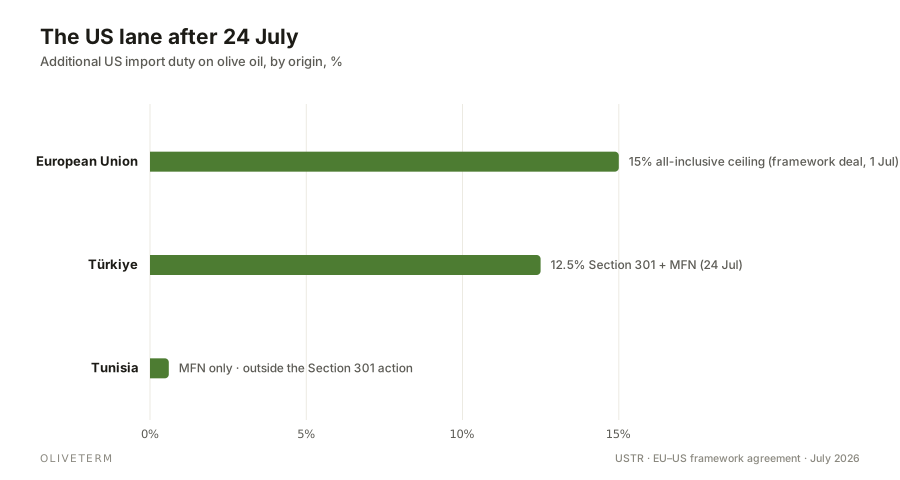
Washington also changed part of the international picture in July. The United States imposed new Section 301 tariffs on 60 trading partners from 24 July following its investigations into forced-labour import restrictions. Türkiye was among the economies covered and falls under the 12.5% rate applied to the group that did not receive the lower treatment, while Tunisia was not among the 60 economies investigated.
For olive oil specifically, that has improved Tunisia's relative position in the US market against Turkish supply. Industry reporting after the decision confirms that Turkish olive oil is facing the additional 12.5% Section 301 duty while Tunisia remains outside the measure. It does not suddenly determine where American buyers will source their oil, since origin prices, freight, quality and existing contracts still matter, but it gives Tunisian exporters another competitive advantage in a market where landed cost can make a meaningful difference.
How it plays out
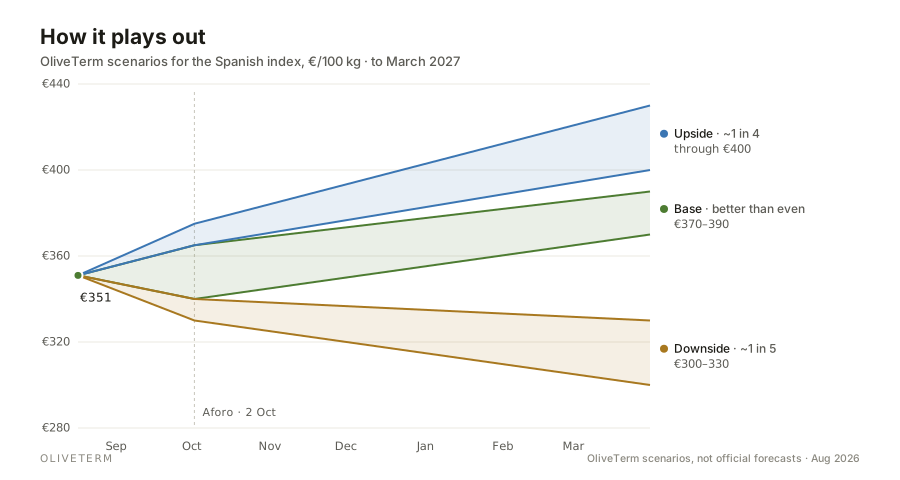
First, the scorecard. Our July base case was that the decline would slow without turning into a meaningful recovery, with Jaén remaining somewhere between €330 and €390/100 kg through the second half of the year. That is broadly what has happened so far. There has been no capitulation, but there has also been no real rebound. Instead, the market has spent several weeks building a floor in the €340s.
From here, the next move depends much more on the crop than it did a month ago. Our base case remains that prices hold broadly between €340 and €365/100 kg while the market waits for a clearer view of 2026/27 production. In our scenario framework, a Spanish crop somewhere around 1.40–1.55 million tonnes would probably be consistent with that kind of balance: large enough to keep buyers comfortable, but not so large that current stocks become a serious burden.
There is also a timing element that cuts in sellers' favour once the new campaign begins. Much of this year's weakness came from one-sided flow: sellers who had to provide liquidity into a market where buyers controlled the timing. That pressure is seasonal, and it expires with the campaign. Fresh oil does not carry the same urgency to be sold, cooperatives will start the season without a backlog, and the leverage that made hand-to-mouth buying so effective fades with it. Provided the official estimates land inside the central band, we would expect the market to firm modestly toward €370–390/100 kg into the new year and to hold that range with more stability than anything seen since March. That would be a repricing of seller psychology rather than of supply.
The downside scenario requires the crop to come in clearly stronger. Better conditions through the final part of summer, limited fruit loss and an eventual official estimate around or above 1.55 million tonnes would put pressure back on sellers. In that case, the market could retest the €300–330/100 kg area, particularly if a large number of cooperatives return to the market at the same time. The regulatory framework could eventually matter in such a scenario, but until the activation conditions are actually met it should not be treated as guaranteed protection against falling prices.
The upside scenario is increasingly agronomic. If dryland conditions deteriorate further and the official estimates eventually point to something below roughly 1.40 million tonnes, the market would have to reconsider how much oil will really be available next season. After months of falling prices, positioning is much lighter and sellers have already become more reluctant to chase the market down. Under that combination, a move back through €400/100 kg would become much easier to justify. These production bands are Oliveterm scenarios, not official crop forecasts.
Between now and then, the most useful hard data will come from AICA. August figures will show how quickly Spain is drawing down the roughly 569,000 tonnes that remained at the end of July and will allow us to tighten our carry-over estimate. After that, attention shifts almost entirely to the first official indications for the new Spanish crop. The closer those numbers come to harvest, the less room there will be for the market to trade on assumptions.
For buyers, the argument for spreading purchases rather than waiting for perfect clarity remains intact. Buying progressively in the €340s and €350s reduces the risk of being forced to cover everything at once if the crop disappoints, while still leaving room to participate if another leg lower develops. For sellers, the market is finally giving more reason to wait. Prices have stopped rewarding aggressive selling, and with the next crop still uncertain there is less incentive to chase every bid lower. The asymmetry is narrower than it was a month ago, but it has not disappeared: current prices still assume a large Spanish crop, while the final size of that crop remains unresolved.
Disclaimer: This report is prepared using publicly available data from the International Olive Council (IOC), European Commission, AICA/MAPA, Eurostat, Poolred, AEMET, MITECO, the Junta de Andalucía, USTR notices and other sector sources through 20 August 2026, together with Oliveterm's own price indices. Provisional figures may be subject to revision. Oliveterm production ranges and carry-over figures identified as estimates or scenarios are our own and should not be interpreted as official forecasts. This document does not constitute financial, commercial or legal advice.