

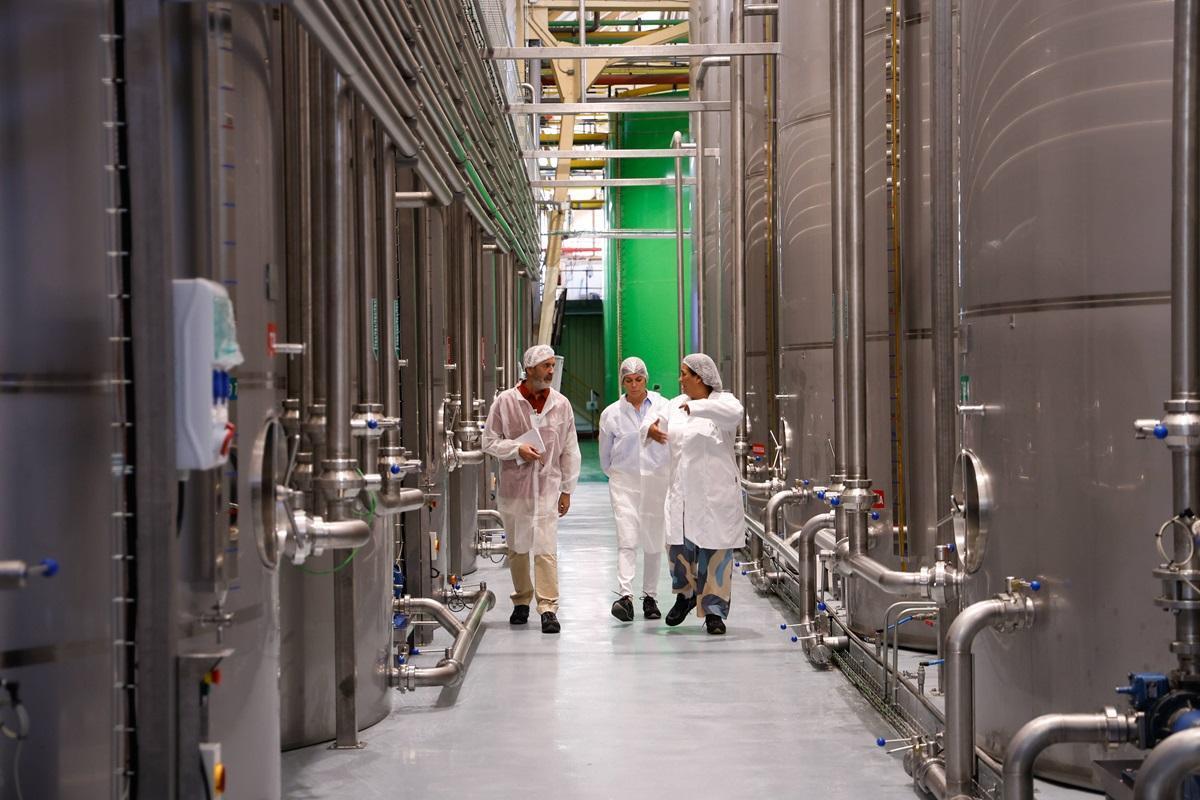
Oil storage tanks at Deoleo's plant in Alcolea, Córdoba. Image: Manuel Murillo
When we mapped who actually owns Europe's olive oil earlier this month, the sale of Deoleo was still a relatively discreet process, with bidders submitting offers behind closed doors. Within a week, it had turned into the most public bidding contest the olive oil sector has seen in years.
According to reports in the Spanish and Italian press, Spanish cooperative Dcoop put €470 million on the table for the group behind Carbonell, Bertolli, Carapelli, Koipe and Hojiblanca, moving ahead of a reported €460 million proposal from fellow Spanish group Acesur. Then came Coricelli. The Italian family-owned bottler, after being told it had been excluded from the process, returned with a €500 million counter-offer and asked for exclusive negotiating rights until closing.
The stock market noticed. Deoleo shares closed 23.78% higher on 19 August, the day Dcoop's offer became widely reported. Deoleo itself was much more cautious. In a statement to the CNMV, Spain's market regulator, the company confirmed only that its main shareholders were examining strategic alternatives, including the possible sale of all or part of the group's assets and businesses. No definitive decision has been taken.
From a quiet process to an open auction
The sale process has been running for months, with KPMG and William Blair advising on the transaction. A long list of industrial buyers has appeared along the way, including Italy's Coricelli, Bonifiche Ferraresi and NewPrinces, France's Lesieur, owned by Avril, and Australia's Cobram Estate, alongside the Spanish contenders.
By mid-August, the discussion had moved from expressions of interest to reported numbers.
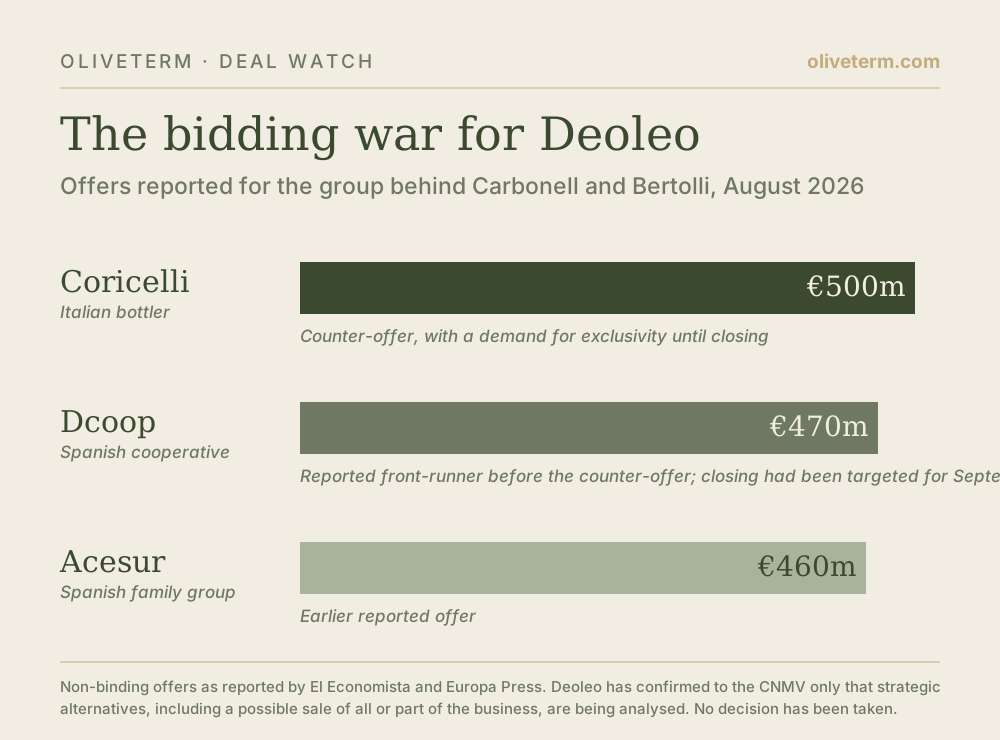
Dcoop's €470 million proposal has been reported as targeting CVC Capital Partners' roughly 57% stake in listed Deoleo S.A., with some reports suggesting a deal could be reached as early as September. That structure matters, because buying CVC's listed stake is not the same thing as simply buying all of Deoleo's operating business.
Coricelli then complicated the process. After being notified by KPMG that it was out of the running, the Italian group submitted a new €500 million proposal on 15 August, according to reports cited by Europa Press, and requested exclusivity until the transaction is completed.
No binding transaction has been publicly announced, and Deoleo's statement to the regulator leaves plenty of room for the process to change. There could still be a full sale, a partial transaction or no deal at all. What is difficult to argue now is that this remains a quiet disposal. Three industrial groups have reportedly put numbers close to or above half a billion euros on the table.
What Dcoop is really buying
For Dcoop, the industrial logic is fairly straightforward.
The cooperative brings together around 75,000 farming families and describes itself as the world's largest producer of virgin olive oil, with average production of around 200,000 tonnes a year depending on the harvest. It already bottles oil and owns 50% of Pompeian in the United States, but it has never controlled an international portfolio of consumer brands on anything close to Deoleo's scale.
Deoleo is almost the reverse. Its value does not come from owning a vast area of olive groves. It comes from procurement, blending, bottling, distribution and, above all, brands with established positions on supermarket shelves around the world.
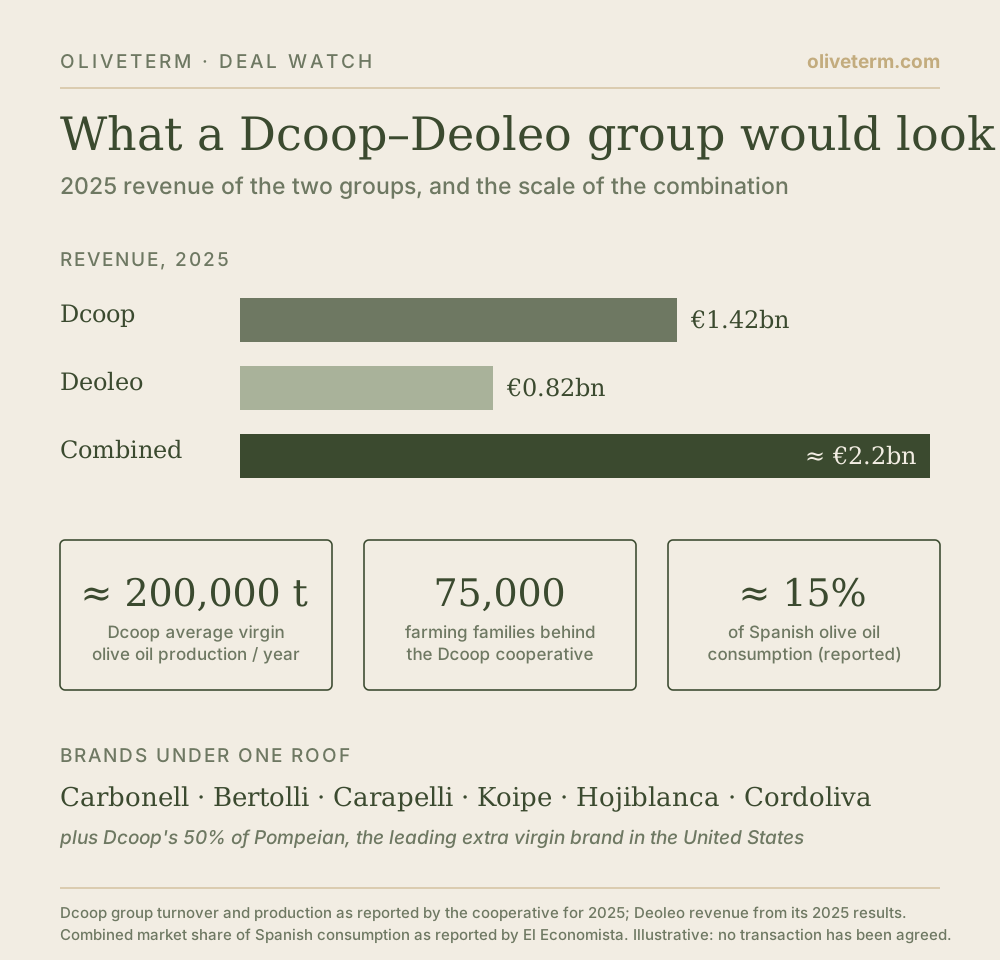
Dcoop reported consolidated revenue of €1.421 billion from the cooperative and its Spanish subsidiaries in 2025. Deoleo generated €821 million. Simply adding the two gives a figure of roughly €2.24 billion, although an actual combined group's revenue would be lower once any sales between the businesses were eliminated. Coverage of the proposed deal has also put the group's potential share of Spanish olive oil consumption at around 15%, bringing names such as Carbonell, Koipe, Hojiblanca, Dcoop and Cordoliva under the same industrial umbrella.
Then there is the United States. Dcoop already owns 50% of Pompeian, which has become the leading extra virgin olive oil brand in the US market. A Deoleo acquisition would add Bertolli and the rest of Deoleo's international distribution network to a business that already gives Dcoop a direct route into American retail.
The attraction is obvious. A cooperative built around production would gain control of one of the strongest branded distribution platforms in the industry. Instead of selling a large part of its oil into a market dominated by bottlers, it would own much more of the route between the farmer and the supermarket shelf.
Hojiblanca would be coming home
There is also a history between Dcoop and Deoleo that makes this deal unusual.
In 2013, Hojiblanca transferred its flagship brand and its Antequera bottling business to Deoleo through a non-cash capital increase. The transaction took the cooperative's holding in Deoleo from 0.69% to 10.32% and gave it two seats on the board. Hojiblanca changed its name to Dcoop that same year.
The relationship did not last long. In 2014, as CVC Capital Partners entered Deoleo, Dcoop sold 8.64% of the company to CVC at €0.38 per share. CVC also bought stakes from Bankia and Banco Mare Nostrum, taking an initial 29.99% position before launching an offer for the rest of the company.
Thirteen years after handing Hojiblanca to Deoleo, Dcoop is now trying to buy its former partner. If the cooperative wins, the Hojiblanca brand would return to the organisation that created it, only this time accompanied by Carbonell, Bertolli, Carapelli, Koipe and the rest of Deoleo's portfolio.
It is difficult to think of another transaction in the sector with quite the same circular history.
The Italian counter-move
Coricelli's €500 million proposal changes the contest because it puts a higher number in front of the sellers and attempts to stop another bidding round at the same time.
The Italian group has reportedly asked for exclusivity until closing. If granted, that would prevent Dcoop and Acesur from continuing to improve their proposals while Coricelli negotiates the final transaction. For a bidder that had apparently been removed from the process only days earlier, it is an aggressive return.
For CVC and Alchemy, the financial calculation is different from the industrial one facing the bidders. They are investors looking for an exit from a company whose financial position has improved considerably after several difficult years. A higher price matters, but so does certainty that the buyer can finance and complete the transaction.
The identity of that buyer is already becoming politically sensitive in Spain. CCOO Andalucía has called for priority to be given to a buyer with Spanish capital and has urged the authorities to protect employment and the country's industrial presence in olive oil. Dcoop has made a similar argument from a different angle, saying that the eventual owner should be committed to quality and the fight against fraud, and warning that it would be damaging for Spain to lose leadership in such a strategic sector.
Carbonell in particular is one of Spain's best-known olive oil brands. Its acquisition by an Italian group would inevitably attract attention in a country that produces far more olive oil than any other in the world but has historically watched a significant part of the value in branding and distribution sit elsewhere.
Why this is more complicated than a €500 million number
The ownership structure underneath Deoleo makes the sale less straightforward than the headlines suggest.
CVC controls 56.96% of listed Deoleo S.A. Deoleo S.A., in turn, owns 50.996% of Deoleo Holding, the company below which the operating business sits. Alchemy owns 40.99% of Deoleo Holding directly. That means CVC's large stake in the listed company translates into a much smaller indirect interest in the holding company, while Alchemy remains a major direct shareholder at the operating holding level.
A buyer therefore has to deal with more than one layer of ownership. A transaction that resulted in someone acquiring control of listed Deoleo S.A. would also have to take Spanish takeover rules into account. Under Spanish law, reaching 30% or more of the voting rights in a listed company normally constitutes control and can trigger an obligation to make an offer to the remaining shareholders, subject to the applicable rules and exemptions.
There is also the business itself.
Deoleo finished 2025 with €821 million of revenue, EBITDA of €50 million and net profit of €20 million. Comparable net financial debt fell 26% to €86 million. Those numbers are a substantial improvement on the position the company was in only a few years ago, although the €20 million profit included a €17 million reversal of previous impairments on the value of its brands.
The first half of 2026 continued the improvement, but again the headline profit needs context. Deoleo reported €19.4 million of net profit, of which €13 million came from the recovery of US tariffs paid under the IEEPA regime. The underlying business also improved: EBITDA reached €33 million and was up 23% on a comparable basis, while gross margin increased even as sales volumes slipped slightly.
In other words, the sellers are negotiating at a point when Deoleo's balance sheet and operating margins look considerably healthier than they did during the worst of the olive oil price shock. That helps explain why there are several credible industrial buyers still willing to compete for it.
For Dcoop, financing and integration would then become the real test. The cooperative is already a very large business, but absorbing Deoleo would add an international branded group with operations across several continents and a very different governance structure. The industrial logic can be explained in a few lines. Putting the two organisations together would be considerably harder.
What it means for the market
Whoever buys Deoleo will change the commercial map of the olive oil industry.
A Dcoop acquisition would be the most radical outcome. One of the world's largest pools of olive oil production would suddenly own a global portfolio of consumer brands. A group that has traditionally been a major supplier of bulk oil would internalise a much larger part of the journey from mill to retail shelf. The separation between producer cooperative and branded multinational, which has defined much of the industry's structure for decades, would become far less clear.
A Coricelli acquisition would point in a different direction. Deoleo's brands would move under the control of an Italian industrial bottler, reinforcing the role of companies whose competitive strength lies in sourcing, bottling and selling oil internationally rather than producing most of the raw material themselves. The oil inside many of those bottles would still be Spanish. The ownership of the margin between production and retail would not be.
Acesur offers a third route: Spanish consolidation without the cooperative structure. One of Spain's largest privately owned olive oil groups would take control of the industry's biggest international brand portfolio.
There is still another possible outcome, and it is the one Deoleo itself continues to leave open. The shareholders may decide not to sell if the final terms do not meet their expectations.
What has changed over the past week is the valuation the industry is putting on the opportunity. Two years ago, record olive oil prices were squeezing bottlers, destroying margins and making the branded end of the business look unusually vulnerable. Today, three industrial groups are reportedly prepared to offer around €460 million to €500 million for Deoleo.
For a company whose future has been questioned repeatedly over the past decade, that is quite a reversal. The next move now belongs to CVC, Alchemy and the bidders, with reports pointing to September as a possible decision point. Deoleo itself, for now, has given no timetable.