

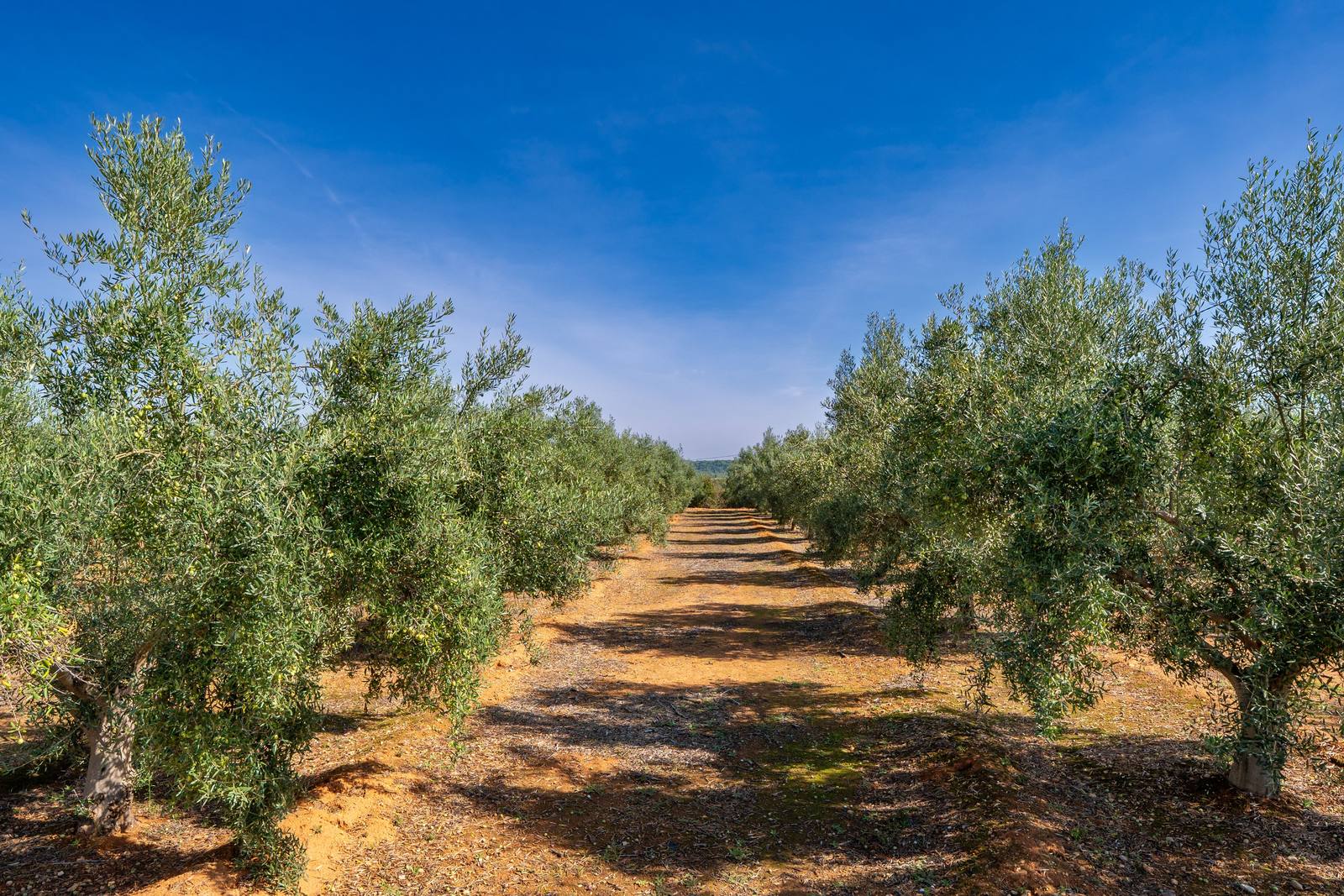
Rows of olive trees beside a farm track in Anna, Spain. Archive photograph. Photo: Emilio Sánchez Hernández / Pexels.
Spanish mills reported more outflows than production in October. Tunisia’s new crop is forecast to shrink after a strong export season.
Spain’s domestic sales and exports of olive oil totalled an estimated 134,600 tonnes in October, 19,000 tonnes more than a year earlier, according to Cooperativas Agro-alimentarias. The organisation said that, if confirmed, this would be the highest monthly volume in six campaigns. The calculation assumes 14,000 tonnes of imports, pending confirmation from customs data.
The ministry’s preliminary SIMO report, with data to 31 October, records mill production of 70,530 tonnes and mill outflows of 91,435 tonnes. The national marketing estimate combines production, those imports and the stock draw of about 50,000 tonnes reported by Cooperativas. Stocks stood at 150,931 tonnes at mills, 154,473 tonnes with packers and other operators, and 1,563 tonnes at the Fundación Patrimonio Comunal Olivarero. Together, they amounted to around 307,000 tonnes.
October’s 70,530 tonnes fall outside the base of Spain’s mandatory withdrawal calculation, which starts with November production. Under the SIMO reporting timetable, the corresponding monthly returns are due by 10 December.
Tunisia exported 413,100 tonnes of olive oil from November 2025 to October 2026, up 47.4%, according to ONAGRI. For the new 2026/27 crop, National Olive Oil Council member Mouldi Ramdhani gave a preliminary forecast of around 300,000 tonnes in an interview with Radio Nationale on 2 November, 40% below the previous season’s approximately 500,000 tonnes.
In Italy, Foggia’s extra virgin quotation fell 9.6% to 4.25€/kg on 12 November (OliveTerm analysis).