

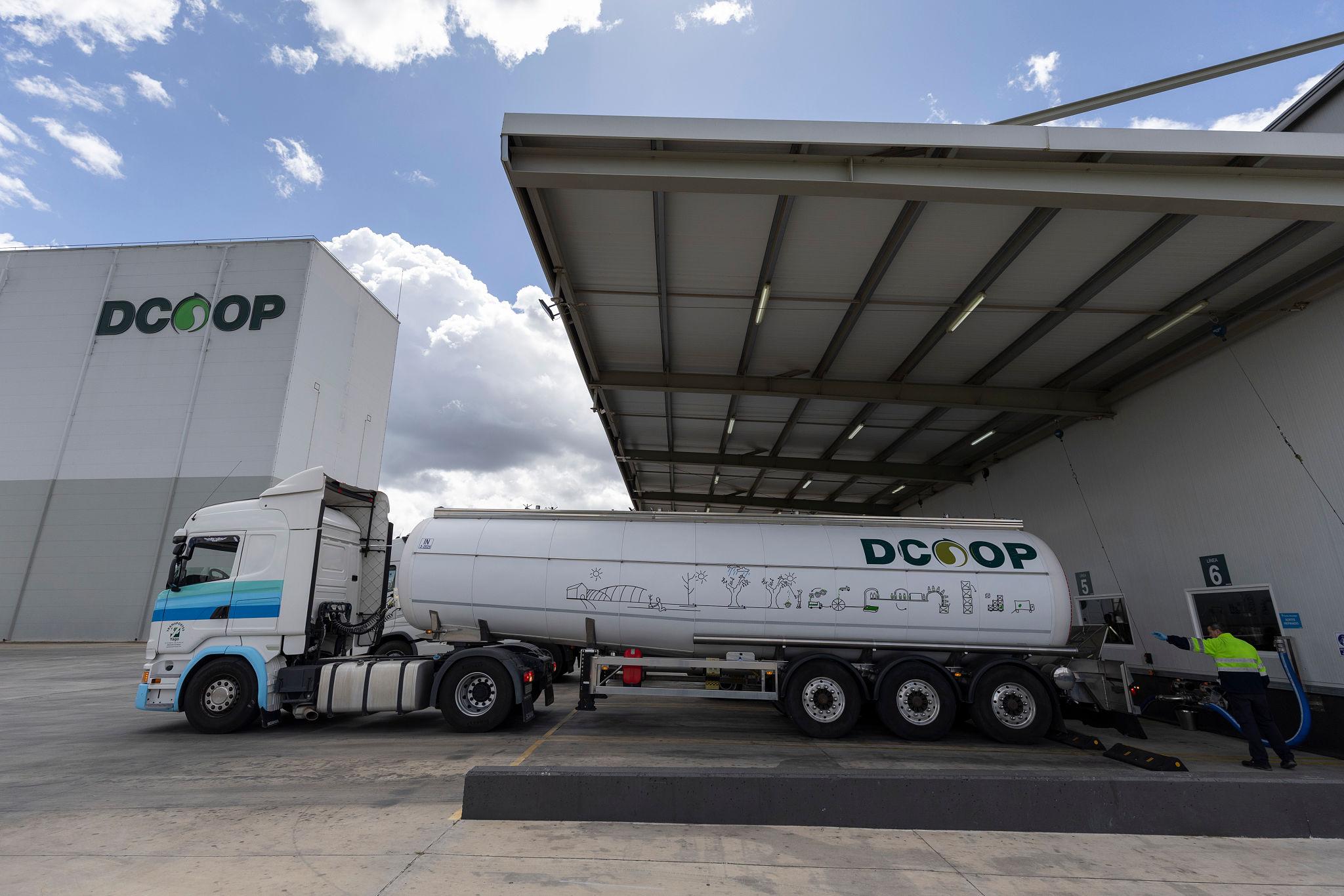
Photo: Dcoop. Used for illustrative purposes.
Purchases from outside the EU have risen by 84%, Tunisia has become the main source, and the cost of paying full import duty suggests that much of the oil was never intended for sale in Spain.
Spain is both the world's largest olive oil producer and its biggest exporter. Yet this season it has also been importing foreign oil at an exceptional rate. At first, that may appear contradictory. It makes considerably more sense once the role of Spain's bottling and trading industry is taken into account.
The volumes involved have been large enough to turn the issue into a political one. Between January and May, Spain imported 115,300 tonnes of olive oil, 27.5% more than during the same period in 2025. Of this total, 73,400 tonnes came from outside the European Union, an increase of 83.9%. By the end of July, imports during the campaign had reached 217,200 tonnes, already above the 206,100 tonnes recorded during the whole of 2024/25, with another two months still remaining. Spanish production, meanwhile, closed the campaign at just under 1.3 million tonnes, around 8.6% below the previous harvest.
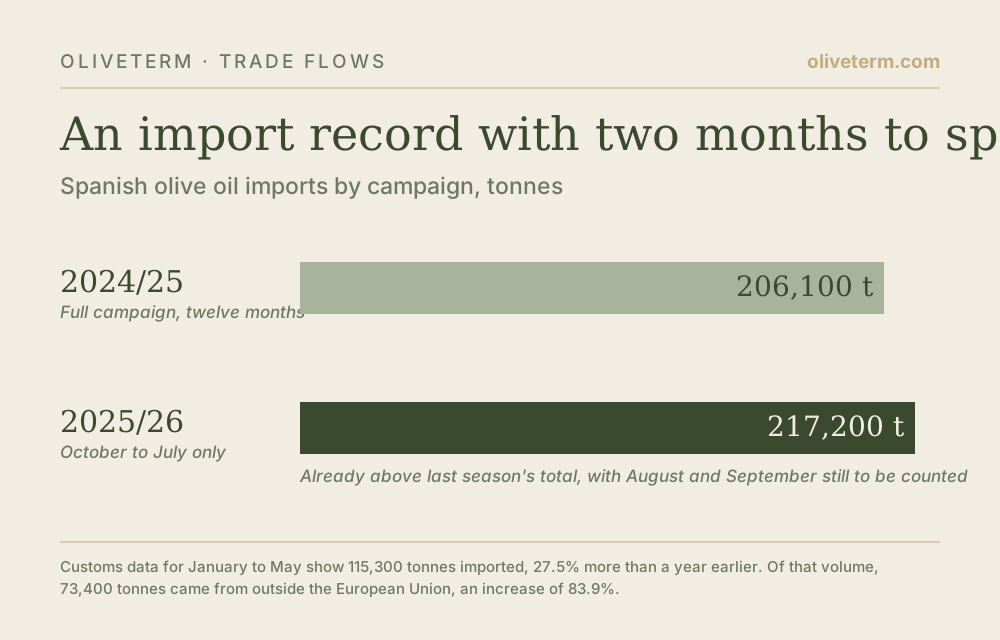
Much of the additional oil came from the same country.
A record campaign for Tunisia
Tunisia has just experienced one of the strongest export campaigns in its recent history. Between November and July, the first nine months of the country's 2025/26 season, it exported 368,000 tonnes of olive oil. In the equivalent period a year earlier, exports had amounted to 236,900 tonnes. That represents growth of 55.3%, while export revenue increased by 44.4% to TND 4.605 billion.
Spain was the largest destination. According to ONAGRI, Tunisia's agricultural observatory, Spain received 32.1% of Tunisian olive oil exports through July. Italy accounted for 20% and the United States for 19.2%. Altogether, the European Union absorbed 57.1% of the country's exports.
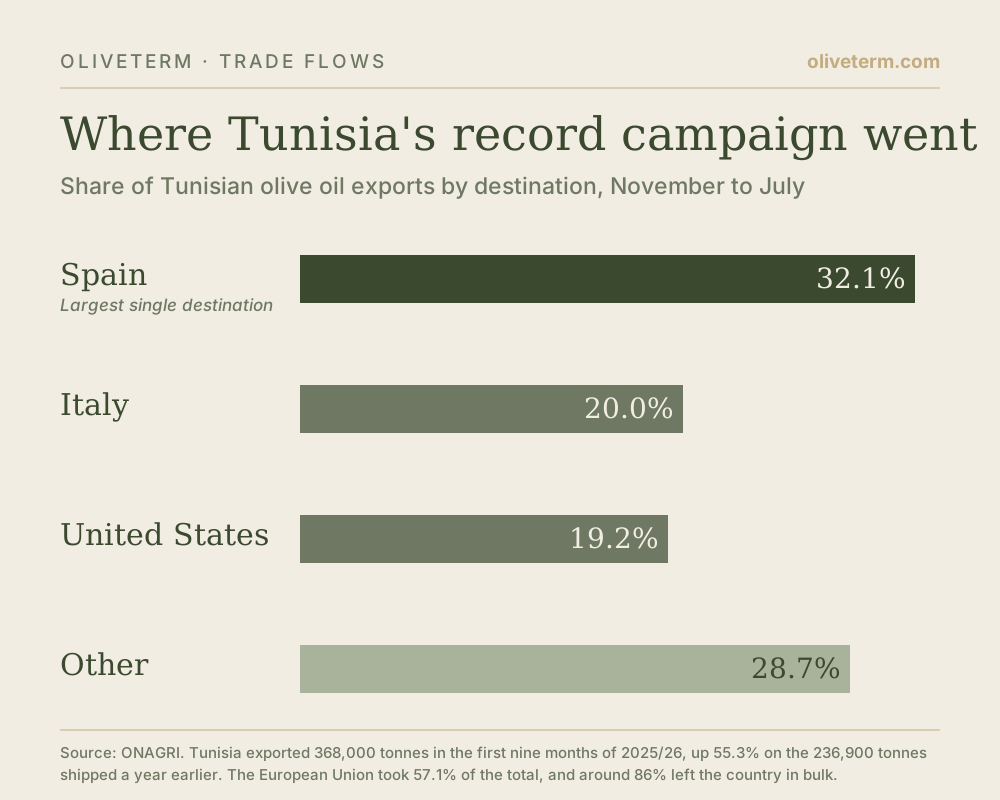
The form in which that oil was sold is also important. Around 86% left Tunisia in bulk, while extra virgin olive oil represented 83.6% of the total volume. Packaged exports are increasing, but Tunisia still sells most of its oil to companies rather than directly to consumers. Spain, with its enormous bottling and export industry, is therefore a natural buyer.
Spanish bottlers do not operate solely for the domestic market. They supply customers in more than 150 countries, and the Spanish agriculture ministry estimates that exports normally account for around 65% of all the olive oil marketed by the sector. The proportion has been even higher this season. By the end of July, Spain had exported 833,400 tonnes while placing 405,100 tonnes on its domestic market. In other words, approximately two out of every three tonnes leaving Spanish storage facilities were sent abroad.
At that scale, there is nothing unusual about Spain being both the world's leading producer and a major importer. Its companies need oil to supply international customers throughout the year, regardless of the size of the Spanish harvest.
The price gap that opened the trade
The reason behind the increase in imports was initially straightforward: price.
In February, Spanish extra virgin olive oil was trading at around 4.39€/kg, while conventional Tunisian extra virgin could be purchased for approximately 3.40€/kg. For a bottler handling thousands of tonnes, a difference of nearly 1€/kg is substantial. The opportunity was especially attractive when filling export orders that did not require the oil to be of Spanish origin.
Two conditions came together. Spain had produced less olive oil than in the previous season, while Tunisia had an exceptionally large quantity available at a lower price. Spanish buyers responded accordingly.
Since then, however, the difference has disappeared. By mid-August, OliveTerm's origin prices placed Spanish extra virgin at 3.51€/kg and Tunisian extra virgin at 3.68€/kg. Tunisian oil had become more expensive than Spanish oil.
This reversal is essential when interpreting the latest import figures. Oil arriving in Spain during June or July may have been purchased several months earlier, when the price advantage was still considerable. Contracts agreed in February do not necessarily appear in the trade statistics during the same month. Current spot prices therefore tell us little about buying decisions made earlier in the year.
Why the customs regime matters
Much of the discussion surrounding Tunisian imports has focused on the EU tariff quota, but the quota alone cannot explain the volumes involved.
Under quota 09.4032, the European Union allows 56,700 tonnes of Tunisian virgin olive oil to enter the bloc free of customs duty each year. To qualify, the oil must be wholly obtained in Tunisia and shipped directly from the country. Once that allowance has been exhausted, extra virgin olive oil imported from third countries pays the standard duty of 124.50€ per 100 kilograms, equivalent to 1,245€ per tonne.
Applying that duty to this season's prices changes the calculation entirely. Tunisian extra virgin priced at 3.68€/kg would cost approximately 4.93€/kg after customs duty, compared with 3.51€/kg for Spanish oil. Even in February, when the gap between the two origins was at its widest, Tunisian oil would have entered the EU at around 4.65€/kg after duty, while Spanish extra virgin was available for 4.39€/kg.
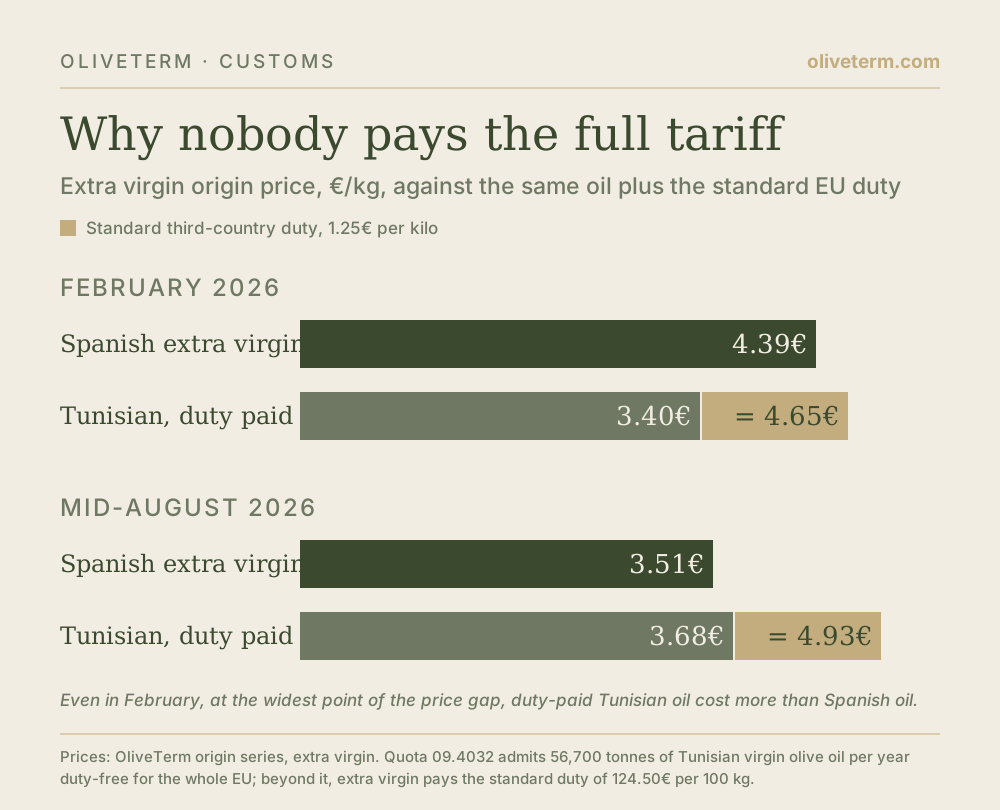
At no point during the campaign did it make commercial sense to import Tunisian oil into free circulation while paying the full tariff.
The duty-free quota is also far too small to account for all the oil apparently shipped towards Spain. Applying Spain's 32.1% share to Tunisia's exports of 368,000 tonnes gives a figure of roughly 118,000 tonnes. The quota covers only 56,700 tonnes for the entire European Union, and Italy received another 20% of Tunisian exports.
The figures are not directly comparable in every respect. Tunisian export declarations and Spanish operator data cover different periods and use different reporting systems, so they cannot be expected to match exactly. Even so, the difference is too large to be explained by the quota alone.
The most likely explanation is inward processing, known in Spain as régimen de perfeccionamiento activo. This customs procedure allows a company to import goods from outside the EU, process them and then re-export the finished product without paying import duty or import VAT. If the goods are subsequently released onto the EU market, those charges become payable.
For a Spanish bottler supplying a customer in São Paulo or Newark, the commercial logic is clear. The company can purchase lower-priced Tunisian oil, bottle it in Andalusia and ship it to a market outside the European Union without paying the normal customs duty. Given the cost of importing Tunisian oil under the standard tariff, the figures strongly suggest that a large share of the volumes exceeding Spain's portion of the quota entered under this system.
Spanish producer organisations are now calling for greater scrutiny. Cooperativas Agro-alimentarias de Andalucía has asked for closer monitoring of olive oil arriving from third countries, both under the tariff quota and through inward processing. Its concern comes at a time when origin prices have fallen to levels that many traditional olive groves say are insufficient to cover production costs.
Are imports responsible for falling prices?
The argument made by producers is easy to understand. Oil held inside a Spanish bottling facility, regardless of where it was produced or where it will eventually be sold, is oil that the bottler does not need to purchase from a Spanish mill at that moment.
A mill in Jaén is therefore competing not only with other Spanish mills. If a buyer can obtain oil of a suitable quality and specification from Tunisia, Portugal or Greece, that alternative influences the maximum price it is prepared to pay in Spain.
Exporters offer a different interpretation. Rafael Pico, director general of the exporters' association Asoliva, told EFE that Spanish companies turned to imports because domestic availability was tighter than expected and Tunisian oil was significantly cheaper. From this perspective, imports did not create the price gap. They were a response to it.
The two explanations are not necessarily incompatible. Lower Tunisian prices created the incentive to import. Once that oil became available, Spanish buyers had less need to return immediately to the domestic market, allowing them to remain cautious for longer and adding further pressure to Spanish prices.
Imports, however, cannot explain the entire decline. Spanish extra virgin fell from 4.39€/kg in February to 3.51€/kg in August. During the same period, expectations for the next harvest improved, purchasing remained subdued and the market increasingly began to anticipate a second consecutive large crop. Spain also ended July with 568,692 tonnes still held across mills, bottlers and registered operators.
There is another important point: Tunisian oil now appears to be trading at broadly similar levels to Spanish oil. The large discount that made imports so attractive earlier in the campaign has therefore narrowed considerably, if not disappeared altogether. If imports alone were responsible for the decline in Spanish prices, some change in the market might already have been expected. So far, that has not happened.
Spain's role as a Mediterranean trading centre
This season's price opportunity is only one part of a much larger change in the olive oil trade.
Spanish bottlers and traders supply international customers throughout the year under contracts that continue even when Spain has a smaller harvest. When domestic oil is competitive, those orders are filled from Spanish production. When another Mediterranean origin offers a large enough discount to cover transport and customs administration, companies buy abroad.
This season, Tunisia provided that opportunity. Earlier in the campaign, however, Portugal was still Spain's largest foreign supplier. MAPA data for the first four months showed Portugal accounting for 49% of Spanish imports and Tunisia for 32%. The balance shifted as the season progressed and more Tunisian oil entered the market.
Olive oil is increasingly produced, traded, bottled and consumed in different countries. Olives may be crushed in one country, the resulting oil transported in bulk to another, bottled elsewhere and finally sold in a completely different market. National production figures remain important, but they no longer describe the full structure of the business.
What happens next
The conditions that encouraged the surge in Tunisian imports have changed. The price discount has disappeared, meaning that any new purchases must be assessed on very different terms from those available in the spring. Tunisia has also already exported a considerable share of its crop, reducing its capacity to continue supplying the market as the Mediterranean's cheapest marginal origin.
Spain enters the final part of the campaign with 568,692 tonnes still in stock and another harvest approaching. Further imports are therefore more likely to reflect the specific requirements of bottlers with export contracts than any general shortage of olive oil in the country.
That does not mean imports will stop. An industry that had already exported more than 800,000 tonnes before the end of the campaign will continue to buy oil wherever the economics are favourable. What has changed is the price needed to make those purchases worthwhile.
If imports from Tunisia fall sharply during the autumn, the surge will look like a temporary trade created by a wide price gap and brought to an end once that gap disappeared. If volumes remain high even without a discount, the explanation will be more structural. It would suggest that Spain is no longer simply the world's largest olive oil producer, but also the principal centre through which Mediterranean oil is purchased, processed, bottled and sold to the rest of the world.