
As growers retire, family ownership and farm management may follow different paths. Keeping the trees in production will require a business that the next generation can afford to run.
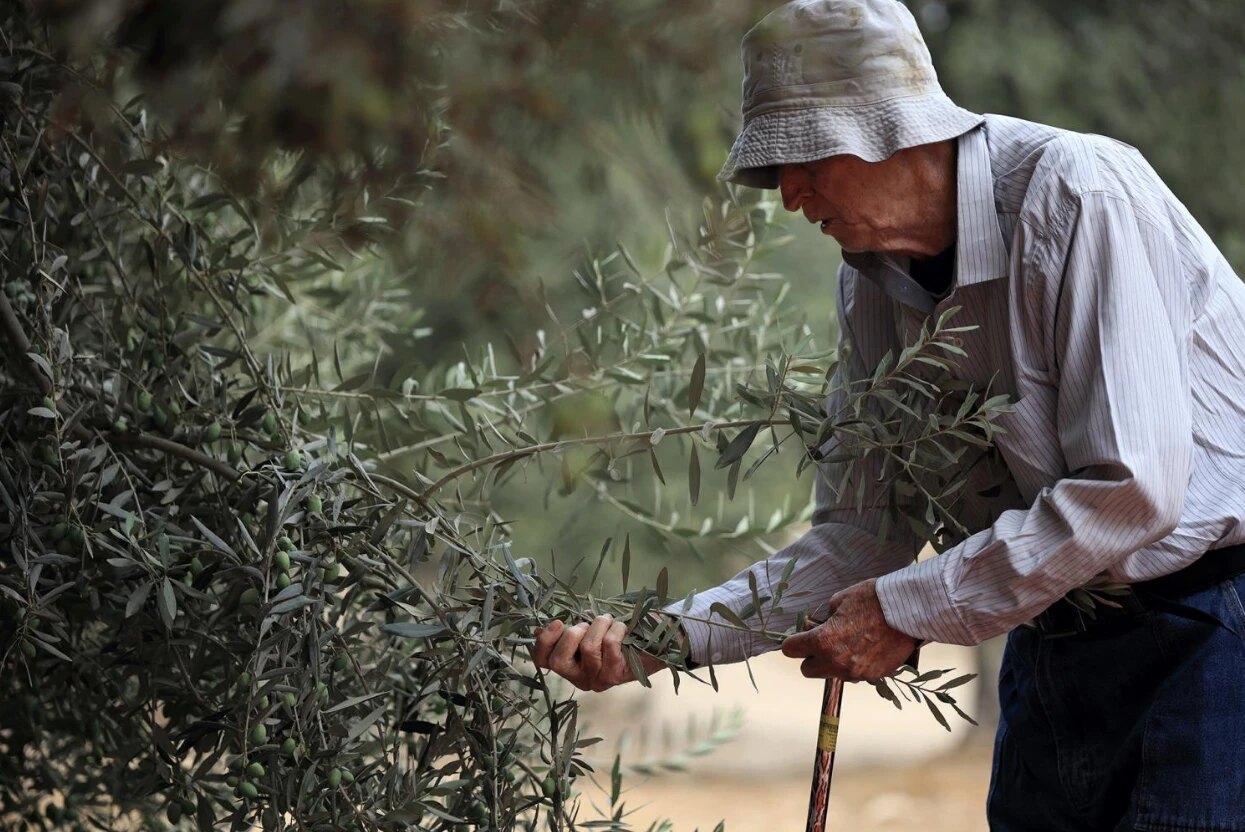
Photo: Saeed Qaq/NurPhoto
A family can agree that an olive grove should never be sold without anyone agreeing to become its farmer. The children may live elsewhere, have different careers or simply be unable to fit pruning, crop protection and harvest into their working lives. Their attachment to the land can be entirely sincere, but the practical question of who will look after it remains. What passes between generations includes knowledge of the trees, relationships with workers and the local mill, and the ability to organise a year's work around weather and harvest. A change of owner does not automatically transfer that system, particularly when much of it has depended on one person's experience and availability.
Across EU agriculture, the average farm manager was 57 in 2020, according to a European Commission brief published in October 2025. Fewer than 12% of farms were managed by people under 40. Those figures cover agriculture as a whole, but they establish the wider demographic setting in which olive-growing families are making their decisions. For the olive sector, the challenge is to make the work transferable as well as the land, while there is still someone available to explain how the holding is run.
A different calculation for the next generation
The same grove can serve very different purposes within a family. For an older owner, it may supplement another income or a pension. Machinery may already be paid for, and much of the work may be done personally. Continuing to cultivate can also have a value that extends beyond the annual return. A successor considering farming as a profession faces a different calculation: the grove must provide an income for the person running it, cover any hired labour and eventually replace ageing equipment. If improvements are needed, the successor must also find the money to pay for them before they begin to generate a return.
A holding can therefore remain worth cultivating for its present owner while offering an unconvincing career to the person expected to take over. Describing that decision as a loss of interest in agriculture misses the economic change taking place. At the same time, someone who wants to farm may have neither inherited land nor enough capital to buy it. The Commission's analysis identifies access to land and finance as obstacles for young farmers across the EU. Owners looking for help and potential operators looking for a viable business can exist in the same area without finding an arrangement that works for both.
Keeping the land, organising the work
One practical response is already visible in the cooperative sector. At technical meetings organised by Cooperativas Agro-alimentarias de España in November 2025, OLEAND Manzanilla Olive presented its farm-management service, which combines the cooperative's own technical supervision with specialist contractors carrying out fieldwork. Members retain ownership and responsibility for strategic decisions, while cultivation is organised through the service. OLEAND explicitly identifies older members, people whose main occupation lies elsewhere, and heirs reluctant to sell or lease their land among those it is intended to support. For these families, the arrangement offers a way to keep their groves cultivated without having to organise every task themselves or find a relative prepared to take on the whole operation.
The model also suggests a different way of achieving scale, with separate properties served by a coordinated operation. Equipment and workers can be scheduled across several holdings, potentially spreading costs over a larger area. How much this achieves depends partly on geography. At the same meetings, Antonio Ruz Carmona, manager of the San Roque de Arjonilla cooperative, described the difficulties of small, scattered holdings and the need to group agricultural tasks by area. Bringing more hectares under a management service is useful only to the extent that the work can be organised efficiently; nearby parcels offer advantages that an equally large collection of distant plots may not.
Such services still have to earn their keep. Coordination cannot remove steep slopes, poor access or weak yields, and the cost of management must be covered by the business it supports. Owners need clear accounts, agreed responsibilities and confidence that their grove will receive attention when it needs it. The service must also be able to organise workers and equipment at the right time, particularly during harvest. Its value ultimately depends on whether it can provide reliable cultivation at a cost the holding can sustain.
A business beyond the family
For mills and cooperatives, succession has consequences well beyond an individual household. If nearby groves stop delivering fruit, processing capacity and other fixed costs must be supported by a smaller volume. Helping members arrange cultivation can therefore protect the cooperative's own future. National production figures would not necessarily reveal every local loss: additional output from productive new orchards could offset declining cultivation elsewhere, allowing total oil production to rise while a particular village lost growers, work for local contractors and part of the supply supporting its mill. The volume of oil produced and the continued viability of the businesses serving an olive-growing area are related, but one does not fully describe the other.
The opportunity for the next generation may consequently take several forms. Some people will inherit and run a family holding; others could lease land, manage several owners' groves or build a business providing pruning, harvesting and technical services. A viable career might draw its income from work across dozens of properties, which changes what is needed to support it. Training and access to equipment matter, but so do dependable contracts and enough work to sustain a business through the year. Experienced growers also need a practical way to pass on their knowledge while they remain involved, allowing new operators to learn the particular needs of the holdings they will manage.
The form will vary from one olive-growing area to another. A family business with sufficient scale may transfer intact, while smaller holdings may depend on cooperation, leasing or professional management. For some difficult groves, viability may also depend on payments that recognise their landscape and environmental benefits. Each arrangement must provide enough income to support the work and investment required to keep the trees productive.
Families cannot settle all these questions through inheritance alone. They can, however, begin while there is still time to organise the work, establish what it costs and involve the people who may eventually take it on. That gives both owners and potential successors a clearer basis for deciding what is possible. For the next generation, a grove with a workable business around it may be the most valuable inheritance of all.
Sources
- European Commission: Young farmers in EU agriculture, Analytical Brief No. 10 (October 2025: the average age of EU farm managers, 57 in 2020 against 55 in 2010, the share of farms managed by people under 40, and young farmers' greater difficulty in accessing land and the financing gap they face; figures for EU agriculture as a whole, not the olive sector)
- Cooperativas Agro-alimentarias de España: El sector del aceite de oliva ante sus grandes retos: agua, reestructuración, mecanización, relevo generacional y garantizar la calidad (6 November 2025: the report of the Jornadas Técnicas de Aceite de Oliva held in Córdoba on 3 and 4 November 2025, with OLEAND's presentation and Antonio Ruz Carmona's remarks on small, scattered holdings and on grouping tasks by area)
- OLEAND Manzanilla Olive: Servicio de gestión de fincas (presentation by José Andrés Estévez Leo, director of the cooperative's agricultural technical department, 3 November 2025: the service's model, with the cooperative's own technical service and specialist contractors, the member keeping the ownership and the strategic decisions, and the members it is intended for)