

Italy's olive oil exporters have spent generations building markets abroad, leaving an advantage that survives changes in ownership and in the origin of the oil they sell.
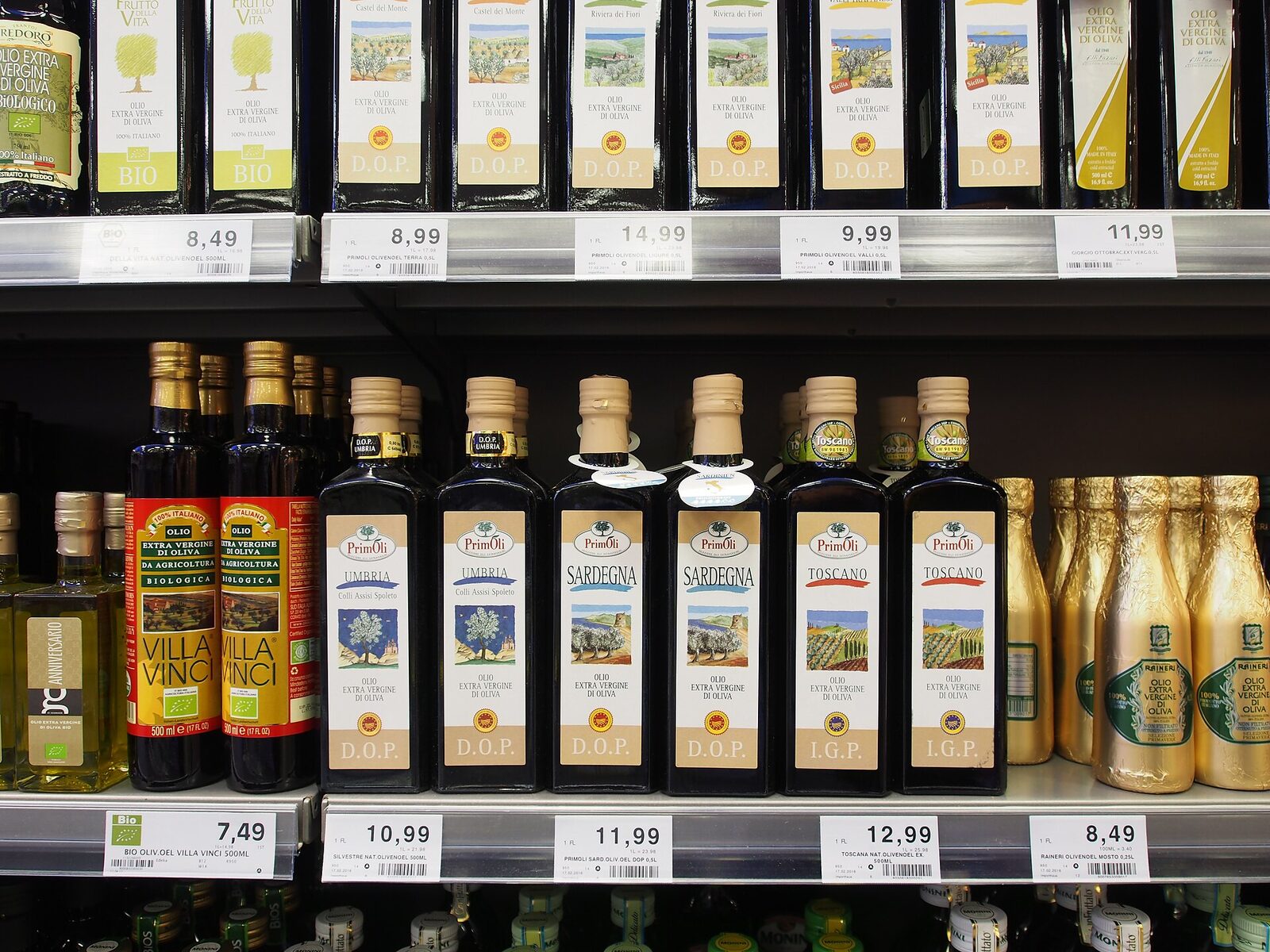
Photo: Alf van Beem, Germany, 2017

An Italian name on an olive oil bottle can be a valuable asset for a Spanish company. Bertolli and Carapelli belong to Deoleo, the Spain-based group that also owns Carbonell. The same group can buy Spanish oil and sell it through an Italian brand, participating in both parts of a trade often described as a rivalry between the two countries.
Between October 2025 and June 2026, Spain recorded approximately 230,700 tonnes of olive oil exports to Italy, according to European Commission figures. The Commission's September estimates put Spanish production for the 2025/26 campaign at roughly four times Italy's. An Italian bottler comparing supplies from several countries has to know what a suitable Spanish oil would cost. After a poor Spanish crop, buyers seeking replacement supplies can put pressure on other Mediterranean origins; with more Spanish oil available, they have greater room to negotiate. Spain's influence comes from the quantity it can supply and the alternatives that quantity gives buyers.
In August 2026, the Commission recorded national average extra virgin producer prices of approximately 4.86€/kg in Italy and 3.51€/kg in Spain, a difference of about 38%. Buyers committed to Italian-origin oil have fewer alternatives than those able to source across the Mediterranean. Origin also matters to consumers: a 2021 choice experiment involving more than 1,000 Italian consumers found that it influenced purchasing preferences. The study supports a role for origin in demand, though it does not isolate the cause of the current price gap.
What the label must say
An Italian brand can buy Spanish extra virgin olive oil and bottle it in Italy. For sale in the EU, the label must declare its origin correctly and the presentation must not mislead consumers. Bottling in Italy does not entitle the company to call it Italian oil. Oil marketed as "100% Italian" must come from olives harvested and milled in Italy.
Blending does not confer Italian origin either. A blend containing 90% Italian extra virgin oil and 10% Spanish extra virgin oil would still require an EU-origin declaration, even if mixed and bottled in Italy. If Tunisian oil were included, the declaration would need to cover both EU and non-EU origin. Blends made entirely from Italian-origin oils can be labelled Italian.
However, false origin claims have appeared repeatedly in enforcement cases. In the 2016 "Mamma Mia" investigation, Italian authorities reported that more than 2,000 tonnes of Spanish and Greek extra virgin oil had been sold as 100% Italian during 2014–15. ICQRF's 2025 report records a further case in Liguria involving 18,000 litres of EU olive oil sold as Italian "Taggiasca" oil.
Even the premium for Italian-origin oil varies with the harvest. ISMEA reported in September 2026 that Italian production had recovered in 2025/26 and national extra virgin prices had fallen during 2026, while remaining above those of Spain, Greece and Tunisia.
Markets built over generations
Bertolli traces its beginnings to a Tuscan grocery opened in 1865 and says demand from Italian emigrants prompted shipments to the United States within the following decade. Filippo Berio's company history describes sales to North American importers, restaurants, hotels and retailers in the 1870s. These firms were reaching customers through businesses already familiar with Italian food, establishing contacts that could support further sales. By 2013, when the US International Trade Commission published its investigation of the sector, Italian brands were already well known abroad, and Italian bottlers were skilled at blending oils. Its report also described major Spanish companies owning Italian brands while continuing to bottle substantial volumes in Italy.
In the 2024/25 crop year, Spain supplied more olive oil to the United States than Italy. Italy's shipments consisted almost entirely of packaged olive oil.
| Supplying country | US olive oil imports, 2024/25 | Packaged olive oil (% of volume) |
|---|---|---|
| Spain | 154,296 tonnes | 57.9% |
| Italy | 134,904 tonnes | 95.6% |
Source: provisional International Olive Council data; OliveTerm calculations. Olive-pomace oil is excluded from both columns.
Spain also sells substantial volumes of packaged oil to the United States. In Italy's case, this format accounts for almost all shipments. These figures include both premium brands and supermarket labels.
What an established name is worth
For an established exporter, a recognised name gives customers a reason to look for its product again. The company can retain that identity while changing suppliers or adjusting its blend, provided it continues to deliver the product customers expect. An importer or retailer buying an established label also has experience of how it sells. A new entrant must persuade buyers to take a chance on its product and support it while demand develops. This is part of the commercial history behind Italian brands: their value includes the purchases and distribution relationships built around them, which a competing producer cannot acquire simply by making more oil.
Deoleo reported spending 17M€ on advertising and promotion in 2025, 30% more than a year earlier. The group also described work on purchasing and production efficiency alongside its investment in brands. Such costs have to be met from sales, together with packaging, financing and the expenses of getting the oil to customers. Distributors and retailers take their own margins.
Where the rivalry breaks down
An Italian bottler buying across the Mediterranean can therefore welcome a large Spanish harvest for the cheaper supplies it may bring. An Italian grower selling oil specifically for its origin is serving a different market. The familiar national comparison puts these businesses on the same side, even when their interests diverge. Deoleo's portfolio adds a further complication: the Italian name on the bottle can help generate sales for a Spanish group. Spain's production strength and Italy's commercial reputation are, in that case, working for the same company.
Sources
- Deoleo: Our Brands (Bertolli, Carapelli and Carbonell in the group's portfolio)
- European Commission: Market situation for olive oil and table olives (30 September 2026: production estimates for 2025/26, and intra-EU trade from October 2025 to June 2026)
- European Commission: Olive oil dashboard (updated 30 September 2026: national average producer prices, August 2026)
- Carzedda et al.: Consumer Preferences for Origin and Organic Attributes of Extra Virgin Olive Oil: A Choice Experiment in the Italian Market, Foods 10(5), 994, 2021 (origin in the purchasing preferences of more than 1,000 Italian consumers)
- EUR-Lex: Commission Delegated Regulation (EU) 2022/2104 (Articles 5 and 8, consolidated version of 10 June 2024: the origin declared on extra virgin and virgin olive oils and their blends)
- EUR-Lex: Regulation (EU) No 1169/2011 (Article 7: food information and presentation must not mislead consumers, including as to origin)
- Guardia di Finanza: Operation "Mamma Mia" (3 February 2016: the official account of the ICQRF investigation into false Italian-origin declarations)
- ICQRF: Activity Report 2025 (section 7.3: the December case in Liguria, 18,000 litres of EU olive oil sold as Italian "Taggiasca" oil)
- ISMEA: Terra Madre: olio italiano verso la nuova campagna (24 September 2026: Italy's 2025/26 production and the fall in its extra virgin prices during 2026)
- Bertolli: Bertolli Olive Oil: What Sets Us Apart (the company's account of its history)
- Filippo Berio: Our Heritage (the company's account of its history)
- US International Trade Commission: Olive Oil: Conditions of Competition between U.S. and Major Foreign Supplier Industries (2013, especially pp. 6-14 to 6-17)
- International Olive Council: Olive sector statistics, February/March 2026 (9 March 2026, Tables 1 and 2: US olive oil imports by supplier and pack size, 2024/25)
- Deoleo: FY2025 results (published 27 February 2026: advertising and promotion spending, purchasing and production efficiency)
- US International Trade Commission: Harmonized Tariff Schedule, heading 1509 (the small-pack category includes oil weighing under 18 kg together with its immediate packaging)