

Spanish mills must set aside 12% of eligible production. Puricon's new tanks show the space it takes to keep different lots apart.
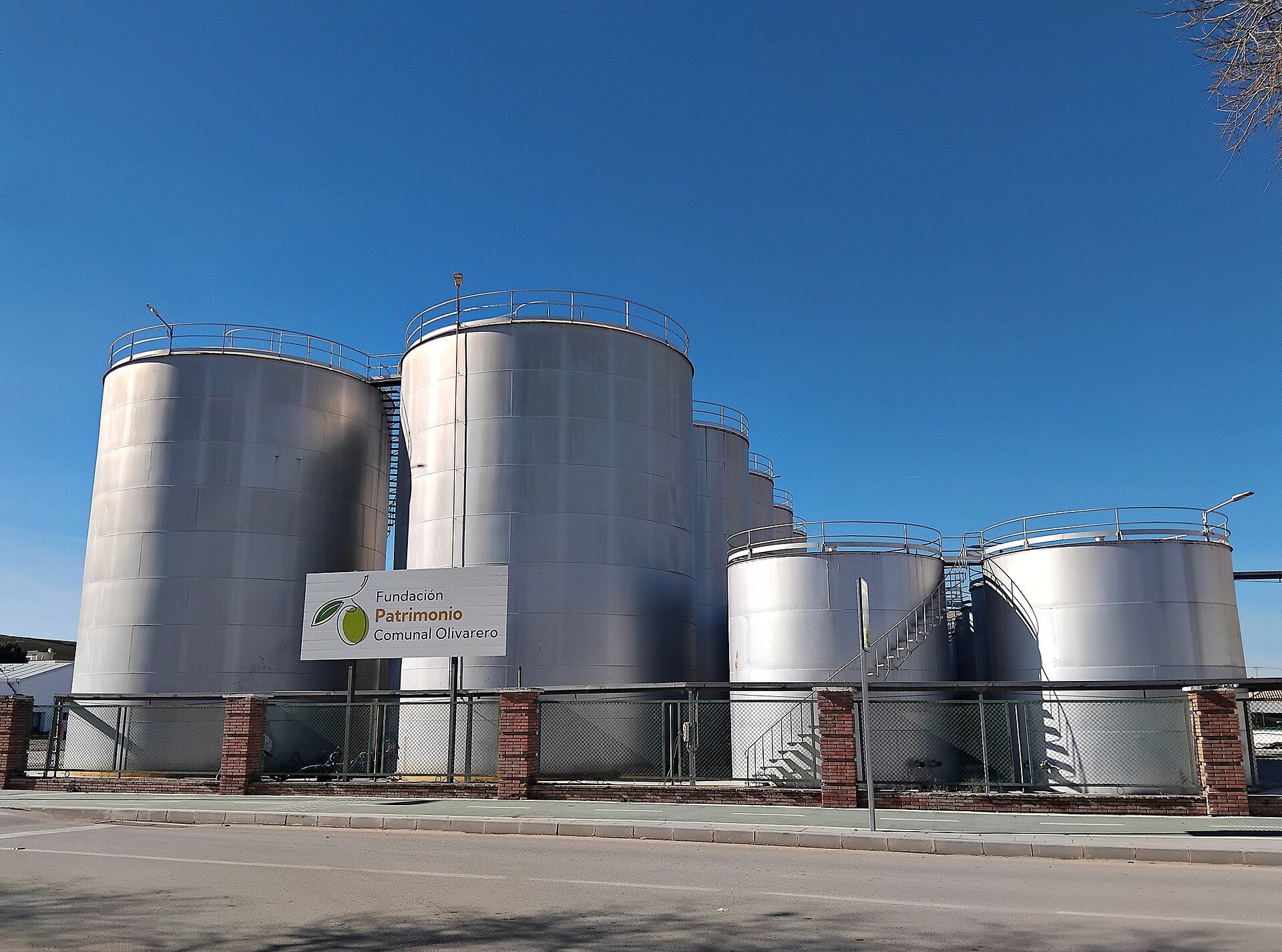
Olive oil storage tanks at the Patrimonio Comunal Olivarero facility in Marchena, Seville. Archive photograph. Photo: CFA1877 / Wikimedia Commons, CC BY-SA 4.0.

Under Spain's withdrawal resolution, mills must set aside 12% of their cumulative production declared from November onward and keep it off the market until 30 September 2027. Mills that sell oil during harvest will receive part of their sales revenue later, while processing and storage bills come due. The OliveTerm Week Ahead explains the reporting timetable.
In Aguadulce, Seville, the Estepa protected designation reported in October that the Puricon cooperative had opened a facility for its extra virgin olive oil. It has 23 stainless steel tanks of 81 tonnes each and eight settling vessels of 27.5 tonnes, for a combined capacity of 2,083 tonnes. The settling vessels also let the cooperative sort incoming oils before assigning them to storage tanks. Mills short of space can rent tanks elsewhere and pay to store oil they cannot yet sell.
A mill declaring 1,000 tonnes of eligible production would have to set aside 120 tonnes. If the entire lot were extra virgin, it would be worth about 364,000€ at the Junta de Andalucía's benchmark of 3.03€/kg for 2–8 November.
In Italy, ISMEA's interest-free lending programme requires mills to show that eligible extra virgin stocks were at least 25% higher on 30 June 2026 than on 30 June 2025. Applications close at noon Italian time on 20 November.
Spain can begin reviewing the amount to be withdrawn from 31 December, with any reduction requiring a new resolution.