

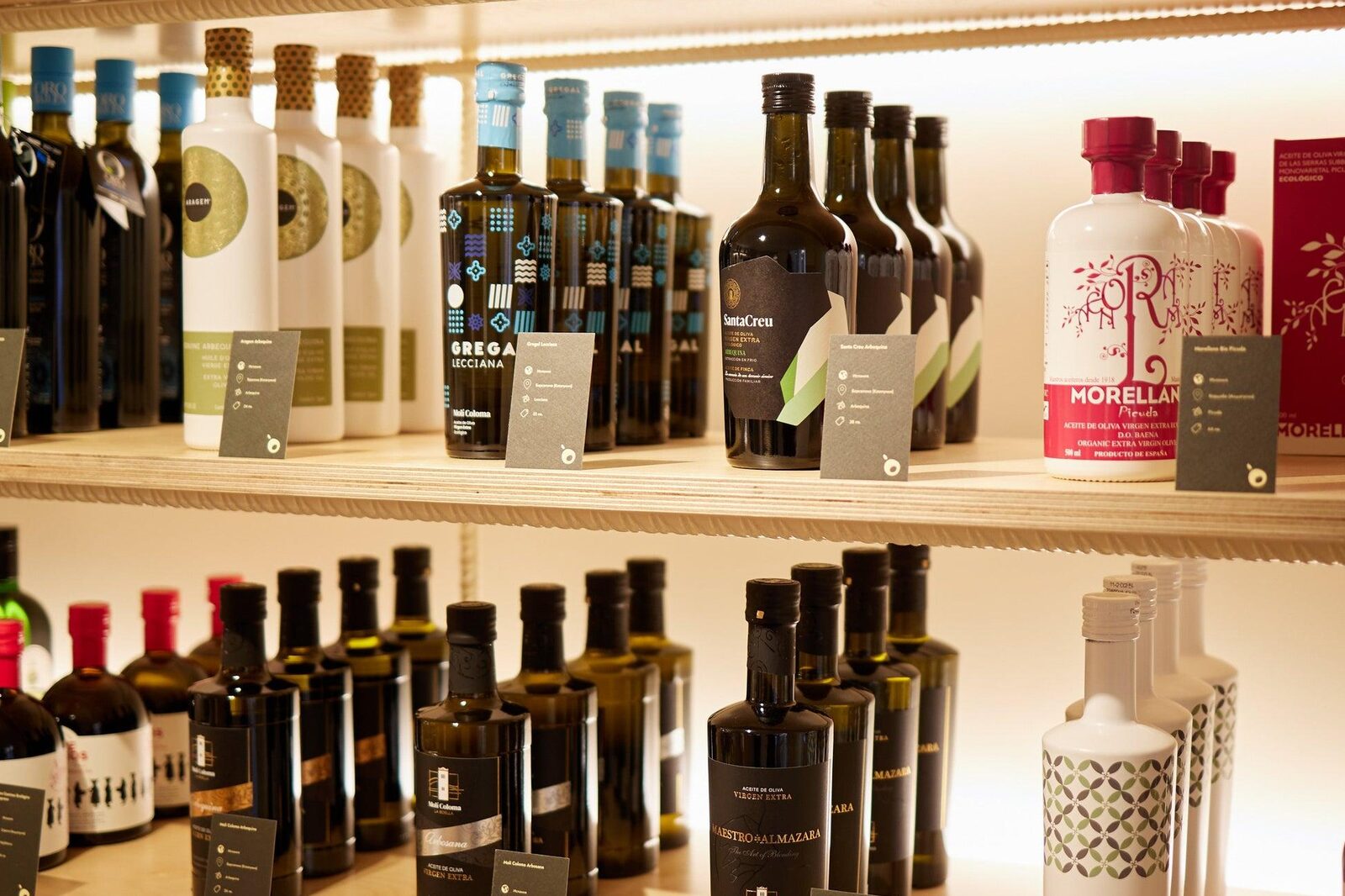
Photo: Oleoteca Urbana, Sofia, Bulgaria
A producer can harvest healthy olives, mill them within hours and store the oil carefully, then find that several bottles competing for the same customer have been made with just as much care. After years of investment, the business has an excellent product and a sales argument that its competitors can also use.
The sector has become much better equipped to produce good oil. Modern mills give operators closer control over processing time and temperature, while research has helped explain how those decisions affect aromas and phenolic compounds. The importance of healthy fruit, prompt milling, hygiene and careful storage is well established. Putting all of this into practice still requires money, judgement and discipline, but the equipment and knowledge are available to competing businesses. As more producers apply them successfully, the methods that helped one business stand out can become standard practice among the suppliers a buyer is considering.
There are still substantial differences between extra virgin oils. The grade sets chemical and sensory requirements; within it, variety, harvest timing and handling leave plenty of room for differences in flavour and freshness. Producing an exceptional oil consistently remains a demanding job.
Much of that work is difficult to appreciate from a bottle on a shelf. A producer tasting two oils may immediately recognise a difference that a customer has no opportunity to discover before buying. Even a customer who notices and enjoys it may be unwilling to pay much more. In a 2013 study in Northern California, researchers found that preferences among consumers judging bottles and labels differed substantially from those recorded in blind tastings of the same oils. Price expectations differed too. A separate choice experiment published in 2021, involving more than 1,000 consumers in north-eastern Italy, found a strong preference for Italian origin. These findings help explain why an oil's commercial appeal can be difficult to predict from its technical merits alone: buyers bring their own preferences, habits and associations to the purchase.
Medals help establish credibility, especially for an unfamiliar producer. But a retailer choosing between several awarded oils still has to decide which one its customers are most likely to buy. The competition result leaves that question open.
For the producer, this can be frustrating. Earlier harvesting, stricter selection and more careful handling may have raised the cost of every litre. Recovering that expense depends on finding buyers who value the result enough to pay for it. Where several producers make similar investments and pursue the same customers, competition within the premium segment can become harder. Each business may be producing better oil while finding it more difficult to secure the price it needs.
A retailer considering two excellent oils has concerns that extend beyond the tasting. Staff need to understand the product well enough to sell it, customers need a reason to try it, and the next order needs to arrive when promised. A producer who organises tastings, explains the oil in terms people can use in their kitchens and keeps stock available is helping the retailer do that job. For a customer, discovering an oil in a restaurant or learning which dishes suit its flavour can provide a much clearer reason to buy than another claim of superior quality. The work involved in selling the oil deserves as much thought as the decision to harvest it early.
That also means looking after what reaches the customer. Heat, light and oxygen can diminish an oil that was excellent at the mill, so storage, packaging and stock turnover remain part of delivering a premium product. A good account of how the oil was made will count for less if the bottle disappoints when it is opened.
The sector is moving towards a higher standard, particularly among producers competing on quality. Earlier harvesting, prompt milling and careful handling provide an established route to fresh, fruity oils with high phenolic content. As these practices spread, that profile becomes a more common production goal. For buyers with several good suppliers to choose from, fruitiness, freshness and high phenolic content can gradually become part of what any extra virgin olive oil is expected to deliver.
For a business already making excellent oil, the next investment may be more useful in helping people discover and use it. A producer can continue improving a product long after those improvements have stopped influencing the customer's choice. Knowing when that point has been reached requires an understanding of the buyer that no laboratory result or competition score can provide.
Sources
- Food Engineering Reviews: Advances in Physical Technologies to Improve Virgin Olive Oil Extraction Efficiency in High-Throughput Production Plants (Juliano et al., 2023: the technologies that give mills control over heating and malaxation, and their effect on phenolic content)
- International Olive Council: Quality Management Guide for the Olive Oil Industry: Olive Oil Mills (T.33/Doc. no. 2-4, 2006: good practice from the olives' arrival at the mill to the storage of the oil)
- International Olive Council: Olive oils (the grades with their chemical and sensory criteria, and storage away from heat, air and light)
- Food Research International: Evaluating bottles and labels versus tasting the oils blind (Delgado, Gómez-Rico and Guinard, 2013: consumer preferences, purchase intentions and price expectations for extra virgin olive oil in Northern California)
- Foods: Consumer Preferences for Origin and Organic Attributes of Extra Virgin Olive Oil: A Choice Experiment in the Italian Market (Carzedda et al., 2021: over 1,000 consumers and the value they place on origin)
- Agriculture: Ripening Crossroads: How Cultivar and Harvest Timing Shape the Extremadura Virgin Olive Oils (Martínez-Cañas et al., 2026: early harvest oils with higher phenolic content and intense green-fruity notes)