

For almost two years, the olive oil market had to confront an uncomfortable question: how much would consumers keep buying if prices remained at exceptionally high levels?
Between 2022 and 2024, the answer was not particularly reassuring. Household consumption fell, shoppers turned more often to cheaper oils, large formats became harder to sell and, even in Spain, where olive oil is part of everyday cooking, demand proved far more sensitive to price than many in the industry had expected.
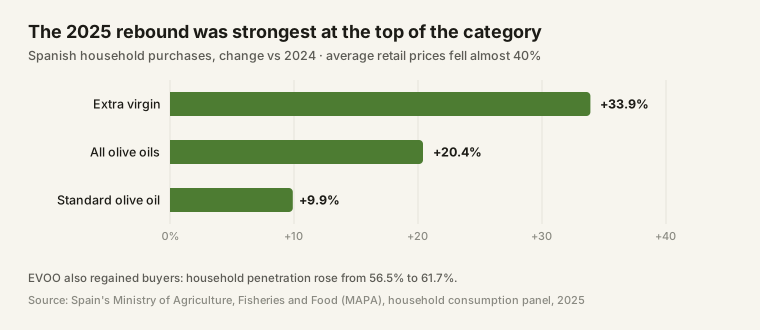
Then prices started to fall. By 2025, Spain offered a much clearer picture of how much of the demand lost during the crisis was actually permanent. According to Spain's Ministry of Agriculture, Fisheries and Food (MAPA), household purchases of olive oils increased by 20.4% during the year. Extra virgin olive oil volumes rose by 33.9%, while average retail prices across the category fell by almost 40%.
A large part of the fall in consumption during the high-price years was clearly temporary. The question now is whether consumers have returned to the same habits they had before the crisis.
What changed during the price shock
The adjustment in household behaviour had been significant. In 2023, Spanish household purchases of olive oils fell by around 15% year on year. Extra virgin olive oil was hit harder, with volumes down almost 24%, while sunflower oil consumption increased by roughly 25%. The pressure continued in 2024, when olive oil volumes fell another 7.6%, sunflower oil gained a further 7.9%, and purchases in the five-litre format declined by 12.6%. One-litre bottles, by contrast, increased slightly.
Much of this can be explained by the size of the purchase itself. When olive oil becomes very expensive, consumers are not only looking at the price per litre. They are also looking at what they have to pay at the checkout. A five-litre container that once represented a fairly routine household purchase suddenly became a much larger expense.
A household that would normally buy five litres may buy one instead, postpone the purchase, use sunflower oil for some types of cooking or save olive oil for the occasions where it matters most. MAPA pointed to this effect in late 2024, noting that the higher upfront cost of larger formats was probably encouraging households to move towards smaller containers even when those containers carried a higher price per litre.
Consumers adapted to the new price environment. The strength of the 2025 recovery suggests that affordability was behind a large part of that change.
Lower prices brought demand back quickly
By the end of 2025, Spanish households had bought 318.7 million litres of olive oils, up from 264.7 million litres a year earlier, while the average price fell from roughly €7.96 to €4.79 per litre.
Extra virgin olive oil reacted even more strongly. Its average price declined by 37.4%, from €8.79 to €5.50 per litre, while household purchases increased from 103.2 million to 138.2 million litres. Household penetration also rose, from around 56.5% to 61.7%. The recovery therefore came from both higher volumes among existing buyers and more households returning to EVOO.
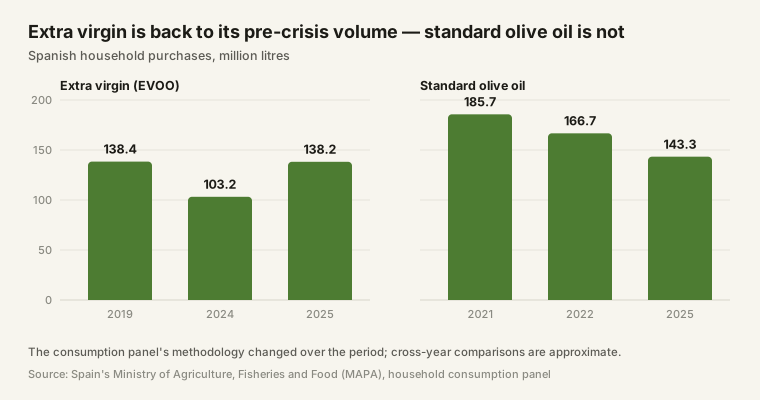
MAPA recorded around 138.4 million litres of household EVOO consumption in 2019, equivalent to roughly 3 litres per person. In 2025, the figure was around 138.2 million litres, or 2.95 litres per person. Changes in the methodology of the consumption panel mean the two years are not perfectly comparable, but the figures still put current household demand remarkably close to its pre-crisis scale.
For many households, EVOO had not become less desirable. It had simply become too expensive.
The middle of the market has recovered more slowly
The recovery has not been the same across all olive oil categories. Standard olive oil has come back far less strongly than EVOO. Spanish households bought around 185.7 million litres of standard olive oil in 2021 and approximately 166.7 million litres in 2022. By 2025, consumption had recovered to only 143.3 million litres.
The difference was also visible during the 2025 rebound itself. Standard olive oil volumes increased by 9.9%, compared with 33.9% for EVOO, even though prices were falling across the market. Its household penetration also slipped slightly, from 52.7% to 51.9%.
The numbers point to a possible change in the way households divide their oil purchases. When price is the main consideration, sunflower oil or another cheaper vegetable oil can replace olive oil altogether. When consumers specifically want olive oil, the premium for EVOO becomes easier to justify once prices return to more normal levels.
That leaves standard olive oil in a more difficult position. It sits between a cheaper alternative on one side and a product with a stronger quality proposition on the other. The consumption panel does not show exactly why individual households make those choices, but the recovery in volumes fits that pattern.
The five-litre container is back
Packaging behaviour points in the same direction. In 2024, purchases of five-litre formats fell by 12.6%, while one-litre formats increased by 2.1%. In 2025, the pattern reversed: five-litre volumes jumped by 33.3% to 197.4 million litres, while purchases of one-litre bottles fell by 5.4%. MAPA linked the shift to lower prices, which once again made it easier for households to buy larger quantities at each shopping trip.
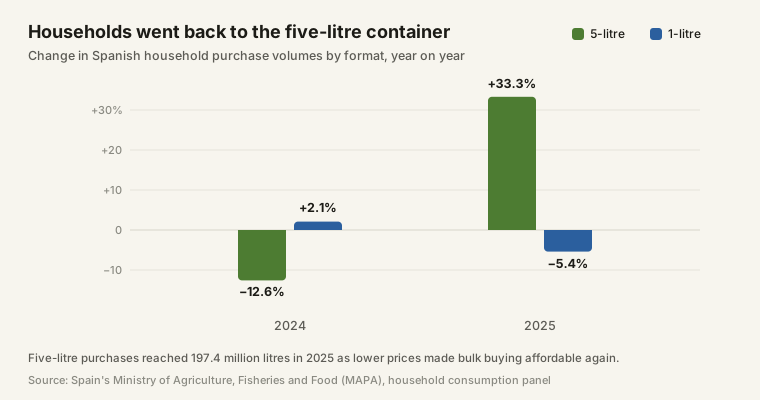
The move back into larger formats is also a sign that households were managing the immediate cost of olive oil during the crisis. Buying one litre at a time limits the amount spent in a single purchase. A five-litre container requires a much larger upfront payment, even when the unit price is lower. Once that payment became more manageable, consumers moved back into larger formats.
The shift towards smaller containers during the high-price period therefore looks much more like a response to affordability than a lasting change in preference.
Not all of the lost volume has returned
Total household olive oil consumption in 2025 remained around 5% below its 2022 level and roughly 11% below 2021. The comparison with 2021 should be treated carefully because at-home food consumption was still unusually strong around the pandemic period, but even allowing for that, some of the volume lost during the crisis remains missing.
Some substitutions may have lasted. A household that previously used olive oil for almost every cooking purpose may have discovered during the crisis that sunflower oil works perfectly well for frying certain foods, while continuing to prefer EVOO for salads, bread, finishing dishes or other uses where flavour and perceived quality matter more. Once that alternative has become part of the routine, there is no guarantee that lower olive oil prices will reverse it completely.
This helps explain how EVOO can return to earlier consumption levels while the broader olive oil category remains below its previous peak. Households may still want olive oil, but use it more selectively than they did before the price shock.
2026 is becoming the second test
The exceptional rebound of 2025 is now starting to settle. In the twelve months to May 2026, household olive oil consumption was still 1.7% higher than in the previous twelve-month period, while EVOO volumes were up 2.8%. Standard olive oil was down 1.4% and sunflower oil down 2.8%. The packaging trend also remained visible, with five-litre purchases up 9.4% on a rolling basis while one-litre volumes fell by 6.3%.
The monthly figures have become much weaker. In May 2026 alone, total household olive oil purchases fell by 17.4% year on year, with EVOO down almost 25%. The comparison is against a very strong period of recovery in 2025, which makes the decline look more dramatic. Larger formats may also be affecting purchase frequency, since households buying five litres at a time need to return to the category less often.
The easy part of the recovery is probably over. Lower prices brought consumers back quickly in 2025, but another year of 20% or 30% volume growth was never likely to follow. The more useful question from here is where consumption stabilises once the rebound fades from the annual comparisons.
Did the price shock permanently change consumer behaviour?
The evidence so far suggests that it did, although the change looks different from what might have been expected when prices were at their peak. Spanish consumers have not permanently abandoned olive oil, and EVOO has recovered particularly strongly. It is back around its pre-crisis household volume, household penetration has increased again, and larger formats returned as prices became more affordable.
The more lasting effect seems to be in the way households manage their consumption. During the crisis, consumers cut usage, moved some cooking to sunflower oil, bought smaller quantities and delayed purchases when the cash cost became too high. Lower prices reversed much of that behaviour, but not necessarily all of it.
The Spanish household oil market now looks somewhat different from the one that entered the crisis. Seed oils remain the obvious choice where price is the main concern, while EVOO has recovered strongly where consumers place a value on olive oil itself. Standard olive oil has been slower to recover and may face increasing pressure between those two ends of the market.
The 2022-24 price shock did not permanently destroy olive oil demand. It did, however, give households several years to rethink how much olive oil they need, which formats they buy and which cooking uses are worth paying more for. That may prove to be the more important change.