


Sociedad Cooperativa San Vicente de Mogón, Samuel Sánchez
Olive oil is barely visible in the world's vegetable-oil supply. That is precisely why its growth potential is so easily misunderstood.
The world is producing close to 238 million tonnes of vegetable oil in 2025/26. Palm oil accounts for roughly 81 million tonnes of that total, soybean oil contributes about 72 million, rapeseed around 36 million and sunflower oil roughly 21 million. Together, these four oils dominate a market whose scale bears little resemblance to the one in which olive oil operates.
The International Olive Council estimates global olive oil production at 3.44 million tonnes this season, following 3.57 million tonnes in 2024/25. USDA's own series is slightly lower, but the broader conclusion is unchanged: olive oil represents only around 1.4% of global vegetable-oil production. On a chart of the world's major oils, the category is almost lost beside palm and soybean, despite several thousand years of cultivation, trade and cultural importance across the Mediterranean.

It is an easy statistic to misuse. One interpretation is that olive oil remains a small niche within the global fats economy and is therefore condemned to remain one; another, common in industry presentations, starts from the opposite premise and argues that even a modest share of the global vegetable-oil market would require an extraordinary expansion in production. Both approaches begin with the same problem, because most of the world's vegetable oil is used in markets that olive oil is never likely to compete for.
The more useful question is therefore not how large the global vegetable-oil market is, but how much of it represents demand that olive oil could realistically displace. Once that distinction is made, the category looks very different.
What olive oil does not compete for
The first major exclusion is fuel. Vegetable oil has become an increasingly important energy feedstock alongside its traditional role in food, particularly through biodiesel and renewable diesel. The International Energy Agency estimated that the share of global vegetable-oil production used in biofuels would rise from 17% in 2022 to 23% by 2027, equivalent to around 54 million tonnes. More recent USDA figures point in the same direction, with industrial use of vegetable oils, much of it connected to biofuel production, expected to reach 68.6 million tonnes in 2026/27.
None of that volume belongs in a realistic addressable market for olive oil. The economics alone make the comparison meaningless, and extra virgin olive oil is clearly not competing for a place in a diesel tank. Europe illustrates just how significant this diversion can become: between 2015 and 2019, EU countries and the UK used an estimated 58% of the rapeseed oil they consumed for biodiesel. The precise percentage has changed since then, but the underlying point remains relevant because a substantial part of vegetable-oil demand now originates outside the food system altogether.
Industrial fats represent another large block of demand that cannot simply be placed alongside olive oil. Palm oil's dominance is partly explained by characteristics that make it especially useful to manufacturers: it is relatively inexpensive, semi-solid at room temperature and can be separated into fractions with different melting properties. Those qualities have made it a standard input in margarines, shortenings, confectionery, bakery products, instant foods and the wider oleochemical industry.
These applications generally require functionality, consistency and commodity-level pricing rather than the flavour profile or premium positioning associated with olive oil. A manufacturer choosing a neutral, plastic fat for a biscuit or confectionery coating is solving a fundamentally different problem from a household deciding what to pour over a salad or use for roasting vegetables.
The same is true, to a large extent, of high-volume commercial frying. Olive oil is considerably more heat-stable than some consumer perceptions suggest, but restaurants and food manufacturers buying very large quantities of frying oil still make decisions heavily on price, durability and operating economics. At the premium normally commanded by olive oil, most of this market is unlikely to migrate in any meaningful way.
Palm oil should not be excluded entirely, since it is also a household cooking oil in many parts of Asia and Africa, but the portion that could plausibly be substituted by a premium Mediterranean oil is far smaller than total palm consumption suggests. The same distinction applies across the broader vegetable-oil complex: total production is not the same thing as commercially contestable demand.
What remains is a narrower market made up primarily of liquid oils used where consumers, chefs and restaurants retain some discretion over quality. This includes cooking, roasting, dressing, marinating and finishing, as well as the supermarket shelf where sunflower, canola, soybean and olive oil compete directly for household spending.
There is no official statistical series that captures this market neatly. USDA food-use data include oils that eventually enter manufactured foods, restaurants and other processing channels, which means they cannot simply be treated as a proxy for household cooking-oil demand. OliveTerm's working estimate therefore places the genuinely substitutable global market in a broad range of 60 to 90 million tonnes a year, with 75 million tonnes used as a practical midpoint. It is an analytical estimate rather than an official USDA or IOC statistic, but it provides a more useful denominator for understanding olive oil's competitive position.
Against that midpoint, global olive oil production of 3.44 million tonnes represents a share of roughly 4.6%, rather than the 1.4% suggested by comparison with the entire vegetable-oil complex.

The real addressable market
This distinction changes the growth equation considerably. Olive oil does not need to capture a meaningful share of the entire global fats market to expand significantly; it only needs to gain ground within a much smaller culinary market where substitution is already possible.
Using a 75 million tonne addressable market, each additional percentage point of share would correspond to roughly 750,000 tonnes of olive oil demand. That figure is equivalent to around 22% of current global production, which helps explain why relatively modest changes in consumer behaviour can have an outsized impact on such a small underlying industry.
It is worth putting those shares into production terms. At the 75 million tonne midpoint, moving from today's roughly 4.6% of the contestable market to 6% would require about 4.5 million tonnes of olive oil a year, roughly 30% more than the industry currently produces. Reaching 8% would take around 6 million tonnes, and doubling today's share would push the requirement towards 7 million tonnes — twice current world production. Demand growth on that scale only materialises if supply can eventually follow, which is why the investment cycle discussed later in this analysis matters as much as the consumer trend.
The United States offers perhaps the clearest example. American olive oil consumption has risen from roughly 28,000 tonnes in the early 1970s to more than 400,000 tonnes in recent years, turning a country with little domestic production and no large historical olive-oil culture into one of the industry's most important demand centres.
In 2023/24, the United States moved ahead of Spain to become the world's second-largest consuming country behind Italy, although that comparison needs context. The change was not the result of a sudden surge in American consumption; it also reflected the sharp contraction in Spanish demand during a period of exceptionally high prices. The longer-term US trend is more informative because it shows a sustained shift in consumption over several decades rather than a temporary reshuffling of country rankings.
USDA estimates that olive oil still accounts for just under 5% of the vegetable oils used for food in the United States. Even after decades of growth, its penetration remains low relative to the size of the market, which suggests that the American success story is not close to exhausting its potential.
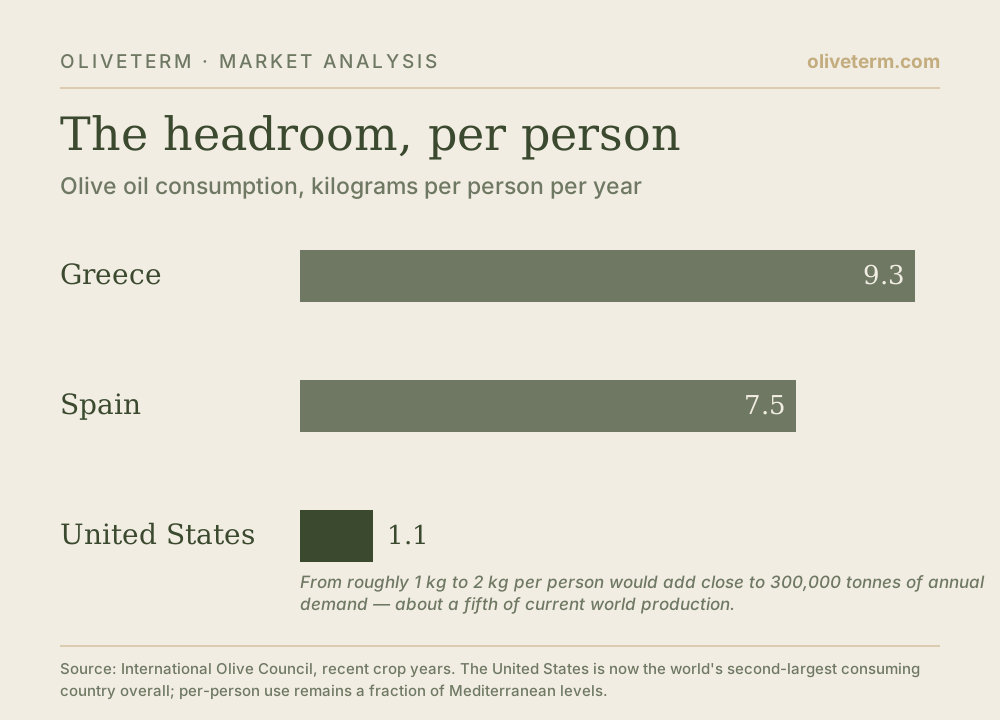
The per-capita comparison makes that headroom easier to see. Recent International Olive Council data place US consumption at around 1.1 kilograms per person, compared with approximately 7.5 kilograms in Spain and 9.3 kilograms in Greece. The United States does not need to approach Mediterranean consumption levels for the effect on world demand to become material. An increase from roughly one kilogram per person towards two, still far below Spanish or Greek norms, would imply something approaching 300,000 additional tonnes of annual consumption before allowing for population growth.
Other non-Mediterranean markets offer similar theoretical potential, although their growth paths are less predictable. Brazil and Japan remain at relatively low levels of per-capita consumption, while China's olive oil market is still extremely small compared with the size of its population. Recent trade data in all three markets have been uneven, which is why low penetration should be viewed as potential rather than as an automatic forecast of future demand.
What the American experience demonstrates is that olive oil can move from an imported speciality into the mainstream grocery basket without requiring consumers to adopt Mediterranean habits wholesale. The commercial opportunity lies in gradual substitution, with households using olive oil in meals where they might previously have reached for canola, soybean or sunflower oil.
Health is an advantage, not a monopoly
Health has played an important role in that substitution, although the case should be made more carefully than it often is in consumer marketing. The Mediterranean diet has accumulated an unusually substantial body of clinical evidence, including the PREDIMED trial, in which participants assigned to a Mediterranean diet supplemented with extra virgin olive oil experienced fewer major cardiovascular events than the control group.
That research gives olive oil a strong position among edible oils, particularly when combined with its high content of monounsaturated fat and, in extra virgin oils, the presence of polyphenols and other minor compounds. It also benefits from a consumer proposition that is unusually easy to understand: olive oil is associated with a recognisable agricultural product, a traditional food culture and a dietary pattern that has been studied for decades.
None of this requires the argument that competing seed oils are inherently unhealthy. Major medical organisations, including the American Heart Association, continue to recommend liquid unsaturated oils such as canola, soybean, sunflower and olive oil in place of saturated fats. The current cultural backlash against so-called seed oils may influence consumer behaviour at the margins, particularly in the United States, but it should not be confused with a settled medical consensus.
Olive oil does not need its competitors to be unhealthy in order to have an advantage. Its commercial position rests instead on the combination of favourable nutritional characteristics, the polyphenols present particularly in extra virgin olive oil, distinctive flavour, agricultural provenance and a culinary identity that allows it to compete on more than price alone. Few major edible oils can sell simultaneously on health, taste, origin and premiumisation, which gives olive oil a position that is difficult to replicate through commodity marketing.
The biofuel effect
There is also a less visible source of support developing within the broader vegetable-oil market. Some of olive oil's largest competitors now have significant buyers outside food, as soybean, rapeseed and palm oil are increasingly pulled into biodiesel, renewable diesel and, to a smaller extent, sustainable aviation fuel.
In the United States alone, USDA expects around 14.7 billion pounds of soybean oil, approximately 6.7 million tonnes, to be used for biofuel in 2025/26, with the forecast for 2026/27 higher again. This does not mean that olive oil will automatically become cheaper relative to seed oils, since its own prices remain highly exposed to Mediterranean harvests and can widen dramatically during periods of poor production.
What biofuel demand does change is the competitive structure. Soybean and rapeseed oil are no longer priced solely by food demand, and energy policy has created an additional source of consumption for products that also compete for space on the supermarket shelf. The IEA has already noted that stronger biofuel demand can support vegetable-oil prices and reduce export availability, particularly in markets such as the United States.
For olive oil, the effect is therefore better understood as a relative tailwind than as a guarantee of convergence. If competing seed oils face structurally stronger demand from the energy sector, the price advantage they have traditionally enjoyed in food markets can become somewhat less pronounced at the margin, even though olive oil will continue to trade at a substantial premium in most circumstances.
Supply still moves on a different clock
The supply side is where olive oil diverges most clearly from annual oilseeds. If sunflower, soybean or rapeseed prices rise sufficiently, farmers can alter planting decisions during the next crop cycle. There are obvious constraints around land, weather and input costs, but the basic supply response can occur relatively quickly.
Olive orchards operate on a much longer investment horizon. Modern production systems have shortened the wait considerably, and a well-managed super-high-density orchard can begin bearing commercially useful fruit in its second or third year and reach substantial production within roughly four to six years. Traditional orchards generally take longer, while local climate, cultivar, irrigation and management can alter the timetable significantly.
Even under modern systems, however, the industry cannot respond to a demand shock in the way an annual crop can. New land must be acquired or converted, trees planted, irrigation developed where water is available, machinery secured and processing capacity positioned close enough to the groves to handle the fruit quickly. Capital is committed years before the orchard reaches its mature economics, and the resulting asset remains exposed to weather over a productive life measured in decades.
Water is becoming the most difficult part of that equation. The Mediterranean is widely regarded as one of the regions most exposed to climate change, and the poor European harvests of 2022/23 and 2023/24 demonstrated just how concentrated the industry's supply risk remains. USDA estimates that global olive oil production fell by almost 30% over those two seasons, tightening stocks, pushing origin prices to record levels and eventually reducing consumption in traditional markets.
Production recovered strongly in 2024/25 and remained comparatively healthy into 2025/26, but the structural vulnerability did not disappear with the return of a larger crop. Spain alone remains responsible for such a large share of world supply that weather across Andalusia can still alter the global balance within a single season.
This is the central asymmetry behind the category. Consumer demand can change relatively quickly, particularly in large import markets where olive oil penetration is still low, while meaningful additions to productive capacity require land, water, capital and several years of development. Supply is not fixed, but it is substantially less elastic than in most of the oils with which olive oil competes.
The thesis
The 1.4% figure makes olive oil look insignificant because it uses a denominator that says little about the market the industry can realistically address. Olive oil does not compete with the entire vegetable-oil complex and has little relevance to biodiesel, industrial shortening, oleochemicals or most high-volume frying applications. Its commercial opportunity lies instead in the smaller market where consumers and food businesses choose a liquid culinary oil and are willing to pay more for quality, flavour, provenance or perceived health benefits.
On OliveTerm's working assumptions, olive oil currently represents roughly 4–5% of that addressable market. That is still a small share, but it becomes much more meaningful when set against an industry producing only around three and a half million tonnes a year. At that scale, one percentage point of additional share in the relevant market would be equivalent to more than one fifth of current global output.
The growth case therefore does not depend on the world abandoning palm, soybean or sunflower oil. It rests on a much more ordinary process of substitution: households changing the bottle beside the stove, restaurants spending a little more on the oil that reaches the table, and consumers in large non-Mediterranean markets gradually incorporating olive oil into meals where another vegetable oil would previously have been used. None of those changes is especially dramatic at the level of an individual consumer, but in a market of this size, relatively modest shifts in behaviour can translate into substantial changes in global demand.
That is ultimately why olive oil's small share of the world's vegetable-oil supply should not automatically be read as evidence of a small future. The more relevant measure is the share it holds within the part of the market it can plausibly win, and at around 4–5%, there remains considerable room for substitution before the industry comes close to anything resembling saturation.
Sources: USDA Foreign Agricultural Service, Oilseeds: World Markets and Trade; USDA Economic Research Service, Oil Crops Outlook; USDA World Agricultural Supply and Demand Estimates; International Olive Council; International Energy Agency; American Heart Association; PREDIMED; University of California Agriculture and Natural Resources. Addressable-market range and midpoint are OliveTerm analytical estimates and are not an official USDA or IOC statistical series. Figures generally refer to 2025/26 unless otherwise stated.