

Spring 2026: The Flowering Season Will Make or Break the Next Campaign
The olives are in. The mills are winding down. And now, as happens every year around this time, the entire Mediterranean holds its breath. Because what happens between April and June, during those few short weeks of flowering, will decide whether 2026/27 is a season of abundance or another year of sweating over supply.
Let's take stock of where we are, what went wrong, what went right, and what to watch next.
Data as of: March 24, 2026 | Sources: IOC · Certified Origins · MAPA · Olivum · ISMEA · ONH
The Season That Just Ended: A Reality Check
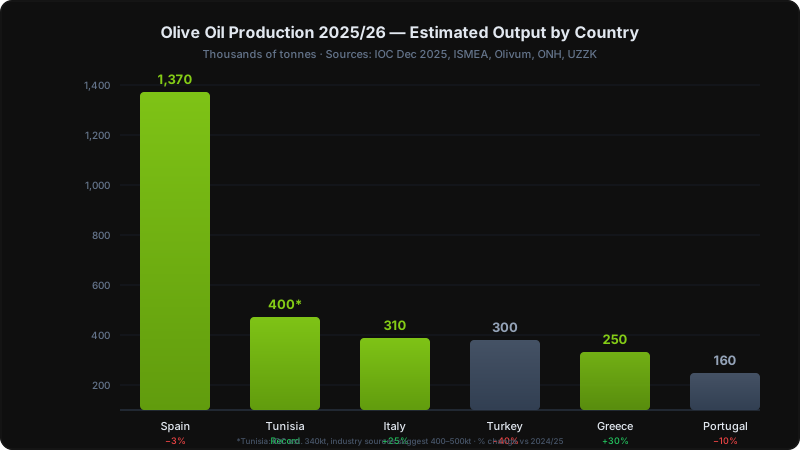
The 2025/26 campaign came in at roughly 3.44 million tonnes globally, according to the IOC. That's a 4% dip from last year's strong rebound, but still a world away from the 2023/24 nightmare, when production cratered to just 2.4 million tonnes and prices went haywire.
So: decent, but not great. And beneath that headline number, the country-by-country story is far more interesting.
Spain, the 800-pound gorilla of olive oil, finished around 1.37 million tonnes. On paper, that's only 3% below last year. But it came with drama. Persistent rainfall battered Andalusia in November and December, cutting effective harvesting days in Jaén and Córdoba. By end-December, cumulative production sat at 716,000 tonnes, with national stocks running 24% below the same point a year earlier. The initial AFORO had pencilled in 1.44 million tonnes; the final figure missed by a good margin.
The consolation? All that rain soaked the soil. Moisture reserves heading into spring are better than they've been in years. That could matter enormously in two months' time.
Italy bounced back from a rough 2024/25 (just 248,000 tonnes, its worst in a decade) to an estimated 310,000 tonnes, a 25% jump driven by strong performances in Puglia, Calabria, and Sicily. Still, that barely matches Italy's own five-year average of 307,000 tonnes. The structural decline of Italian olive oil production is real and ongoing, even if nobody in Rome likes to talk about it.
Greece came in at around 250,000 tonnes, up 30% from last year's disappointing 192,000. Sounds impressive, except that the five-year average is 262,000 tonnes, so Greece is actually still below its own norm. Drought in Crete and olive fly problems in scattered regions capped what could have been a stronger recovery.
Portugal had a tough year, and the data confirms what producers on the ground already knew. Production fell to roughly 160,000 tonnes, a 10% decline from 2024/25's near-record 177,000. The INE (National Statistics Institute) had initially feared a 20% drop, so the final figure is bad but not catastrophic. What happened? A brutal summer of scorching heat followed by spring winds that caused flower drop in the Alentejo, combined with cold, wet conditions in Trás-os-Montes that hammered fruit set. Forest fires also destroyed significant areas of traditional groves in the north.
A word on Trás-os-Montes, because it's often mischaracterised: this is not Portugal's irrigated powerhouse. Quite the opposite. Trás-os-Montes is rugged mountain country: small family farms, indigenous varieties like Cobrançosa and Verdeal, overwhelmingly rainfed. It's Portugal's soul of olive oil, its quality heartland, but also its most climate-vulnerable region. The irrigated super-intensive groves? Those are in Alentejo, which now accounts for 85% of national production volume despite covering only half the grove area. Two very different worlds.
Tunisia is this season's wild card. The IOC's December estimate pegged output at 340,000 tonnes (+55%), but industry sources, including the head of Tunisia's Olive Producers Chamber, suggest the real number could be 400,000 to 500,000 tonnes. If confirmed, that would be a national record, eclipsing even the bumper 2019/20 campaign. Tunisia is quietly becoming the world's number two producer, overtaking Italy. The irony: all this abundance is crashing into a 25% US tariff and collapsing export prices, leaving Tunisian producers with record volumes but shrinking margins.
Turkey tells the opposite story. After smashing its own record in 2024/25 with roughly 475,000–505,000 tonnes (making it briefly the world's second-largest producer), the 2025/26 campaign has crashed back to earth. Official estimates from the UZZK put output at 310,000 tonnes; the IOC is even more conservative at 280,000–290,000. That's a 40%+ decline, driven by the classic alternate-bearing hangover after a massive on-year, compounded by a harsh winter and summer drought.
The Four Things That Will Define the Next Campaign
The 2025/26 harvest is done. What happens between now and July writes the opening chapter of 2026/27. Four variables will dominate, and the first two are non-negotiable.
1. Spring Rainfall: The Make-or-Break Variable
Nothing matters more than water between March and May. This is when flower buds develop, and adequate soil moisture is the difference between a tree that flowers vigorously and one that struggles. The good news: Spain's winter rains have left reservoirs and soil profiles in better shape than a year ago. The question is whether April and May deliver follow-through, particularly across Andalusia, Extremadura, and the Portuguese interior.
In Trás-os-Montes, where there's no irrigation safety net, this is existential. In Alentejo's drip-irrigated hedgerows, it's a cost calculation. Same country, completely different exposure.
2. Flowering: 15 Days That Can't Be Undone
Olive trees across the Mediterranean flower between late April and mid-June, depending on latitude and variety. The critical window is roughly 15 days around full bloom, and what happens during those two weeks is irreversible. The tree doesn't get a second chance.
Cold nights below 7°C slow pollen germination to a crawl. Heat spikes above 35°C desiccate pollen and dry out the stigma. Either scenario, sustained for even a few days, can devastate fruit set across entire regions. Last year, Spain's flowering was described as "spectacular." Whether 2026 repeats that is anyone's guess until the trees actually bloom.
3. The Alternate Bearing Shadow
Olive trees have a biological clock that alternates between high-output "on" years and subdued "off" years. After Spain's exceptional 2024/25 rebound (+66% versus the drought year before it), the natural rhythm points toward moderation. This is already partly visible in the current campaign's slight decline.
Modern intensive groves (Arbequina hedgerows, drip-irrigated, mechanically harvested) are less subject to this cycle. But traditional rainfed orchards, which still dominate in Jaén, across Greece, and in Trás-os-Montes, remain fully exposed. The alternate bearing effect won't disappear just because the market needs supply.
4. The Olive Fly: A Warming Problem
Bactrocera oleae builds up through spring and peaks in late summer. Warm, humid springs are ideal breeding conditions. What's changing is the geography: climate warming is pushing the fly's viable range to higher altitudes and further north, threatening groves that a decade ago were considered safe. Parts of northern Italy now report regular infestations. IOC monitoring reports from May onwards will give the first signals.
Prices: Down From the Peak, But Don't Expect Pre-Crisis Levels
EVOO at origin has dropped 30–45% from the 2024 records, depending on the origin. The supply recovery across Spain, Turkey, and Tunisia has taken the panic premium out of the market. But here's the thing: prices haven't returned to where they were before the crisis, and there are good reasons to think they won't.
Production costs are structurally higher. Labour, fuel, fertiliser, phytosanitary inputs: all up. Irrigation investment is accelerating. And the market has learned, painfully, that climate can wipe out an entire campaign. That risk premium isn't going away.
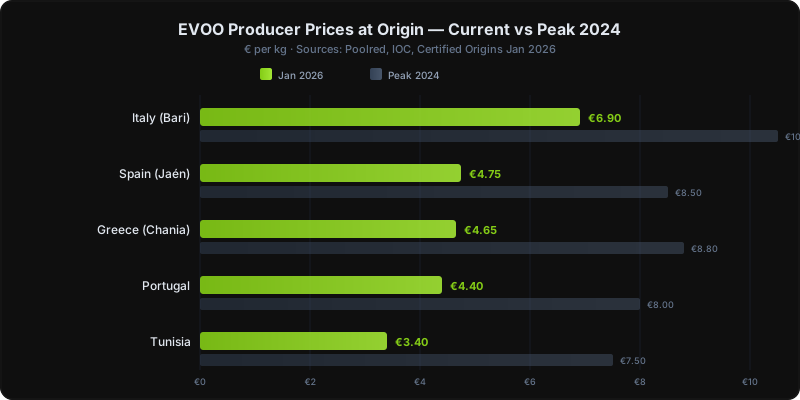
Spanish operators continue to defend the €4.50–5.00 range, citing that actual volumes came in 30% below December 2024 and that demand, from both Europe and the US, has picked up. Italy, as always, commands a premium: €6.90/kg for conventional, €7.40 for organic. The gap has narrowed from roughly double to 1.4–1.5x, but Italian EVOO remains in a different price universe.
Portugal briefly traded below Spanish origin in January, a telling sign of competitive pressure. And Tunisia, despite record volumes, is being squeezed between collapsing export prices (down 46% year-on-year for bulk) and a punishing 25% US tariff that came into effect in August 2025.
Three Scenarios Through the End of the Year
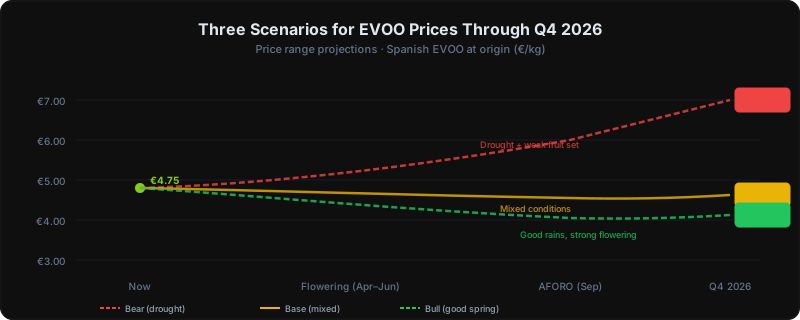
The spring period is binary. What happens during flowering sets the market's expectations for autumn and, by extension, prices through year-end.
🟢 Good Spring: Rains Hold, Flowering Is Clean
Adequate rainfall through May. Mild temperatures during bloom. Low olive fly pressure. Spain, Greece, and Portugal signal solid flowering intensity. The trade starts talking about a comfortable 2026/27 crop.
Price outlook: Prices ease gradually. €4.00–4.50 range for Spanish EVOO by Q3–Q4 2026.
🟡 Mixed Signals: Some Regions Up, Some Down
Uneven rainfall. Good conditions in some basins, below-average in others. Alternate-bearing effects moderate output in Andalusia. The market grinds sideways, absorbing current supply without drama.
Price outlook: Largely flat. €4.50–5.00 range through year-end.
🔴 Drought Returns: Weak Fruit Set, Market Re-Tightens
A dry April–May depletes soil moisture before full bloom. Heat events or late frost damage flowering across the Iberian Peninsula. Combined with alternate-bearing dynamics, early forecasts for 2026/27 point to a sharply reduced crop, and the price cycle resets upward.
Price outlook: Rally risk. €6.00+ by Q4 2026 if early AFORO signals are bearish.
The Calendar: Five Dates to Circle
April 2026: IOC Spring Statistical Bulletin. Updated production and trade figures for the second half of the marketing year. Watch for revisions to Spain, Tunisia, and Turkey.
Late April to Late May: Flowering Period. This is the window. Agronomic reports from Andalusia, Apulia, the Peloponnese, Alentejo, and Trás-os-Montes will start filtering through. Regional ministries, cooperatives, and industry bodies will issue the first qualitative assessments.
Ongoing: US Tariff Developments. The 25% tariff on Tunisian goods (effective August 2025) sits alongside a 15% EU tariff under the July 2025 deal. The Supreme Court struck down the original IEEPA tariffs in February 2026, and Trump imposed a new 10% rate under Section 122. The landscape remains fluid; any shift directly reshapes bulk olive oil trade routes.
Q2–Q3 2026: EU-India & EU-Mercosur FTA Ratification. The EU–India FTA, concluded January 27, 2026, would reduce India's 45% olive oil tariff to zero over five years. The EU–Mercosur deal opens South American channels. Both await parliamentary ratification. If implemented, they represent the most significant structural demand expansion for Mediterranean olive oil in a generation.
September–October 2026: Spain's First AFORO. The Junta de Andalucía's official crop estimate for 2026/27. This single data point moves the market more than anything else on the calendar. Preliminary field signals may circulate in industry channels from late August.
This report is produced for informational purposes only. OliveTerm aggregates publicly available industry data and does not constitute investment, trading, or commercial advice. All production and price figures are estimates subject to revision.
Sources: IOC Dec 2025 & Jan/Feb 2026 Statistics · Certified Origins Jan 2026 Market Report · Olivum · ISMEA · MAPA/AICA · ONH · UZZK
© OliveTerm · oliveterm.com