
1. Executive Summary
The first ten days of May firmed Spain origin noticeably. After consolidating in EUR 430-450/100 kg through April, Jaén pushed to EUR 458 in the first week of May and hit EUR 467 in the May 5-9 Poolred session. Daily turnover stayed healthy, so this is active buying, not a thin-market drift. Three things behind it: lingering caution after the late-April heat spike; US importers leaning into procurement ahead of the July 24 Section 122 expiry; and EU stocks coming in below where buyers had assumed they would.
Italy (Bari) firmed modestly to EUR 645/100 kg. Greece (Chania) at EUR 460, tracking Spain higher. Portugal at parity with or just below Spain. Tunisia nudged up to EUR 3.55-3.65/kg — the first real upward move since the 2025 correction started.
2026/27 is now the dominant narrative. Andalusian fieldwork shows flowering broadly normal in the west of the region but heat-stressed in eastern Jaén, Granada and Almería, where the late-April episode compounded with a second short heat event in early May. Italy and Greece are still fine. The IOC June meeting, which usually puts out the first formal 2026/27 production estimate, is the next big reference point.
On policy: no extension of Section 122 signalled. Press reports have the administration deliberating a Section 232 edible-oils investigation, but no formal initiation yet. The CIT keeps processing IEEPA refund claims.
2. Origin Prices by Country
Spain (Jaen)
Jaén opened May at EUR 458/100 kg and was at EUR 467 by the May 5-9 session — the highest weekly average since the brief late-2024 spike. +9% YoY, +4% MoM. Mill, bottler and bulk stocks combined sit at ~380-410 kt, roughly 26% below the same point of 2024/25 and the lowest May reading in five years. Poolred turnover averaged 6,800 t in the first week of May. Retail bulk: EUR 4.85-5.10/kg conventional, EUR 5.55-5.85/kg organic.
Italy (Bari)
Bari to EUR 645/100 kg in early May, reversing some of the April drift. The Italy-Spain spread narrowed to ~EUR 178/100 kg. Italian bottlers' Q3-Q4 buying programmes are reportedly running on schedule despite Spain's strength.
Greece (Chania)
Chania at EUR 460/100 kg, +9% YoY, tracking Spain. Greek closing stocks are tight — cooperatives and large bottlers are sitting on inventory waiting for further upside before the new harvest.
Portugal
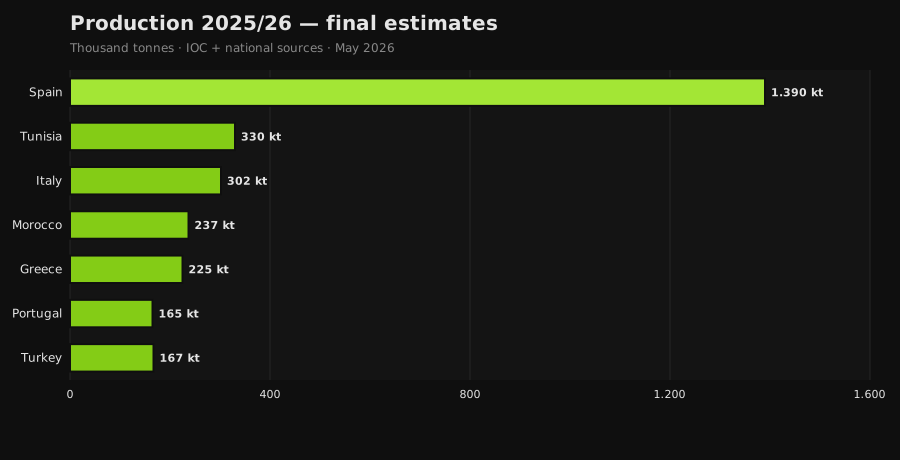
Portugal in EUR 445-460/100 kg. Casa do Azeite has put 2025/26 final national output around 165 kt — towards the lower end of pre-campaign estimates, but a normal-to-strong number.
Tunisia & Turkey
Tunisia: EUR 3.55-3.65/kg conventional, EUR 4.00-4.10/kg organic. First real upward move since late 2024, on strong export commitments to Spain, Italy and the US. The ~EUR 100/100 kg gap to Spain keeps the Tunisian programme attractive. Turkey: domestic firming, export licensing under selective restriction as the government balances domestic affordability against revenue.
Global Benchmark (USA)
IMF/FRED for April (latest): USD 5,950/t. Partial-May bulk data suggests a return to USD 6,000-6,100/t.
3. Consumer Price Dynamics
The European retail correction is plateauing. Eurostat's April HICP reading was -0.8% MoM, the smallest monthly move in fourteen months. From the 2024 peak: Spain -32%, Greece -28%, Portugal -24%, Italy -13% at the EU-4 level.
Import markets are still in their long tail. Germany -15% YoY through April, France -10% — but the pace is slowing. UK retail prices have stabilised in the past two months as the bulk-price tailwind fades.
Volume recovery is the headline. Spanish retail volumes are +21% YoY in April, about 60% of the 2024 volume loss recovered. The remaining gap is concentrated in the lowest income quartiles, where consumer substitution to seed oils has proven sticky.
4. 2026/27 Campaign — Flowering & Field Conditions
4.1. Andalusia
Flowering across Andalusia opened on the normal calendar but hit two heat events — April 26-29 (33-36°C) and May 4-6 (32-35°C). Cooperative agronomists in Jaén, Granada and Almería put fruit set in the affected sub-regions 12-22% below normal. Sevilla, Córdoba and Málaga — where the events were less intense and orography softened them — look broadly normal. The Junta de Andalucía's first formal survey publishes June 5.
4.2. Castilla-La Mancha & Extremadura
Both regions favourable. Spring rainfall adequate, soil moisture above norms, no major heat events. Early read points to a fruit set at or modestly above the 5-year average.
4.3. Italy & Greece
Italy across Apulia, Calabria and Sicily remains favourable. Greece is just opening its window — Crete and the Peloponnese broadly normal, with adequate but not abundant soil moisture. Localised concerns persist in eastern Crete, where rainfall has been below trend.
4.4. Tunisia & Morocco
Tunisia flowers later than the European producers and is just starting. Soil moisture below the long-term average across central and southern Tunisia after a dry winter — already showing up in Tunisian forward offers. Morocco favourable.
5. Trade & US Tariff Developments
5.1. Section 122 Countdown
July 24 expiry. About 10 weeks out, no public signal of extension — the market is pricing a tariff-free window from late July into Q3, possibly extended if no Section 301 or 232 replacement is in place.
US importers have shifted accordingly. Major bottlers and private-label suppliers are timing inbound shipments to land after the expiry; several large buyers delayed Q2 contracted volumes and re-tabled them for July-August arrival. That backloading is one of the main reasons Spanish and Greek origin prices are firming.
5.2. Section 301 / 232 Watch
Press reports cite administration officials deliberating a possible Section 232 national security investigation on edible oils. No formal initiation announced. Section 232 needs a Commerce Department finding and can produce tariffs in 4-9 months from initiation. Section 301 — country/practice-specific — doesn't appear to be the favoured vehicle.
5.3. CIT Refund Status
CIT has now ordered roughly USD 71 billion in refunds across all sectors. Olive oil specifically: refund processing roughly 60% complete, the rest expected by end-Q3.
5.4. EU Trade File
EU-Mercosur is in second-stage ratification — European Council formal vote scheduled May 21. The olive oil tariff schedule is a phased reduction over five years, first cut on entry into force. EU-India: working level, no breakthrough expected before Q4.
6. 2026 Outlook & Updated Price Scenarios
6.1. Base Case (probability ~50%)
Jaén trades EUR 450-490/100 kg through Q3. Section 122 lapses, brief tariff-free window, then either a Section 232 finding (low-moderate probability within 90 days) or a congressional extension (low probability) creates a new regime. The June 5 Andalusian survey comes in moderately below normal in the eastern provinces but within tolerable bounds, producing a 1.30-1.45 Mt 2026/27 Spain estimate.
6.2. Downside (probability ~20%)
June 5 survey stronger than expected. Italy and Greece favourable through their flowering. Section 122 expiry generates only a modest US demand pulse, and the market re-prices to the pre-2024-cycle EUR 380-430/100 kg range by late Q3.
6.3. Upside (probability ~30%)
June 5 confirms material heat damage in eastern Jaén, Granada and Almería. A Section 232 olive oil tariff initiated by mid-Q3 produces sharp backloading of EU-origin US-bound exports. Jaén tests EUR 510-580. This probability has been creeping up since March — both the weather and the trade policy signals are pointing the same way.
7. Strategic Recommendations
Front-load Q3 US contracts. Section 122 out July 24, Section 232 risk on the other side — prioritise July-August arrival programmes and lock shipping windows now.
Hold conservative inventory through June 5. That survey is the single most important data point of the next sixty days. No major directional positioning before it lands.
Indexed contracts for Q4. With the Q3 uncertainty range running EUR 380-580/100 kg, fixed-price Q4 commitments are asymmetric. Poolred- or IOC-indexed contracts are the better default.
Push non-US channels. Brazil under EU-Mercosur is an immediate-term lane, not a long-term plan.
Quality programmes are margin protection. Tunisian floor at EUR 3.40-3.65/kg — certified, branded, traceable oils are the only ones with sustainable margin in a downside.
Disclaimer: This report is prepared using publicly available data from the International Olive Council (IOC), European Commission, FRED/IMF, Poolred, Eurostat, Casa do Azeite, ASOLIVA, Olive Oil Times, and other sector sources through May 10, 2026. Provisional figures may be subject to revision. This document does not constitute financial, commercial, or legal advice.