
OLIVETERM

Reports

REPORTS
MARKET REPORT — JULY 2026

July 2026 Market Report

The slide that began in April still hasn't found its floor. The EU-US trade deal closed the tariff window everyone had been positioning for, the recovery-crop consensus hardened, and Spanish origin has now given back twenty percent from its late-March peak — with July falling hardest. Meanwhile, two verified heatwaves are quietly working on the 2026/27 crop, and the market is choosing not to look. The July report walks through what happened, why, and what to do about it.

Published by OliveTerm Market Intelligence · July 2026

1. Executive Summary

Back in May, we gave the downside scenario a 20% probability. It happened anyway — and it's still happening.

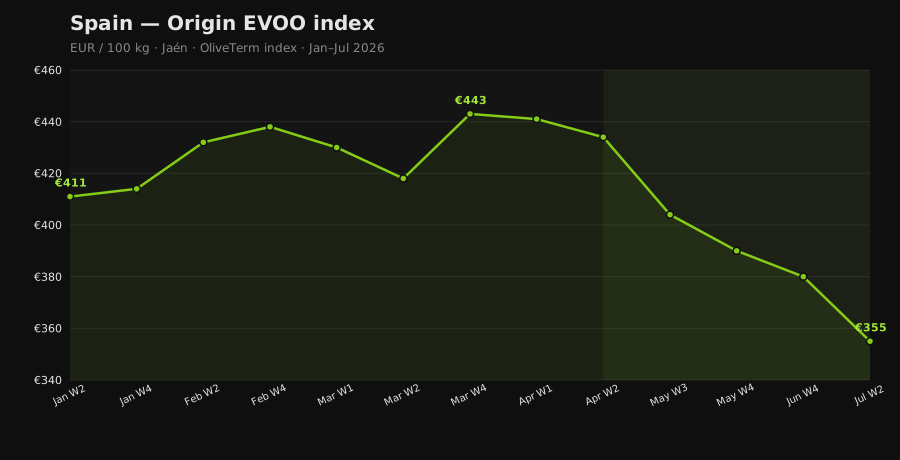
The top of this market, it's now clear, was late March. Our index printed EUR 443/100 kg on March 26 and was still holding EUR 441 in the first days of April. From there the slide began — gently at first, EUR 434 by April 9 — then with growing conviction: EUR 404 by the third week of May, EUR 390 a week later, EUR 380 at the end of June. July has been the cruellest month so far, taking the index down to the mid-350s. That's a decline of roughly 20% from the peak, three months long, and as of this writing it has not found a floor.

Two forces drove it, and they reinforced each other. The first was political: the EU and the US concluded their framework agreement in June, and it went live on July 1 — a 15% all-inclusive ceiling on EU goods, replacing the Section 122 surcharge. Just like that, the tariff-free window the market had spent all spring positioning for stopped existing, and with it the US backloading demand that had been quietly supporting Spanish and Greek origin. The second was agronomic: June field assessments found Jaén's trees carrying 70-75% loads, and projections began circulating of output up roughly 50% year-on-year in Jaén and 30% in Córdoba. When the trade props buckle at the same time the supply outlook turns generous, prices don't drift down. They fall.

Here is the tension the rest of this report keeps returning to: the heat is real. The June episode left a verified 3-7% fruitlet drop in the affected zones, and between July 5 and 11 a second heatwave pushed Jaén, Córdoba and Sevilla to 42-44°C with overnight lows that never dropped below 24°C. A falling market is telling you the recovery crop is enormous; the fields are telling you it's being trimmed week by week. Both of those things cannot stay true forever.

image

2. Origin Prices by Country

Spain (Jaén)

Mid-July finds the index in the mid EUR 350s — down about 20% from the late-March peak of EUR 443, with the fall steepening rather than slowing. Volume behaviour tells you who's in control: turnover thinned through May and June as buyers went hand-to-mouth into the falling market, and sellers — cooperatives above all — have been the ones chasing. Stocks drew down to roughly 340-360 kt by the end of June, a normal seasonal pace, still about 20% below the same point last year; in this market, that tightness buys the seller nothing. At retail, bulk oil is going for EUR 4.05-4.30/kg conventional and EUR 4.75-5.00/kg organic, and those numbers have further to fall as the origin slide feeds through.

Italy (Bari)

Italy is falling too, but from another planet. Our latest reading has Bari at EUR 600/100 kg (June 7), down sharply on the month yet still carrying a ~EUR 245 premium over Spain — which is what a 302 kt crop looks like in a country that consumes far more than that. Italian bottlers keep importing record volumes of Spanish, Greek and Tunisian oil to feed their blends. And it's worth saying plainly, because it slipped by almost unnoticed: Tunisia has now formally overtaken Italy as the world's second-largest olive oil producer. That isn't a one-season quirk. It's the new shape of Mediterranean supply.

Greece & Portugal

We don't carry a fresh Greek index print this month; the market talk has Greek origin tracking Spain down into the EUR 360s, with the same seller fatigue. The structural point stands regardless of the spot: Greek closing stocks are thin, and availability into Q4 remains genuinely tight whatever the price says. Portugal trades at a slight discount to Spain, around the EUR 350 mark, with the 2025/26 crop of roughly 165 kt fully absorbed and mills quoting against Spanish parity for the fourth quarter.

Tunisia & Turkey

Tunisia is this month's quiet headline. Our last reading — EUR 3.85/kg conventional, from May 20 — now sits above Spain. Read that again: the origin that spent the first half of 2026 as the discount programme of the Mediterranean is at a premium to Jaén. Partly that's timing (Spain has fallen further since that print), but the direction is unmistakable — the Spain-Tunisia relationship has inverted, and the arbitrage that defined H1 is gone. Turkey is steady at home, with export licensing still selectively restricted.

Global Benchmark (USA)

The IMF/FRED reading for June came in around USD 5,100/t, and July partials point lower still as the euro-denominated slide passes through.

image

3. Consumer Price Dynamics

Shelves move slower than tanker trucks. Retail follows origin with a lag of three to five months, which means the April-July origin slide won't show up properly in European supermarkets before the fourth quarter — and when it does, it should give the retail correction a second leg. In the meantime, the plateau continues: May and June HICP readings were -0.5% and -0.4% month-on-month at the EU-4 level. Measured from the 2024 peak, Spain is down 34%, Greece 29%, Portugal 25%, and Italy 13%.

The volume recovery is still running, but it's maturing. Spanish retail volumes were up 19% year-on-year in June, and the gap that remains is concentrated where it has been all along — in the lowest income quartiles, where the switch to seed oils has proven stubbornly sticky. In the import markets, Germany is down 13% year-on-year, France 9%, and the UK has now been flat for three months.

The genuinely new variable is the American shelf. The 15% ceiling took effect July 1, and US importers expect it to add 4-7% to retail prices by Q4 — the first meaningful US olive oil price increase since the 2024 cycle. How much demand that costs is now a live question for every EU exporter with a US programme.

4. 2026/27 Campaign — Heat, Fruit Set & First Estimates

image

4.1. The June 5 survey — and what came after

The Junta de Andalucía's June 5 survey confirmed what our May report described: western Andalusia — Sevilla, Córdoba, Málaga, Huelva — broadly normal, while eastern Jaén, Granada and Almería came in 12-20% below normal fruit set after the spring heat. The trouble is that the survey is already out of date. Both of the summer's confirmed heat events happened after it closed, which makes it a baseline rather than an assessment.

4.2. The heat ledger

Here's what we can actually count so far. The mid-June heat event left a verified 3-7% fruitlet drop across the affected Andalusian zones. The July 5-11 heatwave brought 42-44°C peaks to Jaén, Córdoba and Sevilla, and — perhaps more damaging — overnight lows of 24-26°C, the kind of sustained stress that irrigation only partially offsets. A cumulative damage assessment should arrive with the August pre-aforo signals; the October aforo remains the number that settles the argument.

What's striking is that none of this has left a mark on price. The market has decided the recovery crop is big enough to absorb the damage, and July's continued slide says that conviction is strengthening, not weakening. Maybe it's right. But a market that refuses to price a risk doesn't make the risk smaller — it makes the eventual repricing sharper if the fields keep losing fruit.

The human dimension shouldn't be a footnote. The Carlos III Health Institute links more than 1,000 excess deaths to the June-July heat nationally, and in the growing regions, October-November harvest labour planning is already being discussed in exactly those terms.

4.3. First estimates

The IOC's June meeting produced the first formal 2026/27 numbers: Spain around 1.55 Mt — a real recovery from 1.39 — with Tunisia at 345 kt, Italy 315, Morocco 245, Greece 240, Portugal 172 and Turkey 178. Every one of those figures was set before the summer heat did its work. The gap between that 1.55 Mt and whatever the October aforo prints is where the next two quarters of price action lives.

4.4. Italy, Greece & North Africa

Elsewhere the picture is calmer. Italy and Greece closed their flowering windows in decent shape — Apulia, Calabria, Sicily, Crete and the Peloponnese all favourable, with eastern Crete's rainfall deficit the only flag that won't go away. Tunisia is still dry through the centre and south. Morocco looks fine.

5. Trade & US Tariff Developments

image

5.1. The regime change

The EU-US framework agreement went live on July 1, and with it a 15% all-inclusive ceiling replaced the Section 122 surcharge-plus-MFN structure for EU goods. For olive oil that's a net increase — roughly 10% plus 5¢/kg became a flat 15% — and it erased the tariff-free window the market had spent the whole second quarter positioning for. The importers who backloaded their Q2 volumes into July-August arrival, expecting to land duty-free, instead landed into a higher tariff. That unwind has been feeding the origin slide ever since.

5.2. July 24 — now a non-event for the EU

Section 122 still expires on schedule on July 24, but for European origin the date no longer means anything: EU goods already moved to the deal ceiling. Where it does still matter is everywhere else. The administration has signalled Section 301 action of around 12.5% on a 46-country list, expected to take effect around the same date — and whether Tunisia and Turkey are on that list is still unconfirmed. If Tunisia lands on it, the US lane re-prices overnight. For Mediterranean bulk, that's the single most important open question in trade policy right now.

5.3. CIT refund status

IEEPA refund processing for olive oil importers is roughly 75% complete, with the remainder expected by the end of the third quarter.

5.4. EU trade file

EU-Mercosur cleared ratification, and the first olive oil tariff cut applies on entry into force — expected in Q4, which means the Brazil lane is opening on schedule. EU-India remains at working level.

6. 2026 Outlook & Updated Price Scenarios

image

6.1. Base Case (probability ~50%)

The slide decelerates but the trend holds: Jaén spends the rest of the year in EUR 330-390/100 kg. The recovery crop arrives close to the first estimates minus a modest heat trim, the 15% US ceiling keeps a lid on export demand, and the October aforo lands somewhere in the 1.40-1.55 Mt band.

6.2. Downside (probability ~25%)

August tells us the heat damage was contained, the aforo comes in at or above 1.55 Mt, and US demand stays soft under the new ceiling. Sellers who've been chasing the market down finally capitulate, and Jaén breaks through to EUR 300-330 — levels not seen since before the 2024 cycle began.

6.3. Upside (probability ~25%)

The August and September assessments confirm that the damage compounds — the verified fruitlet losses, plus whatever a third heat event would add — and the aforo prints below 1.35 Mt. A market that has spent three months refusing to price heat risk has to price it all at once. If Tunisia also ends up on the Section 301 list, the US supply picture tightens at the same moment. Jaén snaps back to EUR 400-460.

7. Strategic Recommendations

Buyers: this slide is your friend, but stagger it. The reference price is the mid EUR 350s and falling; there is no need to catch the bottom in one order. Laddered purchases through August capture the trend while the heat question is still open.

Sellers: don't chase. Cooperatives selling into every downtick have been feeding the fall. If your storage position allows it, the August pre-aforo signals are close enough to wait for — you may be selling the bottom of a market that's ignoring a real supply risk.

Treat August as the information month. The pre-aforo signals, the IOC summer update and the Section 301 country list all land within a few weeks of each other. There's a good argument for keeping your optionality until they do.

Respect the asymmetry. The market is priced for the recovery crop and not for the heat. That makes the upside scenario (EUR 400-460) the one that hurts an unprepared buyer, while the downside (EUR 300-330) merely helps them a little more. Partial forward cover for H1 2027 needs at today's mid-350s is cheap insurance against an expensive outcome.

Disclaimer: This report is prepared using publicly available data from the International Olive Council (IOC), European Commission, FRED/IMF, Poolred, Eurostat, Junta de Andalucía, the Carlos III Health Institute, Olive Oil Times, and other sector sources through July 13, 2026, together with OliveTerm's own price indices. Provisional figures may be subject to revision. This document does not constitute financial, commercial, or legal advice.

All ReportsOLIVETERM — JULY 2026