

Reports

REPORTS
MARKET REPORT — APRIL 2026

April 2026 Market Report

Following the price-stabilization signals of February-March, April 2026 sees Spanish origin EVOO consolidating in the EUR 4.30-4.50/kg range as the flowering window opens across the western Mediterranean. The Section 122 tariff regime remains in force at 10%, with the July 24 expiry now framing all sales-timing decisions. Soil moisture is favourable, but a warm, dry final third of April has reintroduced caution on the 2026/27 outlook.

Published by OliveTerm Market Intelligence · April 2026

1. Executive Summary

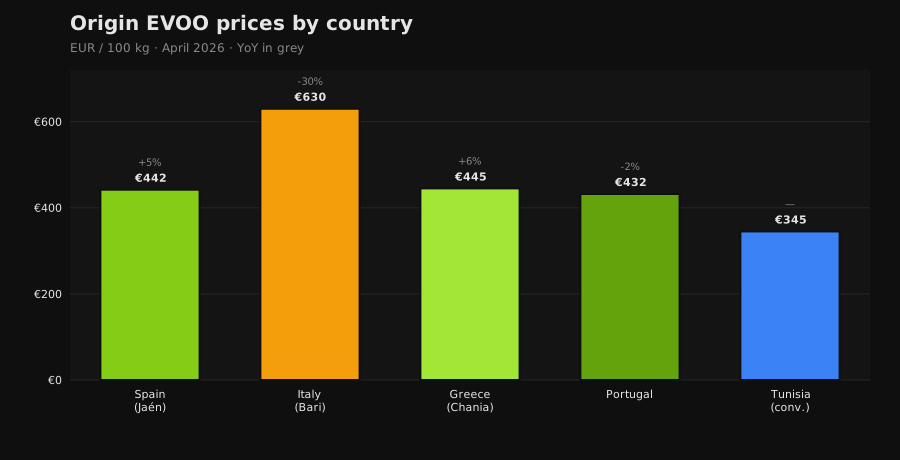
April was a holding month. Spain origin pulled back inside a EUR 430-455/100 kg band after the February rally and stayed there. Italy at Bari eased a touch to EUR 630/100 kg — still 32% below where it was a year ago, the production rebound finally feeding through. Greece tracks Spain at EUR 445. Tunisia is the structural floor at EUR 3.40-3.50/kg, and Portugal keeps dipping in and out below Spanish levels.

Two things matter for the next quarter. The 10% Section 122 tariff on EU exports to the US has flattened the playing field versus the IEEPA regime, but the July 24 expiry now governs every inventory call. And the western Mediterranean is in its flowering window — conditions mostly fine, but with an early heat spike at the end of April that the market has filed away as a warning.

Retail consumers keep seeing prices drift down. Eurostat shows another 4-5% YoY decline through Q1 2026, on top of last year's 23% correction. Spain, Greece and Portugal still lead.
image

2. Origin Prices by Country

Spain (Jaen)

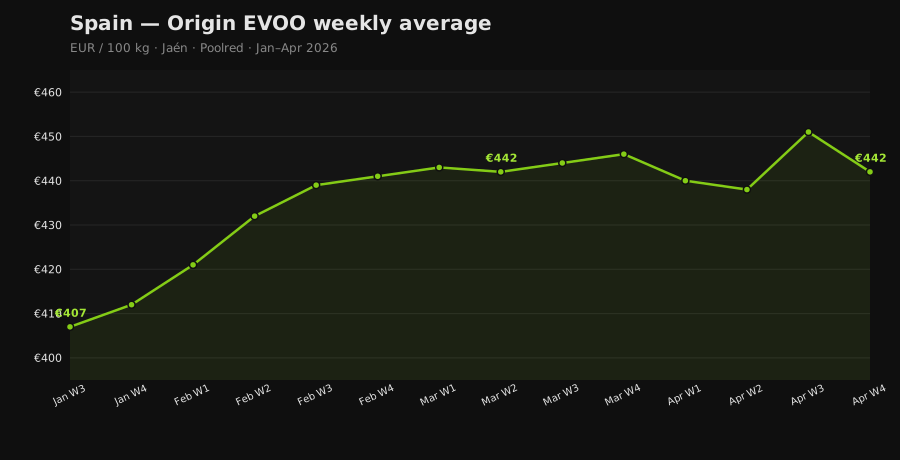
Jaén oscillated EUR 432-451/100 kg through April and closed at EUR 442 — flat versus mid-February but +5% YoY. Poolred turnover stayed strong, ~6,500 t/session, so the market is clearing at these levels rather than drifting. Cumulative production through March was around 1.35 Mt; combined stocks ~22% below the prior campaign. Output light versus expectation, demand active — neither tight nor loose. Retail bulk at EUR 4.50-4.85/kg conventional, EUR 5.30-5.60/kg organic.
image

Italy (Bari)

Bari drifted to EUR 630/100 kg by late April, 30 off the Feb-Mar level. The -30% YoY persists. Production recovery is feeding through (~300 kt) and there is plenty of Spanish, Greek and Tunisian bulk available for blending. The Italy-Spain spread narrowed to ~EUR 188/100 kg from over EUR 240 at the start of the year, but the structural premium isn't going anywhere.

Greece (Chania)

Chania climbed to EUR 445/100 kg (+6% YoY) as physical availability tightened. Crete and the Peloponnese still anchor premium exports. The buyers who reshuffled away from the US over the past 12 months — Germany, Brazil, the UAE — absorbed real volume and supported prices.

Portugal

Portugal sits in EUR 425-440/100 kg, briefly under Spain again in early April. Plenty of supply (150-200 kt for 2025/26) and exporters still trying to claw back the share they lost during the 2023-2024 spike.

Tunisia & Turkey

Tunisia: EUR 3.40-3.50/kg conventional, EUR 3.85-3.95/kg organic. The spread to Spain (~EUR 90-110/100 kg) is wide versus history. Tunisian operators are still lobbying Brussels for a duty-free quota above 100 kt. Turkey: 2025/26 trending to the upper end of 150-170 kt, domestic prices firmer, export licensing back to a friendlier setting.

Global Benchmark (USA)

IMF/FRED for April: USD 5,910/t, marginally below January's USD 6,093. Normalising in slow motion.

image

3. Consumer Price Dynamics

Q1 added another step down. Eurostat's harmonised olive oil index was -4.6% YoY in March, on top of the 23% drop in full-year 2025. From the 2024 peak: Spain -42%, Greece -32%, Portugal -27%.

The pass-through is slower in the import markets — exactly as expected. Germany -14% YoY, France -9%, Netherlands -7%. The UK has fallen just 6% despite a 35-40% drop in import unit values; sterling has absorbed most of the difference.

Volume is what the trade is watching. Spanish retail volumes rebounded ~18% YoY in Q1, recovering about half the loss from the 2024 peak. In non-traditional markets the recovery is slower — many of the consumers who switched to sunflower, rapeseed, soy or palm during the spikes haven't come back, and brand loyalty there has effectively been reset.

image

4. The 2026/27 Campaign — First Reads

April opens the flowering window across the western Mediterranean, so this is the first month the next campaign actually starts mattering. Three things stand out.

Soil moisture across Andalusia and Castilla-La Mancha is well above the 10-year average after the wet November-February. The Guadalquivir basin is at ~71% capacity — the highest April reading since 2018. A strong base for fruit set and oil accumulation.

The end of April brought an early heat episode in southern Spain — 33-36°C in Sevilla, Córdoba and Jaén, roughly 8-10°C above norms. Olive flowers don't take heat well during differentiation; sustained 35+°C in the pollination window cuts fruit set sharply. The episode was brief, damage can't be assessed until late May, but the market has filed it as a warning.

In Italy, the spring rainfall pattern in Apulia and Calabria has been favourable — supportive of a 2026/27 at least in line with this year's recovery. Greece is similar, with localised concerns in eastern Crete.

5. Trade & US Tariff Developments

image

5.1. Section 122 Status

The 10% Section 122 surcharge from February 24 is still in place. The 150-day clock runs out July 24. As of late April, no congressional action to extend or replace, and the administration has been signalling Section 301 and Section 232 as longer-term replacements. Section 301 needs 6-12 months from initiation to determination; Section 232 (national security) can be faster but needs a Commerce Department finding.

5.2. CIT Refund Proceedings

The CIT keeps processing refunds on IEEPA-era duties. By late April, more than 2,400 importers had filed and ~USD 47 billion in refunds + interest had been ordered. For olive oil specifically, US importers paid roughly USD 220-260 million extra during the IEEPA window. That should be substantially recovered by Q3 2026.

5.3. EU Trade File

EU-Mercosur (signed January) cleared its first ratification milestones — INTA voted favourably April 8. Implementing decisions on olive oil and table olives tariff schedules expected by Q3. EU-India is still at working level; an Indian duty reduction from 45% is a multi-year objective, not an imminent deliverable.

5.4. US Demand Pattern

US imports from October 2025 - March 2026 are ~3.4% below the prior season. Inventory at major US bottlers is reportedly lean, and several large buyers are signalling that they'll accelerate procurement once the July 24 status is clearer. That sets up a Q3 demand pulse that could support prices if EU stocks stay where they are.

6. 2026 Outlook & Price Scenarios

6.1. Base Case (probability ~55%)

Jaén trades EUR 420-470/100 kg through Q3 2026. Section 122 either lapses without immediate replacement — brief tariff-free window, modest US demand pulse — or is replaced at a similar rate. The 2026/27 flowering produces a fruit set near the long-term average and the IOC's June meeting comes in with a 3.30-3.50 Mt 2026/27 estimate. EU consumption keeps recovering at the current pace.

6.2. Downside (probability ~25%)

Constructive flowering across the western Mediterranean. Tunisian pressure continues. The Section 122 expiry produces a short import surge from US buyers timing the tariff window, and Q3 ends up oversupplied. Spain origin tests EUR 380-410. Most likely if the late-April heat episode turns out to have been transient and the late-May field surveys confirm strong fruit set.

6.3. Upside (probability ~20%)

Sustained heat damage in Andalusia and southern Italy on the 2026/27 set, plus the July 24 expiry triggering a sharper-than-expected US import pulse, plus a Section 301 or 232 finding that creates new sector tariffs — and Jaén pushes into EUR 480-540 by late Q3. Reinforced by any sign of below-trend rainfall in May-June.

7. Strategic Recommendations

Bridge inventory through July 24. The expiry is binary — 30-60 days of extra cover beyond your usual operating range is cheap optionality.

Lock Q3 contracts via formula. Producers facing a binary tariff outcome on top of weather risk should prefer Poolred- or IOC-indexed contracts over fixed-price.

Push non-US channels harder. Brazil-EU, the India long-game, Middle East and Asia — all still the right places to be regardless of how the US plays out.

Watch the Andalusian field surveys. May 25 to June 15 is when the surveys actually give hard 2026/27 numbers. Material misses will move prices.

Quality differentiation is the only sustainable margin. Tunisian conventional at EUR 3.40-3.50/kg means branded, certified, traceable, origin-distinguished offerings are where margin survives.

Disclaimer: This report is prepared using publicly available data from the International Olive Council (IOC), European Commission, FRED/IMF, Poolred, Eurostat, Casa do Azeite, ASOLIVA, Olive Oil Times, and other sector sources through April 28, 2026. Provisional figures may be subject to revision. This document does not constitute financial, commercial, or legal advice.

All ReportsOLIVETERM — APRIL 2026